

11.3 Templates Obtained Through the Self-assembly of Particles
397
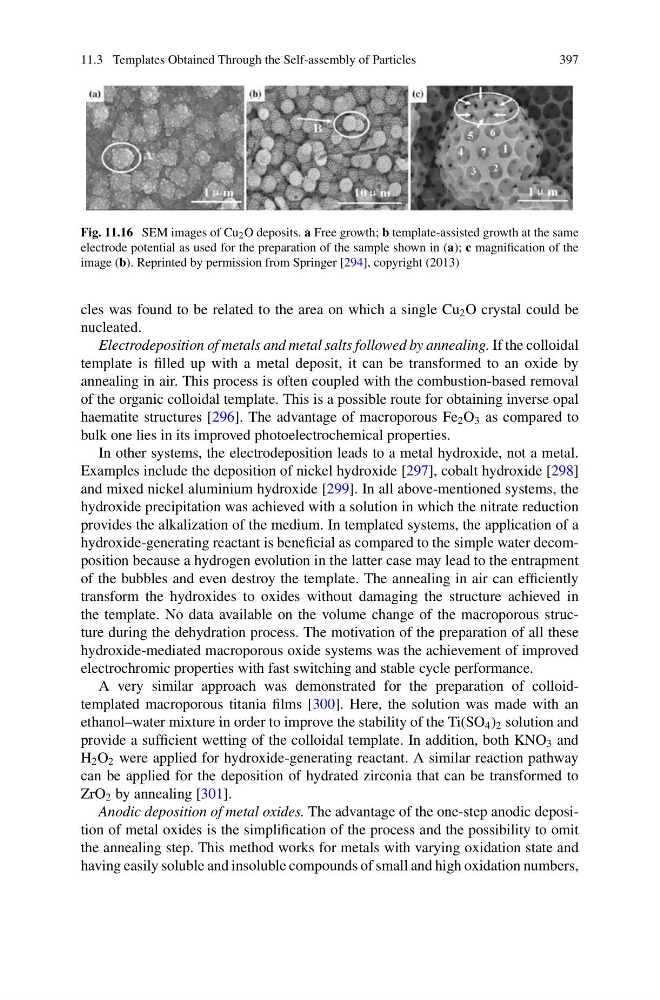
Fig. 11.16 SEM images of Cu 2 O deposits. a Free growth; b template-assisted growth at the same
electrode potential as used for the preparation of the sample shown in (a); c magnification of the
image (b). Reprinted by permission from Springer [294], copyright (2013)
cles was found to be related to the area on which a single Cu 2 O crystal could be
nucleated.
Electrodeposition of metals and metal salts followed by annealing. If the colloidal
template is filled up with a metal deposit, it can be transformed to an oxide by
annealing in air. This process is often coupled with the combustion-based removal
of the organic colloidal template. This is a possible route for obtaining inverse opal
haematite structures [296]. The advantage of macroporous Fe 2 O 3 as compared to
bulk one lies in its improved photoelectrochemical properties.
In other systems, the electrodeposition leads to a metal hydroxide, not a metal.
Examples include the deposition of nickel hydroxide [297], cobalt hydroxide [298]
and mixed nickel aluminium hydroxide [299]. In all above-mentioned systems, the
hydroxide precipitation was achieved with a solution in which the nitrate reduction
provides the alkalization of the medium. In templated systems, the application of a
hydroxide-generating reactant is beneficial as compared to the simple water decomposition because a hydrogen evolution in the latter case may lead to the entrapment
of the bubbles and even destroy the template. The annealing in air can efficiently
transform the hydroxides to oxides without damaging the structure achieved in
the template. No data available on the volume change of the macroporous structure during the dehydration process. The motivation of the preparation of all these
hydroxide-mediated macroporous oxide systems was the achievement of improved
electrochromic properties with fast switching and stable cycle performance.
A very similar approach was demonstrated for the preparation of colloidtemplated macroporous titania films [300]. Here, the solution was made with an
ethanol–water mixture in order to improve the stability of the Ti(SO 4 ) 2 solution and
provide a sufficient wetting of the colloidal template. In addition, both KNO 3 and
H 2 O 2 were applied for hydroxide-generating reactant. A similar reaction pathway
can be applied for the deposition of hydrated zirconia that can be transformed to
ZrO 2 by annealing [301].
Anodic deposition of metal oxides. The advantage of the one-step anodic deposition of metal oxides is the simplification of the process and the possibility to omit
the annealing step. This method works for metals with varying oxidation state and
having easily soluble and insoluble compounds of small and high oxidation numbers,
397
Fig. 11.16 SEM images of Cu 2 O deposits. a Free growth; b template-assisted growth at the same
electrode potential as used for the preparation of the sample shown in (a); c magnification of the
image (b). Reprinted by permission from Springer [294], copyright (2013)
cles was found to be related to the area on which a single Cu 2 O crystal could be
nucleated.
Electrodeposition of metals and metal salts followed by annealing. If the colloidal
template is filled up with a metal deposit, it can be transformed to an oxide by
annealing in air. This process is often coupled with the combustion-based removal
of the organic colloidal template. This is a possible route for obtaining inverse opal
haematite structures [296]. The advantage of macroporous Fe 2 O 3 as compared to
bulk one lies in its improved photoelectrochemical properties.
In other systems, the electrodeposition leads to a metal hydroxide, not a metal.
Examples include the deposition of nickel hydroxide [297], cobalt hydroxide [298]
and mixed nickel aluminium hydroxide [299]. In all above-mentioned systems, the
hydroxide precipitation was achieved with a solution in which the nitrate reduction
provides the alkalization of the medium. In templated systems, the application of a
hydroxide-generating reactant is beneficial as compared to the simple water decomposition because a hydrogen evolution in the latter case may lead to the entrapment
of the bubbles and even destroy the template. The annealing in air can efficiently
transform the hydroxides to oxides without damaging the structure achieved in
the template. No data available on the volume change of the macroporous structure during the dehydration process. The motivation of the preparation of all these
hydroxide-mediated macroporous oxide systems was the achievement of improved
electrochromic properties with fast switching and stable cycle performance.
A very similar approach was demonstrated for the preparation of colloidtemplated macroporous titania films [300]. Here, the solution was made with an
ethanol–water mixture in order to improve the stability of the Ti(SO 4 ) 2 solution and
provide a sufficient wetting of the colloidal template. In addition, both KNO 3 and
H 2 O 2 were applied for hydroxide-generating reactant. A similar reaction pathway
can be applied for the deposition of hydrated zirconia that can be transformed to
ZrO 2 by annealing [301].
Anodic deposition of metal oxides. The advantage of the one-step anodic deposition of metal oxides is the simplification of the process and the possibility to omit
the annealing step. This method works for metals with varying oxidation state and
having easily soluble and insoluble compounds of small and high oxidation numbers,