

11.2 Nanochannel Templates Obtained with Top-Down Synthesis Methods
387
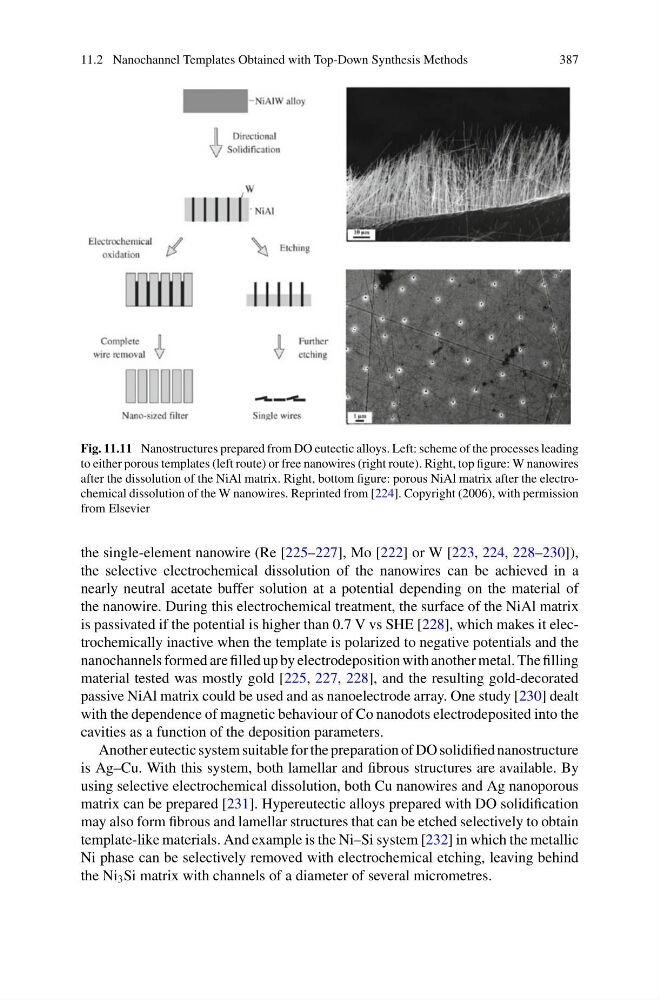
Fig. 11.11 Nanostructures prepared from DO eutectic alloys. Left: scheme of the processes leading
to either porous templates (left route) or free nanowires (right route). Right, top figure: W nanowires
after the dissolution of the NiAl matrix. Right, bottom figure: porous NiAl matrix after the electrochemical dissolution of the W nanowires. Reprinted from [224]. Copyright (2006), with permission
from Elsevier
the single-element nanowire (Re [225–227], Mo [222] or W [223, 224, 228–230]),
the selective electrochemical dissolution of the nanowires can be achieved in a
nearly neutral acetate buffer solution at a potential depending on the material of
the nanowire. During this electrochemical treatment, the surface of the NiAl matrix
is passivated if the potential is higher than 0.7 V vs SHE [228], which makes it electrochemically inactive when the template is polarized to negative potentials and the
nanochannels formed are filled up by electrodeposition with another metal. The filling
material tested was mostly gold [225, 227, 228], and the resulting gold-decorated
passive NiAl matrix could be used and as nanoelectrode array. One study [230] dealt
with the dependence of magnetic behaviour of Co nanodots electrodeposited into the
cavities as a function of the deposition parameters.
Another eutectic system suitable for the preparation of DO solidified nanostructure
is Ag–Cu. With this system, both lamellar and fibrous structures are available. By
using selective electrochemical dissolution, both Cu nanowires and Ag nanoporous
matrix can be prepared [231]. Hypereutectic alloys prepared with DO solidification
may also form fibrous and lamellar structures that can be etched selectively to obtain
template-like materials. And example is the Ni–Si system [232] in which the metallic
Ni phase can be selectively removed with electrochemical etching, leaving behind
the Ni 3 Si matrix with channels of a diameter of several micrometres.
387
Fig. 11.11 Nanostructures prepared from DO eutectic alloys. Left: scheme of the processes leading
to either porous templates (left route) or free nanowires (right route). Right, top figure: W nanowires
after the dissolution of the NiAl matrix. Right, bottom figure: porous NiAl matrix after the electrochemical dissolution of the W nanowires. Reprinted from [224]. Copyright (2006), with permission
from Elsevier
the single-element nanowire (Re [225–227], Mo [222] or W [223, 224, 228–230]),
the selective electrochemical dissolution of the nanowires can be achieved in a
nearly neutral acetate buffer solution at a potential depending on the material of
the nanowire. During this electrochemical treatment, the surface of the NiAl matrix
is passivated if the potential is higher than 0.7 V vs SHE [228], which makes it electrochemically inactive when the template is polarized to negative potentials and the
nanochannels formed are filled up by electrodeposition with another metal. The filling
material tested was mostly gold [225, 227, 228], and the resulting gold-decorated
passive NiAl matrix could be used and as nanoelectrode array. One study [230] dealt
with the dependence of magnetic behaviour of Co nanodots electrodeposited into the
cavities as a function of the deposition parameters.
Another eutectic system suitable for the preparation of DO solidified nanostructure
is Ag–Cu. With this system, both lamellar and fibrous structures are available. By
using selective electrochemical dissolution, both Cu nanowires and Ag nanoporous
matrix can be prepared [231]. Hypereutectic alloys prepared with DO solidification
may also form fibrous and lamellar structures that can be etched selectively to obtain
template-like materials. And example is the Ni–Si system [232] in which the metallic
Ni phase can be selectively removed with electrochemical etching, leaving behind
the Ni 3 Si matrix with channels of a diameter of several micrometres.