

11.2 Nanochannel Templates Obtained with Top-Down Synthesis Methods
385
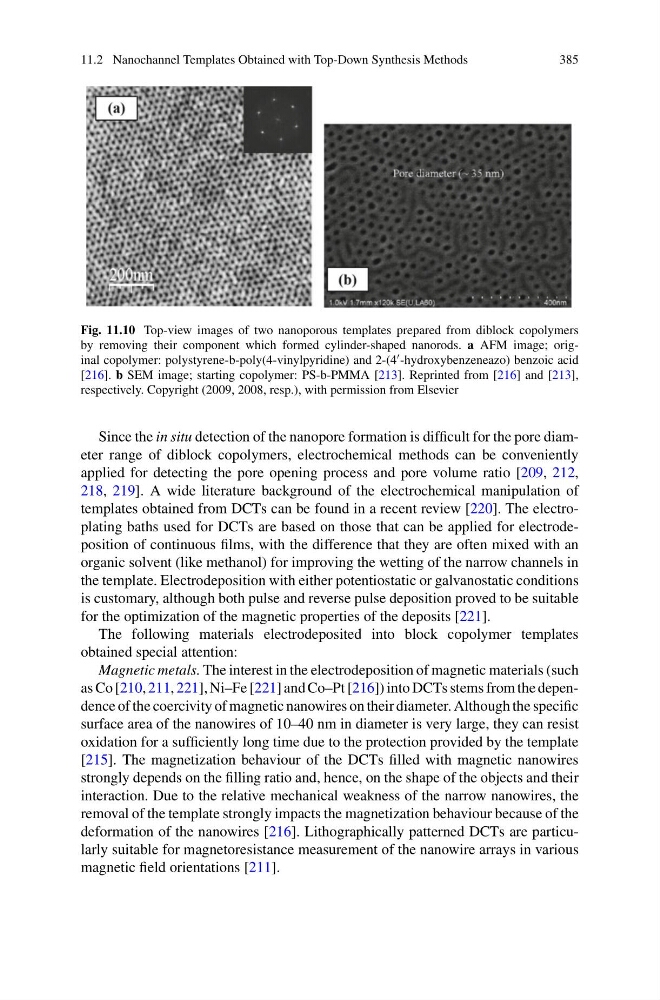
Fig. 11.10 Top-view images of two nanoporous templates prepared from diblock copolymers
by removing their component which formed cylinder-shaped nanorods. a AFM image; original copolymer: polystyrene-b-poly(4-vinylpyridine) and 2-(4 -hydroxybenzeneazo) benzoic acid
[216]. b SEM image; starting copolymer: PS-b-PMMA [213]. Reprinted from [216] and [213],
respectively. Copyright (2009, 2008, resp.), with permission from Elsevier
Since the in situ detection of the nanopore formation is difficult for the pore diameter range of diblock copolymers, electrochemical methods can be conveniently
applied for detecting the pore opening process and pore volume ratio [209, 212,
218, 219]. A wide literature background of the electrochemical manipulation of
templates obtained from DCTs can be found in a recent review [220]. The electroplating baths used for DCTs are based on those that can be applied for electrodeposition of continuous films, with the difference that they are often mixed with an
organic solvent (like methanol) for improving the wetting of the narrow channels in
the template. Electrodeposition with either potentiostatic or galvanostatic conditions
is customary, although both pulse and reverse pulse deposition proved to be suitable
for the optimization of the magnetic properties of the deposits [221].
The following materials electrodeposited into block copolymer templates
obtained special attention:
Magnetic metals. The interest in the electrodeposition of magnetic materials (such
as Co [210, 211, 221], Ni–Fe [221] and Co–Pt [216]) into DCTs stems from the dependence of the coercivity of magnetic nanowires on their diameter. Although the specific
surface area of the nanowires of 10–40 nm in diameter is very large, they can resist
oxidation for a sufficiently long time due to the protection provided by the template
[215]. The magnetization behaviour of the DCTs filled with magnetic nanowires
strongly depends on the filling ratio and, hence, on the shape of the objects and their
interaction. Due to the relative mechanical weakness of the narrow nanowires, the
removal of the template strongly impacts the magnetization behaviour because of the
deformation of the nanowires [216]. Lithographically patterned DCTs are particularly suitable for magnetoresistance measurement of the nanowire arrays in various
magnetic field orientations [211].
385
Fig. 11.10 Top-view images of two nanoporous templates prepared from diblock copolymers
by removing their component which formed cylinder-shaped nanorods. a AFM image; original copolymer: polystyrene-b-poly(4-vinylpyridine) and 2-(4 -hydroxybenzeneazo) benzoic acid
[216]. b SEM image; starting copolymer: PS-b-PMMA [213]. Reprinted from [216] and [213],
respectively. Copyright (2009, 2008, resp.), with permission from Elsevier
Since the in situ detection of the nanopore formation is difficult for the pore diameter range of diblock copolymers, electrochemical methods can be conveniently
applied for detecting the pore opening process and pore volume ratio [209, 212,
218, 219]. A wide literature background of the electrochemical manipulation of
templates obtained from DCTs can be found in a recent review [220]. The electroplating baths used for DCTs are based on those that can be applied for electrodeposition of continuous films, with the difference that they are often mixed with an
organic solvent (like methanol) for improving the wetting of the narrow channels in
the template. Electrodeposition with either potentiostatic or galvanostatic conditions
is customary, although both pulse and reverse pulse deposition proved to be suitable
for the optimization of the magnetic properties of the deposits [221].
The following materials electrodeposited into block copolymer templates
obtained special attention:
Magnetic metals. The interest in the electrodeposition of magnetic materials (such
as Co [210, 211, 221], Ni–Fe [221] and Co–Pt [216]) into DCTs stems from the dependence of the coercivity of magnetic nanowires on their diameter. Although the specific
surface area of the nanowires of 10–40 nm in diameter is very large, they can resist
oxidation for a sufficiently long time due to the protection provided by the template
[215]. The magnetization behaviour of the DCTs filled with magnetic nanowires
strongly depends on the filling ratio and, hence, on the shape of the objects and their
interaction. Due to the relative mechanical weakness of the narrow nanowires, the
removal of the template strongly impacts the magnetization behaviour because of the
deformation of the nanowires [216]. Lithographically patterned DCTs are particularly suitable for magnetoresistance measurement of the nanowire arrays in various
magnetic field orientations [211].