

11.2 Nanochannel Templates Obtained with Top-Down Synthesis Methods
381
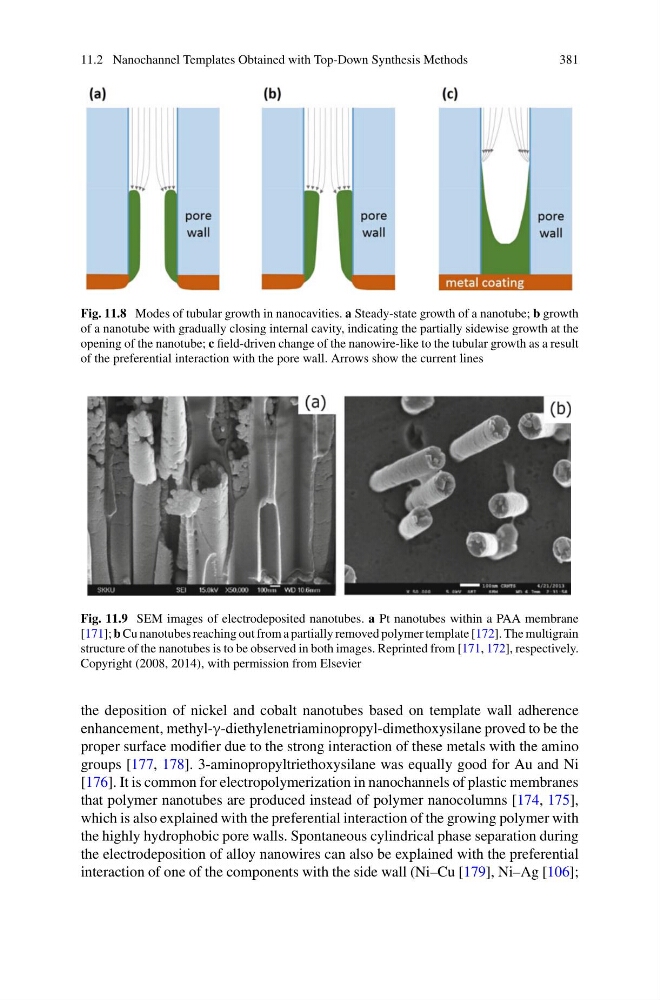
Fig. 11.8 Modes of tubular growth in nanocavities. a Steady-state growth of a nanotube; b growth
of a nanotube with gradually closing internal cavity, indicating the partially sidewise growth at the
opening of the nanotube; c field-driven change of the nanowire-like to the tubular growth as a result
of the preferential interaction with the pore wall. Arrows show the current lines
Fig. 11.9 SEM images of electrodeposited nanotubes. a Pt nanotubes within a PAA membrane
[171]; b Cu nanotubes reaching out from a partially removed polymer template [172]. The multigrain
structure of the nanotubes is to be observed in both images. Reprinted from [171, 172], respectively.
Copyright (2008, 2014), with permission from Elsevier
the deposition of nickel and cobalt nanotubes based on template wall adherence
enhancement, methyl-γ-diethylenetriaminopropyl-dimethoxysilane proved to be the
proper surface modifier due to the strong interaction of these metals with the amino
groups [177, 178]. 3-aminopropyltriethoxysilane was equally good for Au and Ni
[176]. It is common for electropolymerization in nanochannels of plastic membranes
that polymer nanotubes are produced instead of polymer nanocolumns [174, 175],
which is also explained with the preferential interaction of the growing polymer with
the highly hydrophobic pore walls. Spontaneous cylindrical phase separation during
the electrodeposition of alloy nanowires can also be explained with the preferential
interaction of one of the components with the side wall (Ni–Cu [179], Ni–Ag [106];
381
Fig. 11.8 Modes of tubular growth in nanocavities. a Steady-state growth of a nanotube; b growth
of a nanotube with gradually closing internal cavity, indicating the partially sidewise growth at the
opening of the nanotube; c field-driven change of the nanowire-like to the tubular growth as a result
of the preferential interaction with the pore wall. Arrows show the current lines
Fig. 11.9 SEM images of electrodeposited nanotubes. a Pt nanotubes within a PAA membrane
[171]; b Cu nanotubes reaching out from a partially removed polymer template [172]. The multigrain
structure of the nanotubes is to be observed in both images. Reprinted from [171, 172], respectively.
Copyright (2008, 2014), with permission from Elsevier
the deposition of nickel and cobalt nanotubes based on template wall adherence
enhancement, methyl-γ-diethylenetriaminopropyl-dimethoxysilane proved to be the
proper surface modifier due to the strong interaction of these metals with the amino
groups [177, 178]. 3-aminopropyltriethoxysilane was equally good for Au and Ni
[176]. It is common for electropolymerization in nanochannels of plastic membranes
that polymer nanotubes are produced instead of polymer nanocolumns [174, 175],
which is also explained with the preferential interaction of the growing polymer with
the highly hydrophobic pore walls. Spontaneous cylindrical phase separation during
the electrodeposition of alloy nanowires can also be explained with the preferential
interaction of one of the components with the side wall (Ni–Cu [179], Ni–Ag [106];