

374
11 Templated Systems
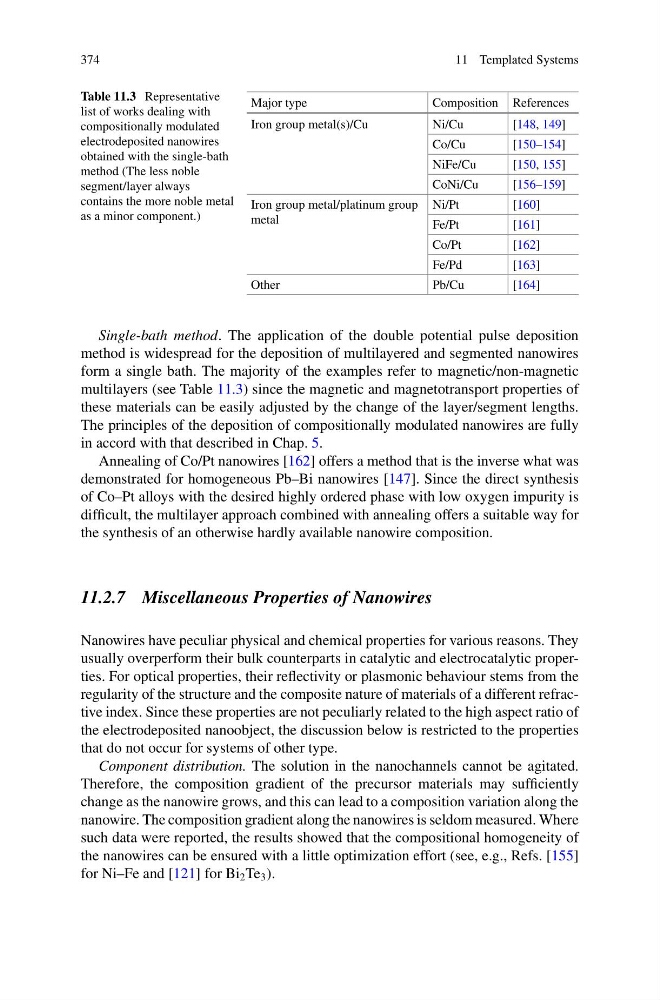
Table 11.3 Representative
list of works dealing with
compositionally modulated
electrodeposited nanowires
obtained with the single-bath
method (The less noble
segment/layer always
contains the more noble metal
as a minor component.)
Major type
Composition References
Iron group metal(s)/Cu
Ni/Cu
[148, 149]
Co/Cu
[150–154]
NiFe/Cu
[150, 155]
CoNi/Cu
[156–159]
Iron group metal/platinum group
metal
Ni/Pt
[160]
Fe/Pt
[161]
Co/Pt
[162]
Fe/Pd
[163]
Other
Pb/Cu
[164]
Single-bath method. The application of the double potential pulse deposition
method is widespread for the deposition of multilayered and segmented nanowires
form a single bath. The majority of the examples refer to magnetic/non-magnetic
multilayers (see Table 11.3) since the magnetic and magnetotransport properties of
these materials can be easily adjusted by the change of the layer/segment lengths.
The principles of the deposition of compositionally modulated nanowires are fully
in accord with that described in Chap. 5.
Annealing of Co/Pt nanowires [162] offers a method that is the inverse what was
demonstrated for homogeneous Pb–Bi nanowires [147]. Since the direct synthesis
of Co–Pt alloys with the desired highly ordered phase with low oxygen impurity is
difficult, the multilayer approach combined with annealing offers a suitable way for
the synthesis of an otherwise hardly available nanowire composition.
11.2.7 Miscellaneous Properties of Nanowires
Nanowires have peculiar physical and chemical properties for various reasons. They
usually overperform their bulk counterparts in catalytic and electrocatalytic properties. For optical properties, their reflectivity or plasmonic behaviour stems from the
regularity of the structure and the composite nature of materials of a different refractive index. Since these properties are not peculiarly related to the high aspect ratio of
the electrodeposited nanoobject, the discussion below is restricted to the properties
that do not occur for systems of other type.
Component distribution. The solution in the nanochannels cannot be agitated.
Therefore, the composition gradient of the precursor materials may sufficiently
change as the nanowire grows, and this can lead to a composition variation along the
nanowire. The composition gradient along the nanowires is seldom measured. Where
such data were reported, the results showed that the compositional homogeneity of
the nanowires can be ensured with a little optimization effort (see, e.g., Refs. [155]
for Ni–Fe and [121] for Bi 2 Te 3 ).
11 Templated Systems
Table 11.3 Representative
list of works dealing with
compositionally modulated
electrodeposited nanowires
obtained with the single-bath
method (The less noble
segment/layer always
contains the more noble metal
as a minor component.)
Major type
Composition References
Iron group metal(s)/Cu
Ni/Cu
[148, 149]
Co/Cu
[150–154]
NiFe/Cu
[150, 155]
CoNi/Cu
[156–159]
Iron group metal/platinum group
metal
Ni/Pt
[160]
Fe/Pt
[161]
Co/Pt
[162]
Fe/Pd
[163]
Other
Pb/Cu
[164]
Single-bath method. The application of the double potential pulse deposition
method is widespread for the deposition of multilayered and segmented nanowires
form a single bath. The majority of the examples refer to magnetic/non-magnetic
multilayers (see Table 11.3) since the magnetic and magnetotransport properties of
these materials can be easily adjusted by the change of the layer/segment lengths.
The principles of the deposition of compositionally modulated nanowires are fully
in accord with that described in Chap. 5.
Annealing of Co/Pt nanowires [162] offers a method that is the inverse what was
demonstrated for homogeneous Pb–Bi nanowires [147]. Since the direct synthesis
of Co–Pt alloys with the desired highly ordered phase with low oxygen impurity is
difficult, the multilayer approach combined with annealing offers a suitable way for
the synthesis of an otherwise hardly available nanowire composition.
11.2.7 Miscellaneous Properties of Nanowires
Nanowires have peculiar physical and chemical properties for various reasons. They
usually overperform their bulk counterparts in catalytic and electrocatalytic properties. For optical properties, their reflectivity or plasmonic behaviour stems from the
regularity of the structure and the composite nature of materials of a different refractive index. Since these properties are not peculiarly related to the high aspect ratio of
the electrodeposited nanoobject, the discussion below is restricted to the properties
that do not occur for systems of other type.
Component distribution. The solution in the nanochannels cannot be agitated.
Therefore, the composition gradient of the precursor materials may sufficiently
change as the nanowire grows, and this can lead to a composition variation along the
nanowire. The composition gradient along the nanowires is seldom measured. Where
such data were reported, the results showed that the compositional homogeneity of
the nanowires can be ensured with a little optimization effort (see, e.g., Refs. [155]
for Ni–Fe and [121] for Bi 2 Te 3 ).