

370
11 Templated Systems
11.2.4 Electrodeposited Homogeneous Metallic Nanowires
Nanowires composed of a single metallic element or alloys have been synthesized in
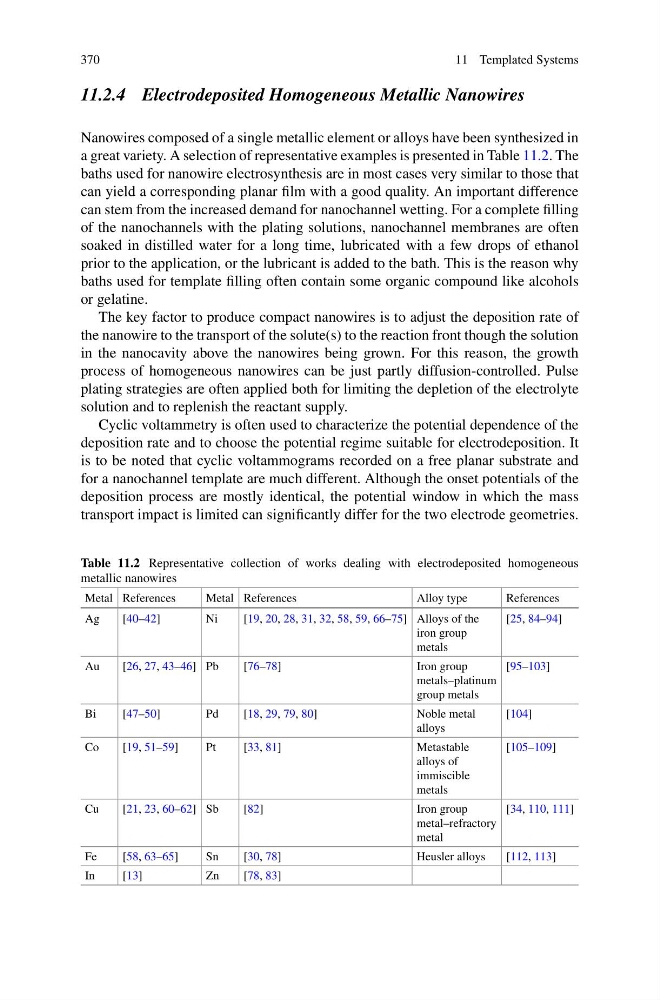
a great variety. A selection of representative examples is presented in Table 11.2. The
baths used for nanowire electrosynthesis are in most cases very similar to those that
can yield a corresponding planar film with a good quality. An important difference
can stem from the increased demand for nanochannel wetting. For a complete filling
of the nanochannels with the plating solutions, nanochannel membranes are often
soaked in distilled water for a long time, lubricated with a few drops of ethanol
prior to the application, or the lubricant is added to the bath. This is the reason why
baths used for template filling often contain some organic compound like alcohols
or gelatine.
The key factor to produce compact nanowires is to adjust the deposition rate of
the nanowire to the transport of the solute(s) to the reaction front though the solution
in the nanocavity above the nanowires being grown. For this reason, the growth
process of homogeneous nanowires can be just partly diffusion-controlled. Pulse
plating strategies are often applied both for limiting the depletion of the electrolyte
solution and to replenish the reactant supply.
Cyclic voltammetry is often used to characterize the potential dependence of the
deposition rate and to choose the potential regime suitable for electrodeposition. It
is to be noted that cyclic voltammograms recorded on a free planar substrate and
for a nanochannel template are much different. Although the onset potentials of the
deposition process are mostly identical, the potential window in which the mass
transport impact is limited can significantly differ for the two electrode geometries.
Table 11.2 Representative collection of works dealing with electrodeposited homogeneous
metallic nanowires
Metal References
Metal References
Alloy type
References
Ag
[40–42]
Ni
[19, 20, 28, 31, 32, 58, 59, 66–75] Alloys of the
iron group
metals
[25, 84–94]
Au
[26, 27, 43–46] Pb
[76–78]
Iron group
metals–platinum
group metals
[95–103]
Bi
[47–50]
Pd
[18, 29, 79, 80]
Noble metal
alloys
[104]
Co
[19, 51–59]
Pt
[33, 81]
Metastable
alloys of
immiscible
metals
[105–109]
Cu
[21, 23, 60–62] Sb
[82]
Iron group
metal–refractory
metal
[34, 110, 111]
Fe
[58, 63–65]
Sn
[30, 78]
Heusler alloys
[112, 113]
In
[13]
Zn
[78, 83]
11 Templated Systems
11.2.4 Electrodeposited Homogeneous Metallic Nanowires
Nanowires composed of a single metallic element or alloys have been synthesized in
a great variety. A selection of representative examples is presented in Table 11.2. The
baths used for nanowire electrosynthesis are in most cases very similar to those that
can yield a corresponding planar film with a good quality. An important difference
can stem from the increased demand for nanochannel wetting. For a complete filling
of the nanochannels with the plating solutions, nanochannel membranes are often
soaked in distilled water for a long time, lubricated with a few drops of ethanol
prior to the application, or the lubricant is added to the bath. This is the reason why
baths used for template filling often contain some organic compound like alcohols
or gelatine.
The key factor to produce compact nanowires is to adjust the deposition rate of
the nanowire to the transport of the solute(s) to the reaction front though the solution
in the nanocavity above the nanowires being grown. For this reason, the growth
process of homogeneous nanowires can be just partly diffusion-controlled. Pulse
plating strategies are often applied both for limiting the depletion of the electrolyte
solution and to replenish the reactant supply.
Cyclic voltammetry is often used to characterize the potential dependence of the
deposition rate and to choose the potential regime suitable for electrodeposition. It
is to be noted that cyclic voltammograms recorded on a free planar substrate and
for a nanochannel template are much different. Although the onset potentials of the
deposition process are mostly identical, the potential window in which the mass
transport impact is limited can significantly differ for the two electrode geometries.
Table 11.2 Representative collection of works dealing with electrodeposited homogeneous
metallic nanowires
Metal References
Metal References
Alloy type
References
Ag
[40–42]
Ni
[19, 20, 28, 31, 32, 58, 59, 66–75] Alloys of the
iron group
metals
[25, 84–94]
Au
[26, 27, 43–46] Pb
[76–78]
Iron group
metals–platinum
group metals
[95–103]
Bi
[47–50]
Pd
[18, 29, 79, 80]
Noble metal
alloys
[104]
Co
[19, 51–59]
Pt
[33, 81]
Metastable
alloys of
immiscible
metals
[105–109]
Cu
[21, 23, 60–62] Sb
[82]
Iron group
metal–refractory
metal
[34, 110, 111]
Fe
[58, 63–65]
Sn
[30, 78]
Heusler alloys
[112, 113]
In
[13]
Zn
[78, 83]