

18
2 Electrochemistry and Electrodeposition
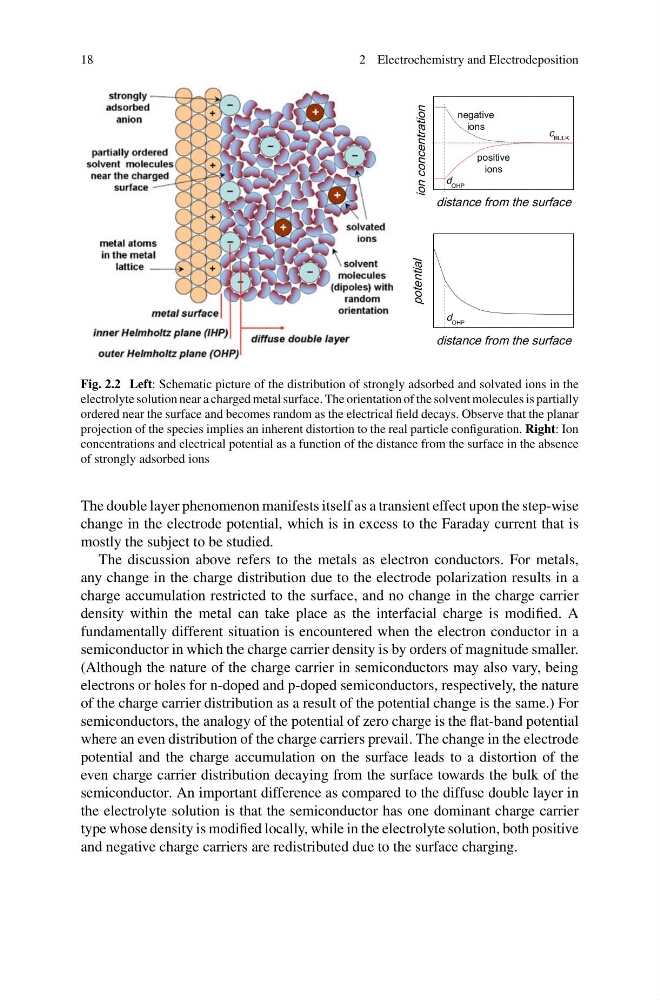
Fig. 2.2 Left: Schematic picture of the distribution of strongly adsorbed and solvated ions in the
electrolyte solution near a charged metal surface. The orientation of the solvent molecules is partially
ordered near the surface and becomes random as the electrical field decays. Observe that the planar
projection of the species implies an inherent distortion to the real particle configuration. Right: Ion
concentrations and electrical potential as a function of the distance from the surface in the absence
of strongly adsorbed ions
The double layer phenomenon manifests itself as a transient effect upon the step-wise
change in the electrode potential, which is in excess to the Faraday current that is
mostly the subject to be studied.
The discussion above refers to the metals as electron conductors. For metals,
any change in the charge distribution due to the electrode polarization results in a
charge accumulation restricted to the surface, and no change in the charge carrier
density within the metal can take place as the interfacial charge is modified. A
fundamentally different situation is encountered when the electron conductor in a
semiconductor in which the charge carrier density is by orders of magnitude smaller.
(Although the nature of the charge carrier in semiconductors may also vary, being
electrons or holes for n-doped and p-doped semiconductors, respectively, the nature
of the charge carrier distribution as a result of the potential change is the same.) For
semiconductors, the analogy of the potential of zero charge is the flat-band potential
where an even distribution of the charge carriers prevail. The change in the electrode
potential and the charge accumulation on the surface leads to a distortion of the
even charge carrier distribution decaying from the surface towards the bulk of the
semiconductor. An important difference as compared to the diffuse double layer in
the electrolyte solution is that the semiconductor has one dominant charge carrier
type whose density is modified locally, while in the electrolyte solution, both positive
and negative charge carriers are redistributed due to the surface charging.
2 Electrochemistry and Electrodeposition
Fig. 2.2 Left: Schematic picture of the distribution of strongly adsorbed and solvated ions in the
electrolyte solution near a charged metal surface. The orientation of the solvent molecules is partially
ordered near the surface and becomes random as the electrical field decays. Observe that the planar
projection of the species implies an inherent distortion to the real particle configuration. Right: Ion
concentrations and electrical potential as a function of the distance from the surface in the absence
of strongly adsorbed ions
The double layer phenomenon manifests itself as a transient effect upon the step-wise
change in the electrode potential, which is in excess to the Faraday current that is
mostly the subject to be studied.
The discussion above refers to the metals as electron conductors. For metals,
any change in the charge distribution due to the electrode polarization results in a
charge accumulation restricted to the surface, and no change in the charge carrier
density within the metal can take place as the interfacial charge is modified. A
fundamentally different situation is encountered when the electron conductor in a
semiconductor in which the charge carrier density is by orders of magnitude smaller.
(Although the nature of the charge carrier in semiconductors may also vary, being
electrons or holes for n-doped and p-doped semiconductors, respectively, the nature
of the charge carrier distribution as a result of the potential change is the same.) For
semiconductors, the analogy of the potential of zero charge is the flat-band potential
where an even distribution of the charge carriers prevail. The change in the electrode
potential and the charge accumulation on the surface leads to a distortion of the
even charge carrier distribution decaying from the surface towards the bulk of the
semiconductor. An important difference as compared to the diffuse double layer in
the electrolyte solution is that the semiconductor has one dominant charge carrier
type whose density is modified locally, while in the electrolyte solution, both positive
and negative charge carriers are redistributed due to the surface charging.