

10.5 Top-Down Electrochemical Synthesis of Nanosheets
343
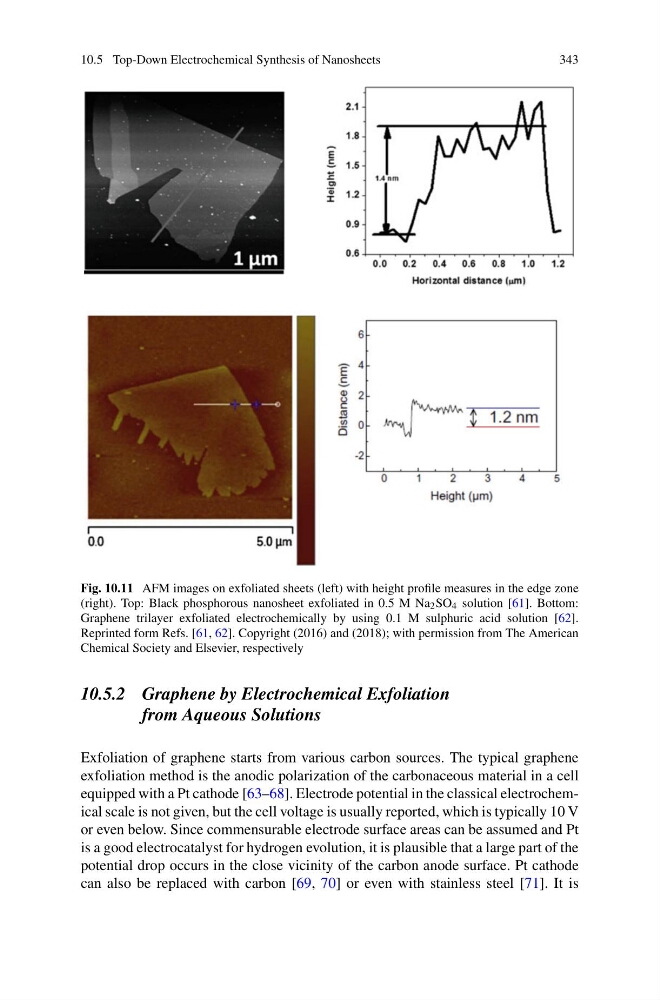
Fig. 10.11 AFM images on exfoliated sheets (left) with height profile measures in the edge zone
(right). Top: Black phosphorous nanosheet exfoliated in 0.5 M Na 2 SO 4 solution [61]. Bottom:
Graphene trilayer exfoliated electrochemically by using 0.1 M sulphuric acid solution [62].
Reprinted form Refs. [61, 62]. Copyright (2016) and (2018); with permission from The American
Chemical Society and Elsevier, respectively
10.5.2 Graphene by Electrochemical Exfoliation
from Aqueous Solutions
Exfoliation of graphene starts from various carbon sources. The typical graphene
exfoliation method is the anodic polarization of the carbonaceous material in a cell
equipped with a Pt cathode [63–68]. Electrode potential in the classical electrochemical scale is not given, but the cell voltage is usually reported, which is typically 10 V
or even below. Since commensurable electrode surface areas can be assumed and Pt
is a good electrocatalyst for hydrogen evolution, it is plausible that a large part of the
potential drop occurs in the close vicinity of the carbon anode surface. Pt cathode
can also be replaced with carbon [69, 70] or even with stainless steel [71]. It is
343
Fig. 10.11 AFM images on exfoliated sheets (left) with height profile measures in the edge zone
(right). Top: Black phosphorous nanosheet exfoliated in 0.5 M Na 2 SO 4 solution [61]. Bottom:
Graphene trilayer exfoliated electrochemically by using 0.1 M sulphuric acid solution [62].
Reprinted form Refs. [61, 62]. Copyright (2016) and (2018); with permission from The American
Chemical Society and Elsevier, respectively
10.5.2 Graphene by Electrochemical Exfoliation
from Aqueous Solutions
Exfoliation of graphene starts from various carbon sources. The typical graphene
exfoliation method is the anodic polarization of the carbonaceous material in a cell
equipped with a Pt cathode [63–68]. Electrode potential in the classical electrochemical scale is not given, but the cell voltage is usually reported, which is typically 10 V
or even below. Since commensurable electrode surface areas can be assumed and Pt
is a good electrocatalyst for hydrogen evolution, it is plausible that a large part of the
potential drop occurs in the close vicinity of the carbon anode surface. Pt cathode
can also be replaced with carbon [69, 70] or even with stainless steel [71]. It is