

10.3 Electrodeposition on Surfaces with Step Edges
329
were studied in an as-received state, and the removal of the nanowires could not
be performed efficiently. Since physical deposition techniques work also with nonconducting substrates, removal was not even necessary even if the electrical transport
was the property of interest.
Electrodeposition of a nanostructure along the step edge of a metal is highly nonconventional. The explanation is that the step edge of a non-noble metal surface is
ill-defined, regarding that it is formed after the reduction of the oxide usually present
on a metal surface. For noble metals, step edges can be well visualized and some
preference of the nucleation along the step edges can be identified for a few substrate–
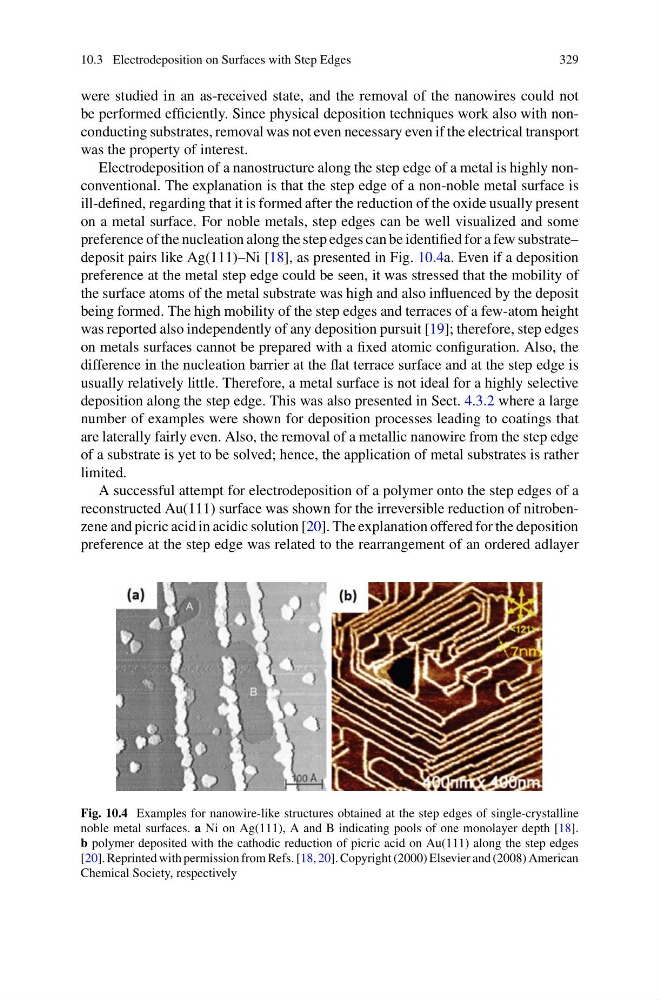
deposit pairs like Ag(111)–Ni [18], as presented in Fig. 10.4a. Even if a deposition
preference at the metal step edge could be seen, it was stressed that the mobility of
the surface atoms of the metal substrate was high and also influenced by the deposit
being formed. The high mobility of the step edges and terraces of a few-atom height
was reported also independently of any deposition pursuit [19]; therefore, step edges
on metals surfaces cannot be prepared with a fixed atomic configuration. Also, the
difference in the nucleation barrier at the flat terrace surface and at the step edge is
usually relatively little. Therefore, a metal surface is not ideal for a highly selective
deposition along the step edge. This was also presented in Sect. 4.3.2 where a large
number of examples were shown for deposition processes leading to coatings that
are laterally fairly even. Also, the removal of a metallic nanowire from the step edge
of a substrate is yet to be solved; hence, the application of metal substrates is rather
limited.
A successful attempt for electrodeposition of a polymer onto the step edges of a
reconstructed Au(111) surface was shown for the irreversible reduction of nitrobenzene and picric acid in acidic solution [20]. The explanation offered for the deposition
preference at the step edge was related to the rearrangement of an ordered adlayer
Fig. 10.4 Examples for nanowire-like structures obtained at the step edges of single-crystalline
noble metal surfaces. a Ni on Ag(111), A and B indicating pools of one monolayer depth [18].
b polymer deposited with the cathodic reduction of picric acid on Au(111) along the step edges
[20]. Reprinted with permission from Refs. [18, 20]. Copyright (2000) Elsevier and (2008) American
Chemical Society, respectively
329
were studied in an as-received state, and the removal of the nanowires could not
be performed efficiently. Since physical deposition techniques work also with nonconducting substrates, removal was not even necessary even if the electrical transport
was the property of interest.
Electrodeposition of a nanostructure along the step edge of a metal is highly nonconventional. The explanation is that the step edge of a non-noble metal surface is
ill-defined, regarding that it is formed after the reduction of the oxide usually present
on a metal surface. For noble metals, step edges can be well visualized and some
preference of the nucleation along the step edges can be identified for a few substrate–
deposit pairs like Ag(111)–Ni [18], as presented in Fig. 10.4a. Even if a deposition
preference at the metal step edge could be seen, it was stressed that the mobility of
the surface atoms of the metal substrate was high and also influenced by the deposit
being formed. The high mobility of the step edges and terraces of a few-atom height
was reported also independently of any deposition pursuit [19]; therefore, step edges
on metals surfaces cannot be prepared with a fixed atomic configuration. Also, the
difference in the nucleation barrier at the flat terrace surface and at the step edge is
usually relatively little. Therefore, a metal surface is not ideal for a highly selective
deposition along the step edge. This was also presented in Sect. 4.3.2 where a large
number of examples were shown for deposition processes leading to coatings that
are laterally fairly even. Also, the removal of a metallic nanowire from the step edge
of a substrate is yet to be solved; hence, the application of metal substrates is rather
limited.
A successful attempt for electrodeposition of a polymer onto the step edges of a
reconstructed Au(111) surface was shown for the irreversible reduction of nitrobenzene and picric acid in acidic solution [20]. The explanation offered for the deposition
preference at the step edge was related to the rearrangement of an ordered adlayer
Fig. 10.4 Examples for nanowire-like structures obtained at the step edges of single-crystalline
noble metal surfaces. a Ni on Ag(111), A and B indicating pools of one monolayer depth [18].
b polymer deposited with the cathodic reduction of picric acid on Au(111) along the step edges
[20]. Reprinted with permission from Refs. [18, 20]. Copyright (2000) Elsevier and (2008) American
Chemical Society, respectively