

10.2 Electrodeposition of Nanocrystals
327
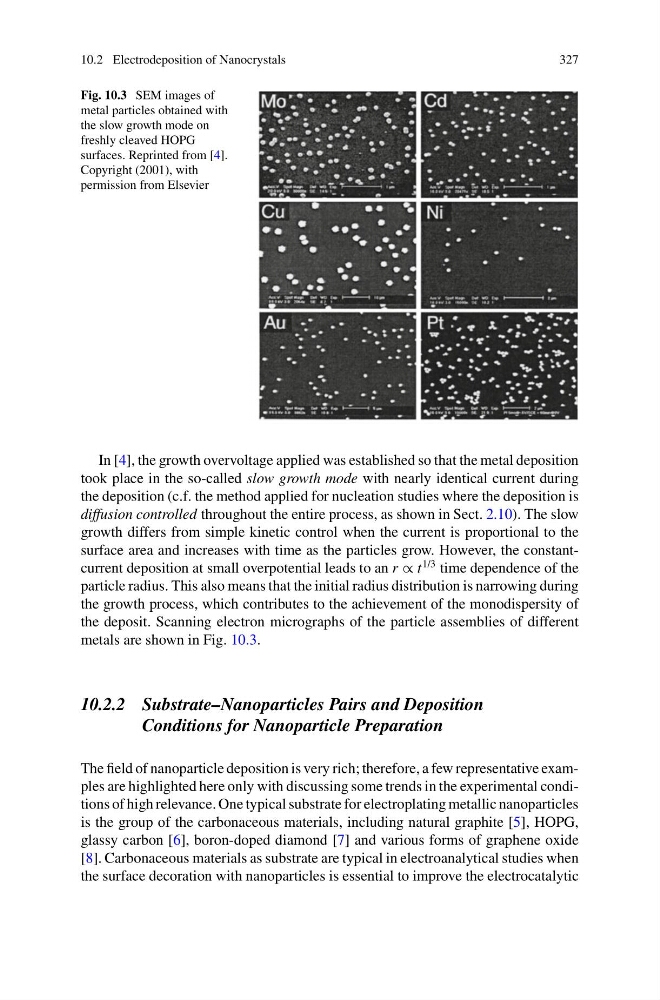
Fig. 10.3 SEM images of
metal particles obtained with
the slow growth mode on
freshly cleaved HOPG
surfaces. Reprinted from [4].
Copyright (2001), with
permission from Elsevier
In [4], the growth overvoltage applied was established so that the metal deposition
took place in the so-called slow growth mode with nearly identical current during
the deposition (c.f. the method applied for nucleation studies where the deposition is
diffusion controlled throughout the entire process, as shown in Sect. 2.10). The slow
growth differs from simple kinetic control when the current is proportional to the
surface area and increases with time as the particles grow. However, the constantcurrent deposition at small overpotential leads to an r ∝ t
1/3 time dependence of the
particle radius. This also means that the initial radius distribution is narrowing during
the growth process, which contributes to the achievement of the monodispersity of
the deposit. Scanning electron micrographs of the particle assemblies of different
metals are shown in Fig. 10.3.
10.2.2 Substrate–Nanoparticles Pairs and Deposition
Conditions for Nanoparticle Preparation
The field of nanoparticle deposition is very rich; therefore, a few representative examples are highlighted here only with discussing some trends in the experimental conditions of high relevance. One typical substrate for electroplating metallic nanoparticles
is the group of the carbonaceous materials, including natural graphite [5], HOPG,
glassy carbon [6], boron-doped diamond [7] and various forms of graphene oxide
[8]. Carbonaceous materials as substrate are typical in electroanalytical studies when
the surface decoration with nanoparticles is essential to improve the electrocatalytic
327
Fig. 10.3 SEM images of
metal particles obtained with
the slow growth mode on
freshly cleaved HOPG
surfaces. Reprinted from [4].
Copyright (2001), with
permission from Elsevier
In [4], the growth overvoltage applied was established so that the metal deposition
took place in the so-called slow growth mode with nearly identical current during
the deposition (c.f. the method applied for nucleation studies where the deposition is
diffusion controlled throughout the entire process, as shown in Sect. 2.10). The slow
growth differs from simple kinetic control when the current is proportional to the
surface area and increases with time as the particles grow. However, the constantcurrent deposition at small overpotential leads to an r ∝ t
1/3 time dependence of the
particle radius. This also means that the initial radius distribution is narrowing during
the growth process, which contributes to the achievement of the monodispersity of
the deposit. Scanning electron micrographs of the particle assemblies of different
metals are shown in Fig. 10.3.
10.2.2 Substrate–Nanoparticles Pairs and Deposition
Conditions for Nanoparticle Preparation
The field of nanoparticle deposition is very rich; therefore, a few representative examples are highlighted here only with discussing some trends in the experimental conditions of high relevance. One typical substrate for electroplating metallic nanoparticles
is the group of the carbonaceous materials, including natural graphite [5], HOPG,
glassy carbon [6], boron-doped diamond [7] and various forms of graphene oxide
[8]. Carbonaceous materials as substrate are typical in electroanalytical studies when
the surface decoration with nanoparticles is essential to improve the electrocatalytic