

324
10 Electrochemical Manufacturing Methods Based on Surface …
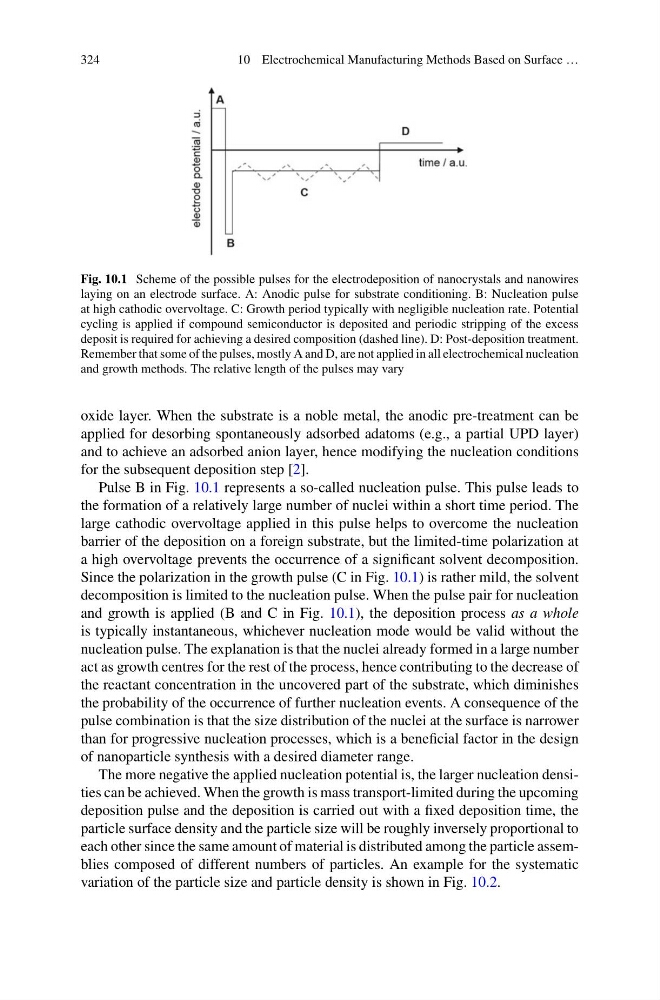
Fig. 10.1 Scheme of the possible pulses for the electrodeposition of nanocrystals and nanowires
laying on an electrode surface. A: Anodic pulse for substrate conditioning. B: Nucleation pulse
at high cathodic overvoltage. C: Growth period typically with negligible nucleation rate. Potential
cycling is applied if compound semiconductor is deposited and periodic stripping of the excess
deposit is required for achieving a desired composition (dashed line). D: Post-deposition treatment.
Remember that some of the pulses, mostly A and D, are not applied in all electrochemical nucleation
and growth methods. The relative length of the pulses may vary
oxide layer. When the substrate is a noble metal, the anodic pre-treatment can be
applied for desorbing spontaneously adsorbed adatoms (e.g., a partial UPD layer)
and to achieve an adsorbed anion layer, hence modifying the nucleation conditions
for the subsequent deposition step [2].
Pulse B in Fig. 10.1 represents a so-called nucleation pulse. This pulse leads to
the formation of a relatively large number of nuclei within a short time period. The
large cathodic overvoltage applied in this pulse helps to overcome the nucleation
barrier of the deposition on a foreign substrate, but the limited-time polarization at
a high overvoltage prevents the occurrence of a significant solvent decomposition.
Since the polarization in the growth pulse (C in Fig. 10.1) is rather mild, the solvent
decomposition is limited to the nucleation pulse. When the pulse pair for nucleation
and growth is applied (B and C in Fig. 10.1), the deposition process as a whole
is typically instantaneous, whichever nucleation mode would be valid without the
nucleation pulse. The explanation is that the nuclei already formed in a large number
act as growth centres for the rest of the process, hence contributing to the decrease of
the reactant concentration in the uncovered part of the substrate, which diminishes
the probability of the occurrence of further nucleation events. A consequence of the
pulse combination is that the size distribution of the nuclei at the surface is narrower
than for progressive nucleation processes, which is a beneficial factor in the design
of nanoparticle synthesis with a desired diameter range.
The more negative the applied nucleation potential is, the larger nucleation densities can be achieved. When the growth is mass transport-limited during the upcoming
deposition pulse and the deposition is carried out with a fixed deposition time, the
particle surface density and the particle size will be roughly inversely proportional to
each other since the same amount of material is distributed among the particle assemblies composed of different numbers of particles. An example for the systematic
variation of the particle size and particle density is shown in Fig. 10.2.
10 Electrochemical Manufacturing Methods Based on Surface …
Fig. 10.1 Scheme of the possible pulses for the electrodeposition of nanocrystals and nanowires
laying on an electrode surface. A: Anodic pulse for substrate conditioning. B: Nucleation pulse
at high cathodic overvoltage. C: Growth period typically with negligible nucleation rate. Potential
cycling is applied if compound semiconductor is deposited and periodic stripping of the excess
deposit is required for achieving a desired composition (dashed line). D: Post-deposition treatment.
Remember that some of the pulses, mostly A and D, are not applied in all electrochemical nucleation
and growth methods. The relative length of the pulses may vary
oxide layer. When the substrate is a noble metal, the anodic pre-treatment can be
applied for desorbing spontaneously adsorbed adatoms (e.g., a partial UPD layer)
and to achieve an adsorbed anion layer, hence modifying the nucleation conditions
for the subsequent deposition step [2].
Pulse B in Fig. 10.1 represents a so-called nucleation pulse. This pulse leads to
the formation of a relatively large number of nuclei within a short time period. The
large cathodic overvoltage applied in this pulse helps to overcome the nucleation
barrier of the deposition on a foreign substrate, but the limited-time polarization at
a high overvoltage prevents the occurrence of a significant solvent decomposition.
Since the polarization in the growth pulse (C in Fig. 10.1) is rather mild, the solvent
decomposition is limited to the nucleation pulse. When the pulse pair for nucleation
and growth is applied (B and C in Fig. 10.1), the deposition process as a whole
is typically instantaneous, whichever nucleation mode would be valid without the
nucleation pulse. The explanation is that the nuclei already formed in a large number
act as growth centres for the rest of the process, hence contributing to the decrease of
the reactant concentration in the uncovered part of the substrate, which diminishes
the probability of the occurrence of further nucleation events. A consequence of the
pulse combination is that the size distribution of the nuclei at the surface is narrower
than for progressive nucleation processes, which is a beneficial factor in the design
of nanoparticle synthesis with a desired diameter range.
The more negative the applied nucleation potential is, the larger nucleation densities can be achieved. When the growth is mass transport-limited during the upcoming
deposition pulse and the deposition is carried out with a fixed deposition time, the
particle surface density and the particle size will be roughly inversely proportional to
each other since the same amount of material is distributed among the particle assemblies composed of different numbers of particles. An example for the systematic
variation of the particle size and particle density is shown in Fig. 10.2.