

9.1 Synthesis of Nanoparticles on Electrodes
305
solvent was necessary for Cu nanoparticle synthesis [3]. The number of reports is
yet insufficient to clarify the role of the solvents accurately.
Since the cell configurations are optimized for the current density and the anode–
cathode distance, the critical concentration of the metal ions that allow the formation
of nanoparticles at the cathode has not been reported. Another piece of information missing is the cationic form produced in the dissolution when the metal may
form various cations [like Au(I) versus Au(III) and Cu(I) versus Cu(II)]. The current
density is between 0.1 and 25 mA cm
–2 , regardless whether galvanostatic of potentiostatic control was applied, and the typical interelectrode distance was 5–20 mm.
It was demonstrated for Pd [4], Ag [1] and Au [6] that the diameter of the nanoparticles decreases with the increase in current density. It has to be noted that the range
of the mean particle size for Pd and Ag was between 1.4–6.0 nm, the gold particles were an order of magnitude larger (although the current density intervals were
comparable). Since the current density is a monotonous function of the electrode
potential, it is widely accepted that the current density dependence of the particle
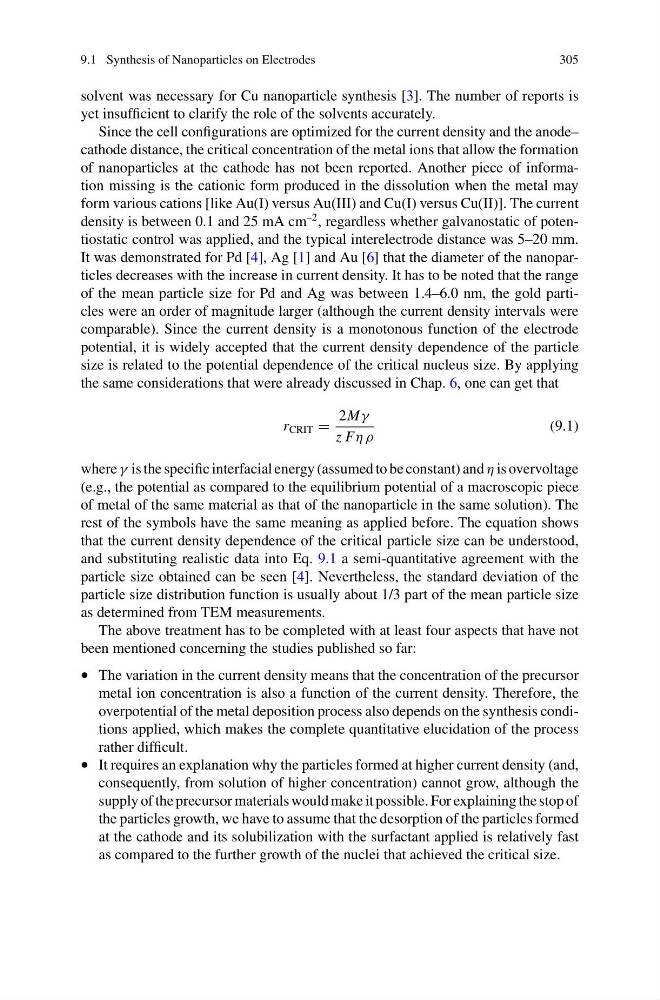
size is related to the potential dependence of the critical nucleus size. By applying
the same considerations that were already discussed in Chap. 6, one can get that
r CRIT =
2Mγ
z Fη ρ
(9.1)
where γ is the specific interfacial energy (assumed to be constant) and η is overvoltage
(e.g., the potential as compared to the equilibrium potential of a macroscopic piece
of metal of the same material as that of the nanoparticle in the same solution). The
rest of the symbols have the same meaning as applied before. The equation shows
that the current density dependence of the critical particle size can be understood,
and substituting realistic data into Eq. 9.1 a semi-quantitative agreement with the
particle size obtained can be seen [4]. Nevertheless, the standard deviation of the
particle size distribution function is usually about 1/3 part of the mean particle size
as determined from TEM measurements.
The above treatment has to be completed with at least four aspects that have not
been mentioned concerning the studies published so far:
• The variation in the current density means that the concentration of the precursor
metal ion concentration is also a function of the current density. Therefore, the
overpotential of the metal deposition process also depends on the synthesis conditions applied, which makes the complete quantitative elucidation of the process
rather difficult.
• It requires an explanation why the particles formed at higher current density (and,
consequently, from solution of higher concentration) cannot grow, although the
supply of the precursor materials would make it possible. For explaining the stop of
the particles growth, we have to assume that the desorption of the particles formed
at the cathode and its solubilization with the surfactant applied is relatively fast
as compared to the further growth of the nuclei that achieved the critical size.
305
solvent was necessary for Cu nanoparticle synthesis [3]. The number of reports is
yet insufficient to clarify the role of the solvents accurately.
Since the cell configurations are optimized for the current density and the anode–
cathode distance, the critical concentration of the metal ions that allow the formation
of nanoparticles at the cathode has not been reported. Another piece of information missing is the cationic form produced in the dissolution when the metal may
form various cations [like Au(I) versus Au(III) and Cu(I) versus Cu(II)]. The current
density is between 0.1 and 25 mA cm
–2 , regardless whether galvanostatic of potentiostatic control was applied, and the typical interelectrode distance was 5–20 mm.
It was demonstrated for Pd [4], Ag [1] and Au [6] that the diameter of the nanoparticles decreases with the increase in current density. It has to be noted that the range
of the mean particle size for Pd and Ag was between 1.4–6.0 nm, the gold particles were an order of magnitude larger (although the current density intervals were
comparable). Since the current density is a monotonous function of the electrode
potential, it is widely accepted that the current density dependence of the particle
size is related to the potential dependence of the critical nucleus size. By applying
the same considerations that were already discussed in Chap. 6, one can get that
r CRIT =
2Mγ
z Fη ρ
(9.1)
where γ is the specific interfacial energy (assumed to be constant) and η is overvoltage
(e.g., the potential as compared to the equilibrium potential of a macroscopic piece
of metal of the same material as that of the nanoparticle in the same solution). The
rest of the symbols have the same meaning as applied before. The equation shows
that the current density dependence of the critical particle size can be understood,
and substituting realistic data into Eq. 9.1 a semi-quantitative agreement with the
particle size obtained can be seen [4]. Nevertheless, the standard deviation of the
particle size distribution function is usually about 1/3 part of the mean particle size
as determined from TEM measurements.
The above treatment has to be completed with at least four aspects that have not
been mentioned concerning the studies published so far:
• The variation in the current density means that the concentration of the precursor
metal ion concentration is also a function of the current density. Therefore, the
overpotential of the metal deposition process also depends on the synthesis conditions applied, which makes the complete quantitative elucidation of the process
rather difficult.
• It requires an explanation why the particles formed at higher current density (and,
consequently, from solution of higher concentration) cannot grow, although the
supply of the precursor materials would make it possible. For explaining the stop of
the particles growth, we have to assume that the desorption of the particles formed
at the cathode and its solubilization with the surfactant applied is relatively fast
as compared to the further growth of the nuclei that achieved the critical size.