

280
8 Porous Nanostructured Materials
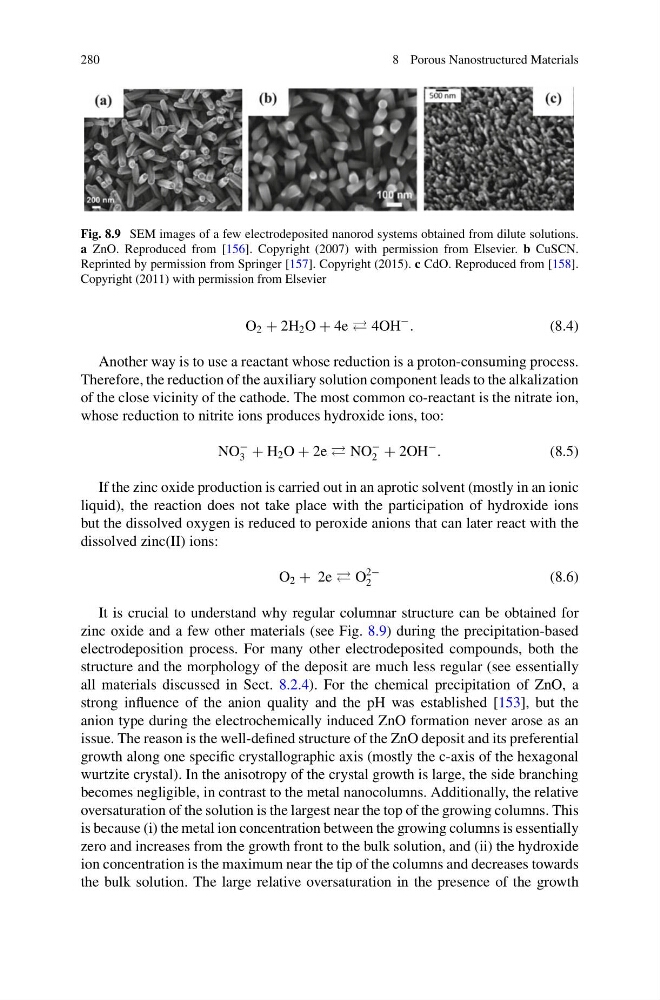
Fig. 8.9 SEM images of a few electrodeposited nanorod systems obtained from dilute solutions.
a ZnO. Reproduced from [156]. Copyright (2007) with permission from Elsevier. b CuSCN.
Reprinted by permission from Springer [157]. Copyright (2015). c CdO. Reproduced from [158].
Copyright (2011) with permission from Elsevier
O 2 + 2H 2 O + 4e 4OH
−
.
(8.4)
Another way is to use a reactant whose reduction is a proton-consuming process.
Therefore, the reduction of the auxiliary solution component leads to the alkalization
of the close vicinity of the cathode. The most common co-reactant is the nitrate ion,
whose reduction to nitrite ions produces hydroxide ions, too:
NO
−
3 + H 2 O + 2e NO
−
2 + 2OH
−
.
(8.5)
If the zinc oxide production is carried out in an aprotic solvent (mostly in an ionic
liquid), the reaction does not take place with the participation of hydroxide ions
but the dissolved oxygen is reduced to peroxide anions that can later react with the
dissolved zinc(II) ions:
O 2 + 2e O
2−
2
(8.6)
It is crucial to understand why regular columnar structure can be obtained for
zinc oxide and a few other materials (see Fig. 8.9) during the precipitation-based
electrodeposition process. For many other electrodeposited compounds, both the
structure and the morphology of the deposit are much less regular (see essentially
all materials discussed in Sect. 8.2.4). For the chemical precipitation of ZnO, a
strong influence of the anion quality and the pH was established [153], but the
anion type during the electrochemically induced ZnO formation never arose as an
issue. The reason is the well-defined structure of the ZnO deposit and its preferential
growth along one specific crystallographic axis (mostly the c-axis of the hexagonal
wurtzite crystal). In the anisotropy of the crystal growth is large, the side branching
becomes negligible, in contrast to the metal nanocolumns. Additionally, the relative
oversaturation of the solution is the largest near the top of the growing columns. This
is because (i) the metal ion concentration between the growing columns is essentially
zero and increases from the growth front to the bulk solution, and (ii) the hydroxide
ion concentration is the maximum near the tip of the columns and decreases towards
the bulk solution. The large relative oversaturation in the presence of the growth
8 Porous Nanostructured Materials
Fig. 8.9 SEM images of a few electrodeposited nanorod systems obtained from dilute solutions.
a ZnO. Reproduced from [156]. Copyright (2007) with permission from Elsevier. b CuSCN.
Reprinted by permission from Springer [157]. Copyright (2015). c CdO. Reproduced from [158].
Copyright (2011) with permission from Elsevier
O 2 + 2H 2 O + 4e 4OH
−
.
(8.4)
Another way is to use a reactant whose reduction is a proton-consuming process.
Therefore, the reduction of the auxiliary solution component leads to the alkalization
of the close vicinity of the cathode. The most common co-reactant is the nitrate ion,
whose reduction to nitrite ions produces hydroxide ions, too:
NO
−
3 + H 2 O + 2e NO
−
2 + 2OH
−
.
(8.5)
If the zinc oxide production is carried out in an aprotic solvent (mostly in an ionic
liquid), the reaction does not take place with the participation of hydroxide ions
but the dissolved oxygen is reduced to peroxide anions that can later react with the
dissolved zinc(II) ions:
O 2 + 2e O
2−
2
(8.6)
It is crucial to understand why regular columnar structure can be obtained for
zinc oxide and a few other materials (see Fig. 8.9) during the precipitation-based
electrodeposition process. For many other electrodeposited compounds, both the
structure and the morphology of the deposit are much less regular (see essentially
all materials discussed in Sect. 8.2.4). For the chemical precipitation of ZnO, a
strong influence of the anion quality and the pH was established [153], but the
anion type during the electrochemically induced ZnO formation never arose as an
issue. The reason is the well-defined structure of the ZnO deposit and its preferential
growth along one specific crystallographic axis (mostly the c-axis of the hexagonal
wurtzite crystal). In the anisotropy of the crystal growth is large, the side branching
becomes negligible, in contrast to the metal nanocolumns. Additionally, the relative
oversaturation of the solution is the largest near the top of the growing columns. This
is because (i) the metal ion concentration between the growing columns is essentially
zero and increases from the growth front to the bulk solution, and (ii) the hydroxide
ion concentration is the maximum near the tip of the columns and decreases towards
the bulk solution. The large relative oversaturation in the presence of the growth