

8.2 Superhydrophobic Porous Surfaces by Electrodeposition
273
to be the strongest among the surface layer types mentioned because of the triple
anchoring of the R–Si(O–) 3 group to the metal surface.
8.2.4 Hydrophobic Porous Salt Films Prepared
with Electrochemical Methods
The methods of the impregnation of porous deposits mean some achievement as
compared to the spontaneous formation of hydrophobicity. Nevertheless, the impregnation methods yield fairly thin surface layers, and thicker intrinsically hydrophobic
layers are desired for many applications. Hydrophobic salt films synthesized with
electrochemical methods comply with this criterion.
Salt films with superhydrophobic properties can be deposited with both cathodic
and anodic electrodeposition. Since the hydrophobic nature of the weakly soluble
(or practically insoluble) salt films partly stems form the anion having a long apolar
chain, the porosity achieved is less critical than for stand-alone porous metallic
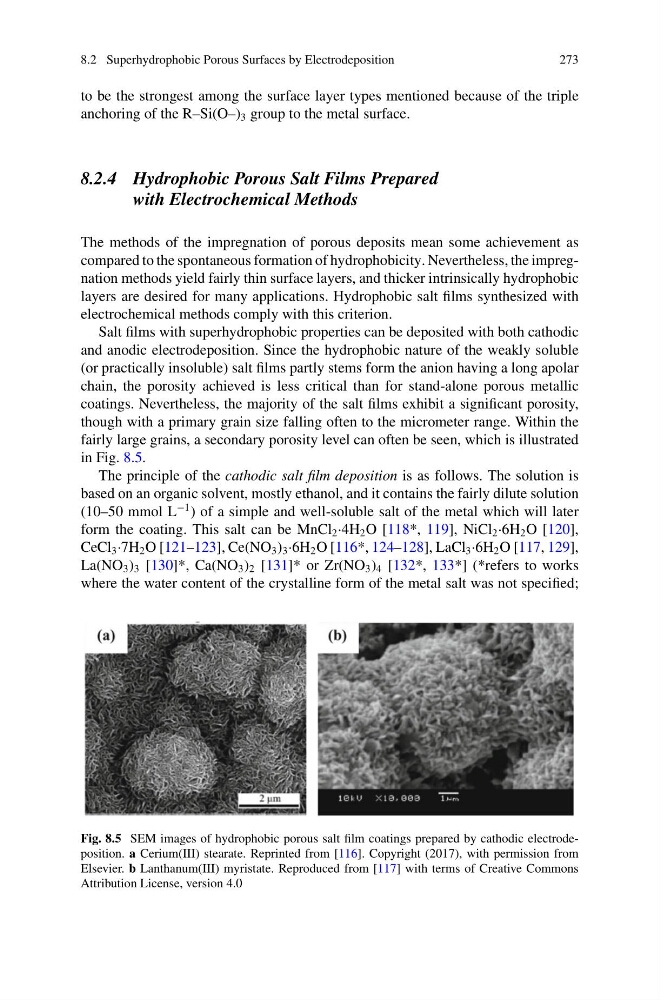
coatings. Nevertheless, the majority of the salt films exhibit a significant porosity,
though with a primary grain size falling often to the micrometer range. Within the
fairly large grains, a secondary porosity level can often be seen, which is illustrated
in Fig. 8.5.
The principle of the cathodic salt film deposition is as follows. The solution is
based on an organic solvent, mostly ethanol, and it contains the fairly dilute solution
(10–50 mmol L
−1 ) of a simple and well-soluble salt of the metal which will later
form the coating. This salt can be MnCl 2 ·4H 2 O [118*, 119], NiCl 2 ·6H 2 O [120],
CeCl 3 ·7H 2 O [121–123], Ce(NO 3 ) 3 ·6H 2 O [116*, 124–128], LaCl 3 ·6H 2 O [117, 129],
La(NO 3 ) 3 [130]*, Ca(NO 3 ) 2 [131]* or Zr(NO 3 ) 4 [132*, 133*] (*refers to works
where the water content of the crystalline form of the metal salt was not specified;
Fig. 8.5 SEM images of hydrophobic porous salt film coatings prepared by cathodic electrodeposition. a Cerium(III) stearate. Reprinted from [116]. Copyright (2017), with permission from
Elsevier. b Lanthanum(III) myristate. Reproduced from [117] with terms of Creative Commons
Attribution License, version 4.0
273
to be the strongest among the surface layer types mentioned because of the triple
anchoring of the R–Si(O–) 3 group to the metal surface.
8.2.4 Hydrophobic Porous Salt Films Prepared
with Electrochemical Methods
The methods of the impregnation of porous deposits mean some achievement as
compared to the spontaneous formation of hydrophobicity. Nevertheless, the impregnation methods yield fairly thin surface layers, and thicker intrinsically hydrophobic
layers are desired for many applications. Hydrophobic salt films synthesized with
electrochemical methods comply with this criterion.
Salt films with superhydrophobic properties can be deposited with both cathodic
and anodic electrodeposition. Since the hydrophobic nature of the weakly soluble
(or practically insoluble) salt films partly stems form the anion having a long apolar
chain, the porosity achieved is less critical than for stand-alone porous metallic
coatings. Nevertheless, the majority of the salt films exhibit a significant porosity,
though with a primary grain size falling often to the micrometer range. Within the
fairly large grains, a secondary porosity level can often be seen, which is illustrated
in Fig. 8.5.
The principle of the cathodic salt film deposition is as follows. The solution is
based on an organic solvent, mostly ethanol, and it contains the fairly dilute solution
(10–50 mmol L
−1 ) of a simple and well-soluble salt of the metal which will later
form the coating. This salt can be MnCl 2 ·4H 2 O [118*, 119], NiCl 2 ·6H 2 O [120],
CeCl 3 ·7H 2 O [121–123], Ce(NO 3 ) 3 ·6H 2 O [116*, 124–128], LaCl 3 ·6H 2 O [117, 129],
La(NO 3 ) 3 [130]*, Ca(NO 3 ) 2 [131]* or Zr(NO 3 ) 4 [132*, 133*] (*refers to works
where the water content of the crystalline form of the metal salt was not specified;
Fig. 8.5 SEM images of hydrophobic porous salt film coatings prepared by cathodic electrodeposition. a Cerium(III) stearate. Reprinted from [116]. Copyright (2017), with permission from
Elsevier. b Lanthanum(III) myristate. Reproduced from [117] with terms of Creative Commons
Attribution License, version 4.0