

8.2 Superhydrophobic Porous Surfaces by Electrodeposition
267
8.2 Superhydrophobic Porous Surfaces
by Electrodeposition
8.2.1 General Aspects of Morphology-Based Hydrophobicity
The preparation of hydrophobic surfaces gained an immense attention in the last
decade [61, 62]. Deposits for which the hydrophobic behaviour is due to the presence
of co-deposited hydrophobic particles were already discussed in Chap. 7. Here, the
cases will be dealt with when the hydrophobic behaviour is strongly related to the
porosity and high surface roughness of the deposits.
When the hydrophobic behaviour is related to the surface porosity, the wetting
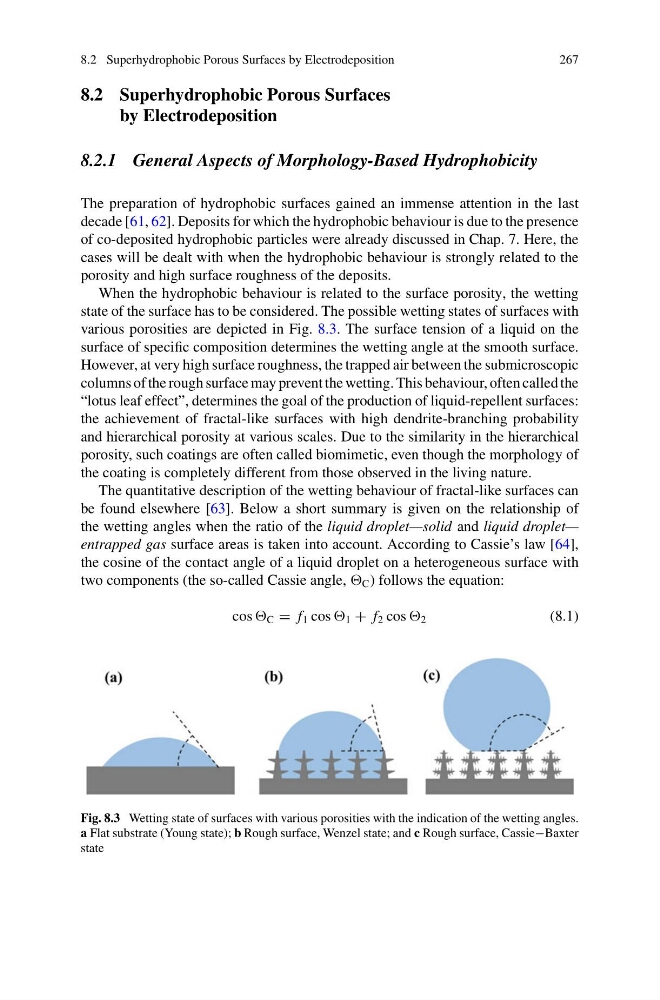
state of the surface has to be considered. The possible wetting states of surfaces with
various porosities are depicted in Fig. 8.3. The surface tension of a liquid on the
surface of specific composition determines the wetting angle at the smooth surface.
However, at very high surface roughness, the trapped air between the submicroscopic
columns of the rough surface may prevent the wetting. This behaviour, often called the
“lotus leaf effect”, determines the goal of the production of liquid-repellent surfaces:
the achievement of fractal-like surfaces with high dendrite-branching probability
and hierarchical porosity at various scales. Due to the similarity in the hierarchical
porosity, such coatings are often called biomimetic, even though the morphology of
the coating is completely different from those observed in the living nature.
The quantitative description of the wetting behaviour of fractal-like surfaces can
be found elsewhere [63]. Below a short summary is given on the relationship of
the wetting angles when the ratio of the liquid droplet—solid and liquid droplet—
entrapped gas surface areas is taken into account. According to Cassie’s law [64],
the cosine of the contact angle of a liquid droplet on a heterogeneous surface with
two components (the so-called Cassie angle, C ) follows the equation:
cos C = f 1 cos 1 + f 2 cos 2
(8.1)
Fig. 8.3 Wetting state of surfaces with various porosities with the indication of the wetting angles.
a Flat substrate (Young state); b Rough surface, Wenzel state; and c Rough surface, Cassie−Baxter
state
267
8.2 Superhydrophobic Porous Surfaces
by Electrodeposition
8.2.1 General Aspects of Morphology-Based Hydrophobicity
The preparation of hydrophobic surfaces gained an immense attention in the last
decade [61, 62]. Deposits for which the hydrophobic behaviour is due to the presence
of co-deposited hydrophobic particles were already discussed in Chap. 7. Here, the
cases will be dealt with when the hydrophobic behaviour is strongly related to the
porosity and high surface roughness of the deposits.
When the hydrophobic behaviour is related to the surface porosity, the wetting
state of the surface has to be considered. The possible wetting states of surfaces with
various porosities are depicted in Fig. 8.3. The surface tension of a liquid on the
surface of specific composition determines the wetting angle at the smooth surface.
However, at very high surface roughness, the trapped air between the submicroscopic
columns of the rough surface may prevent the wetting. This behaviour, often called the
“lotus leaf effect”, determines the goal of the production of liquid-repellent surfaces:
the achievement of fractal-like surfaces with high dendrite-branching probability
and hierarchical porosity at various scales. Due to the similarity in the hierarchical
porosity, such coatings are often called biomimetic, even though the morphology of
the coating is completely different from those observed in the living nature.
The quantitative description of the wetting behaviour of fractal-like surfaces can
be found elsewhere [63]. Below a short summary is given on the relationship of
the wetting angles when the ratio of the liquid droplet—solid and liquid droplet—
entrapped gas surface areas is taken into account. According to Cassie’s law [64],
the cosine of the contact angle of a liquid droplet on a heterogeneous surface with
two components (the so-called Cassie angle, C ) follows the equation:
cos C = f 1 cos 1 + f 2 cos 2
(8.1)
Fig. 8.3 Wetting state of surfaces with various porosities with the indication of the wetting angles.
a Flat substrate (Young state); b Rough surface, Wenzel state; and c Rough surface, Cassie−Baxter
state