

242
7 Composites
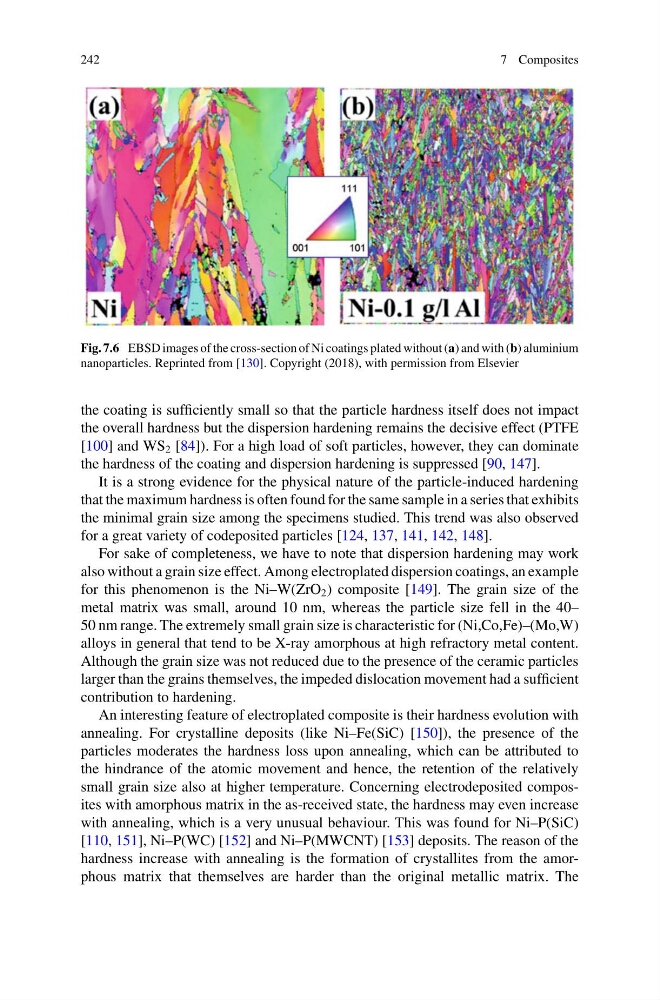
Fig. 7.6 EBSD images of the cross-section of Ni coatings plated without (a) and with (b) aluminium
nanoparticles. Reprinted from [130]. Copyright (2018), with permission from Elsevier
the coating is sufficiently small so that the particle hardness itself does not impact
the overall hardness but the dispersion hardening remains the decisive effect (PTFE
[100] and WS 2 [84]). For a high load of soft particles, however, they can dominate
the hardness of the coating and dispersion hardening is suppressed [90, 147].
It is a strong evidence for the physical nature of the particle-induced hardening
that the maximum hardness is often found for the same sample in a series that exhibits
the minimal grain size among the specimens studied. This trend was also observed
for a great variety of codeposited particles [124, 137, 141, 142, 148].
For sake of completeness, we have to note that dispersion hardening may work
also without a grain size effect. Among electroplated dispersion coatings, an example
for this phenomenon is the Ni–W(ZrO 2 ) composite [149]. The grain size of the
metal matrix was small, around 10 nm, whereas the particle size fell in the 40–
50 nm range. The extremely small grain size is characteristic for (Ni,Co,Fe)–(Mo,W)
alloys in general that tend to be X-ray amorphous at high refractory metal content.
Although the grain size was not reduced due to the presence of the ceramic particles
larger than the grains themselves, the impeded dislocation movement had a sufficient
contribution to hardening.
An interesting feature of electroplated composite is their hardness evolution with
annealing. For crystalline deposits (like Ni–Fe(SiC) [150]), the presence of the
particles moderates the hardness loss upon annealing, which can be attributed to
the hindrance of the atomic movement and hence, the retention of the relatively
small grain size also at higher temperature. Concerning electrodeposited composites with amorphous matrix in the as-received state, the hardness may even increase
with annealing, which is a very unusual behaviour. This was found for Ni–P(SiC)
[110, 151], Ni–P(WC) [152] and Ni–P(MWCNT) [153] deposits. The reason of the
hardness increase with annealing is the formation of crystallites from the amorphous matrix that themselves are harder than the original metallic matrix. The
7 Composites
Fig. 7.6 EBSD images of the cross-section of Ni coatings plated without (a) and with (b) aluminium
nanoparticles. Reprinted from [130]. Copyright (2018), with permission from Elsevier
the coating is sufficiently small so that the particle hardness itself does not impact
the overall hardness but the dispersion hardening remains the decisive effect (PTFE
[100] and WS 2 [84]). For a high load of soft particles, however, they can dominate
the hardness of the coating and dispersion hardening is suppressed [90, 147].
It is a strong evidence for the physical nature of the particle-induced hardening
that the maximum hardness is often found for the same sample in a series that exhibits
the minimal grain size among the specimens studied. This trend was also observed
for a great variety of codeposited particles [124, 137, 141, 142, 148].
For sake of completeness, we have to note that dispersion hardening may work
also without a grain size effect. Among electroplated dispersion coatings, an example
for this phenomenon is the Ni–W(ZrO 2 ) composite [149]. The grain size of the
metal matrix was small, around 10 nm, whereas the particle size fell in the 40–
50 nm range. The extremely small grain size is characteristic for (Ni,Co,Fe)–(Mo,W)
alloys in general that tend to be X-ray amorphous at high refractory metal content.
Although the grain size was not reduced due to the presence of the ceramic particles
larger than the grains themselves, the impeded dislocation movement had a sufficient
contribution to hardening.
An interesting feature of electroplated composite is their hardness evolution with
annealing. For crystalline deposits (like Ni–Fe(SiC) [150]), the presence of the
particles moderates the hardness loss upon annealing, which can be attributed to
the hindrance of the atomic movement and hence, the retention of the relatively
small grain size also at higher temperature. Concerning electrodeposited composites with amorphous matrix in the as-received state, the hardness may even increase
with annealing, which is a very unusual behaviour. This was found for Ni–P(SiC)
[110, 151], Ni–P(WC) [152] and Ni–P(MWCNT) [153] deposits. The reason of the
hardness increase with annealing is the formation of crystallites from the amorphous matrix that themselves are harder than the original metallic matrix. The