

7.2 Composite Deposition from Particle Suspensions
239
Examples for the application of pulse plating for composite deposition are
numerous [75, 83, 100–112] but no general trend can be established concerning
the application of pulses on the particle incorporation ratio. Due to the large variety
of the choice of the parameters of pulse plating, the comparison is difficult, especially
since the bath and particle types also vary from one work to another. The application
of pulse plating itself was reported to increase the particle incorporation ratio for
a number of systems (Co–Ni(SiO 2 ) [102], Ag(PTFE) [75], Cu(SiC) [105], Ni(SiC)
[113], Ni–P(SiC) [110]). However, some other pulse-plated deposits exhibited lower
particle content than their d.c.-plated counterparts (Ni(Ti) [83], Ni(SiC) [108]). The
application of pulsed current can be used to reduce the porosity of the resulting
composite [109, 112]. Concerning the pulse frequency, the results are even more
diverse than the trend on the incorporation ratio. Studies show cases of no impact of
the pulse frequency on the particle incorporation ratio [83], adverse effects of microand nanosized particle of the same composition [103], advantage of either the low
[104] or high [111] pulse frequency for the particle incorporation or existence of an
optimal intermediate pulse frequency [105, 107].
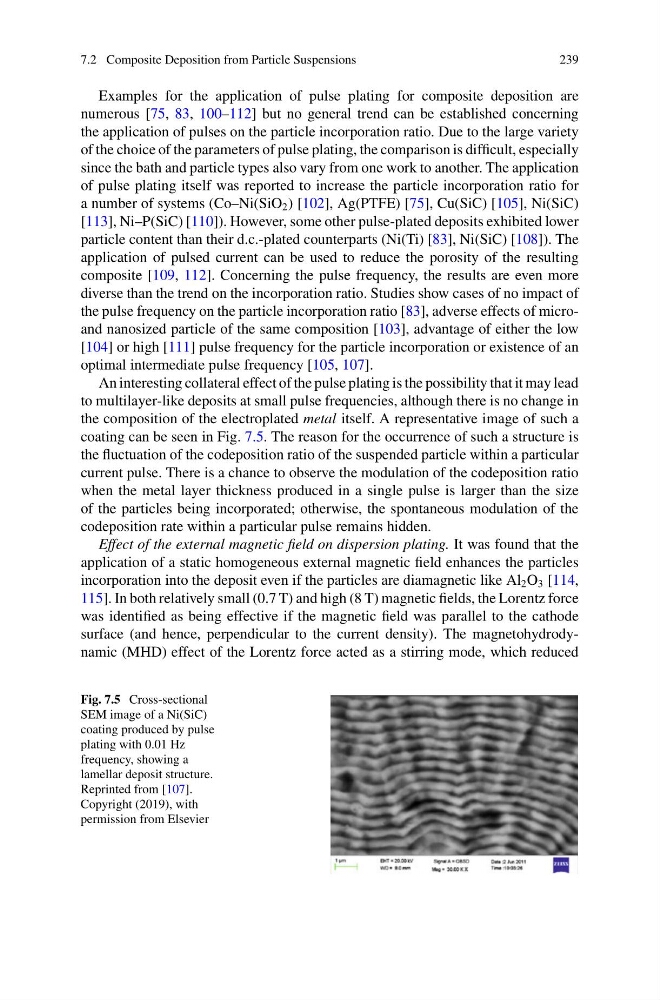
An interesting collateral effect of the pulse plating is the possibility that it may lead
to multilayer-like deposits at small pulse frequencies, although there is no change in
the composition of the electroplated metal itself. A representative image of such a
coating can be seen in Fig. 7.5. The reason for the occurrence of such a structure is
the fluctuation of the codeposition ratio of the suspended particle within a particular
current pulse. There is a chance to observe the modulation of the codeposition ratio
when the metal layer thickness produced in a single pulse is larger than the size
of the particles being incorporated; otherwise, the spontaneous modulation of the
codeposition rate within a particular pulse remains hidden.
Effect of the external magnetic field on dispersion plating. It was found that the
application of a static homogeneous external magnetic field enhances the particles
incorporation into the deposit even if the particles are diamagnetic like Al 2 O 3 [114,
115]. In both relatively small (0.7 T) and high (8 T) magnetic fields, the Lorentz force
was identified as being effective if the magnetic field was parallel to the cathode
surface (and hence, perpendicular to the current density). The magnetohydrodynamic (MHD) effect of the Lorentz force acted as a stirring mode, which reduced
Fig. 7.5 Cross-sectional
SEM image of a Ni(SiC)
coating produced by pulse
plating with 0.01 Hz
frequency, showing a
lamellar deposit structure.
Reprinted from [107].
Copyright (2019), with
permission from Elsevier
239
Examples for the application of pulse plating for composite deposition are
numerous [75, 83, 100–112] but no general trend can be established concerning
the application of pulses on the particle incorporation ratio. Due to the large variety
of the choice of the parameters of pulse plating, the comparison is difficult, especially
since the bath and particle types also vary from one work to another. The application
of pulse plating itself was reported to increase the particle incorporation ratio for
a number of systems (Co–Ni(SiO 2 ) [102], Ag(PTFE) [75], Cu(SiC) [105], Ni(SiC)
[113], Ni–P(SiC) [110]). However, some other pulse-plated deposits exhibited lower
particle content than their d.c.-plated counterparts (Ni(Ti) [83], Ni(SiC) [108]). The
application of pulsed current can be used to reduce the porosity of the resulting
composite [109, 112]. Concerning the pulse frequency, the results are even more
diverse than the trend on the incorporation ratio. Studies show cases of no impact of
the pulse frequency on the particle incorporation ratio [83], adverse effects of microand nanosized particle of the same composition [103], advantage of either the low
[104] or high [111] pulse frequency for the particle incorporation or existence of an
optimal intermediate pulse frequency [105, 107].
An interesting collateral effect of the pulse plating is the possibility that it may lead
to multilayer-like deposits at small pulse frequencies, although there is no change in
the composition of the electroplated metal itself. A representative image of such a
coating can be seen in Fig. 7.5. The reason for the occurrence of such a structure is
the fluctuation of the codeposition ratio of the suspended particle within a particular
current pulse. There is a chance to observe the modulation of the codeposition ratio
when the metal layer thickness produced in a single pulse is larger than the size
of the particles being incorporated; otherwise, the spontaneous modulation of the
codeposition rate within a particular pulse remains hidden.
Effect of the external magnetic field on dispersion plating. It was found that the
application of a static homogeneous external magnetic field enhances the particles
incorporation into the deposit even if the particles are diamagnetic like Al 2 O 3 [114,
115]. In both relatively small (0.7 T) and high (8 T) magnetic fields, the Lorentz force
was identified as being effective if the magnetic field was parallel to the cathode
surface (and hence, perpendicular to the current density). The magnetohydrodynamic (MHD) effect of the Lorentz force acted as a stirring mode, which reduced
Fig. 7.5 Cross-sectional
SEM image of a Ni(SiC)
coating produced by pulse
plating with 0.01 Hz
frequency, showing a
lamellar deposit structure.
Reprinted from [107].
Copyright (2019), with
permission from Elsevier