

236
7 Composites
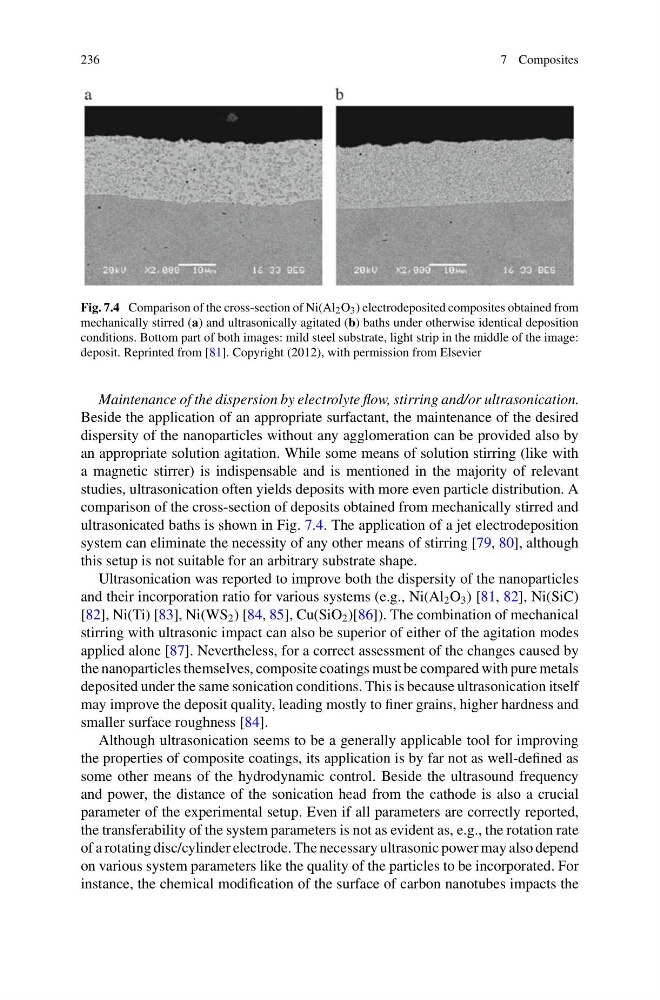
Fig. 7.4 Comparison of the cross-section of Ni(Al 2 O 3 ) electrodeposited composites obtained from
mechanically stirred (a) and ultrasonically agitated (b) baths under otherwise identical deposition
conditions. Bottom part of both images: mild steel substrate, light strip in the middle of the image:
deposit. Reprinted from [81]. Copyright (2012), with permission from Elsevier
Maintenance of the dispersion by electrolyte flow, stirring and/or ultrasonication.
Beside the application of an appropriate surfactant, the maintenance of the desired
dispersity of the nanoparticles without any agglomeration can be provided also by
an appropriate solution agitation. While some means of solution stirring (like with
a magnetic stirrer) is indispensable and is mentioned in the majority of relevant
studies, ultrasonication often yields deposits with more even particle distribution. A
comparison of the cross-section of deposits obtained from mechanically stirred and
ultrasonicated baths is shown in Fig. 7.4. The application of a jet electrodeposition
system can eliminate the necessity of any other means of stirring [79, 80], although
this setup is not suitable for an arbitrary substrate shape.
Ultrasonication was reported to improve both the dispersity of the nanoparticles
and their incorporation ratio for various systems (e.g., Ni(Al 2 O 3 ) [81, 82], Ni(SiC)
[82], Ni(Ti) [83], Ni(WS 2 ) [84, 85], Cu(SiO 2 )[86]). The combination of mechanical
stirring with ultrasonic impact can also be superior of either of the agitation modes
applied alone [87]. Nevertheless, for a correct assessment of the changes caused by
the nanoparticles themselves, composite coatings must be compared with pure metals
deposited under the same sonication conditions. This is because ultrasonication itself
may improve the deposit quality, leading mostly to finer grains, higher hardness and
smaller surface roughness [84].
Although ultrasonication seems to be a generally applicable tool for improving
the properties of composite coatings, its application is by far not as well-defined as
some other means of the hydrodynamic control. Beside the ultrasound frequency
and power, the distance of the sonication head from the cathode is also a crucial
parameter of the experimental setup. Even if all parameters are correctly reported,
the transferability of the system parameters is not as evident as, e.g., the rotation rate
of a rotating disc/cylinder electrode. The necessary ultrasonic power may also depend
on various system parameters like the quality of the particles to be incorporated. For
instance, the chemical modification of the surface of carbon nanotubes impacts the
7 Composites
Fig. 7.4 Comparison of the cross-section of Ni(Al 2 O 3 ) electrodeposited composites obtained from
mechanically stirred (a) and ultrasonically agitated (b) baths under otherwise identical deposition
conditions. Bottom part of both images: mild steel substrate, light strip in the middle of the image:
deposit. Reprinted from [81]. Copyright (2012), with permission from Elsevier
Maintenance of the dispersion by electrolyte flow, stirring and/or ultrasonication.
Beside the application of an appropriate surfactant, the maintenance of the desired
dispersity of the nanoparticles without any agglomeration can be provided also by
an appropriate solution agitation. While some means of solution stirring (like with
a magnetic stirrer) is indispensable and is mentioned in the majority of relevant
studies, ultrasonication often yields deposits with more even particle distribution. A
comparison of the cross-section of deposits obtained from mechanically stirred and
ultrasonicated baths is shown in Fig. 7.4. The application of a jet electrodeposition
system can eliminate the necessity of any other means of stirring [79, 80], although
this setup is not suitable for an arbitrary substrate shape.
Ultrasonication was reported to improve both the dispersity of the nanoparticles
and their incorporation ratio for various systems (e.g., Ni(Al 2 O 3 ) [81, 82], Ni(SiC)
[82], Ni(Ti) [83], Ni(WS 2 ) [84, 85], Cu(SiO 2 )[86]). The combination of mechanical
stirring with ultrasonic impact can also be superior of either of the agitation modes
applied alone [87]. Nevertheless, for a correct assessment of the changes caused by
the nanoparticles themselves, composite coatings must be compared with pure metals
deposited under the same sonication conditions. This is because ultrasonication itself
may improve the deposit quality, leading mostly to finer grains, higher hardness and
smaller surface roughness [84].
Although ultrasonication seems to be a generally applicable tool for improving
the properties of composite coatings, its application is by far not as well-defined as
some other means of the hydrodynamic control. Beside the ultrasound frequency
and power, the distance of the sonication head from the cathode is also a crucial
parameter of the experimental setup. Even if all parameters are correctly reported,
the transferability of the system parameters is not as evident as, e.g., the rotation rate
of a rotating disc/cylinder electrode. The necessary ultrasonic power may also depend
on various system parameters like the quality of the particles to be incorporated. For
instance, the chemical modification of the surface of carbon nanotubes impacts the