

7.2 Composite Deposition from Particle Suspensions
233
is not available from an independent measurement. The probability is described with
a binomial expression:
P (k/K , j) =
K
z=k
C
K
z
1 − p j
K −z p
z
j
(7.6)
The probability factor related to the reduction of one particular ion at the current
density j, p j , can be calculated by taking into account the transport process through
a Nernstian diffusion layer of thickness δ. The appropriate substitution leads to
p j =
j
z Fc M δ +
jδ 2
2D M
+ j
(7.7)
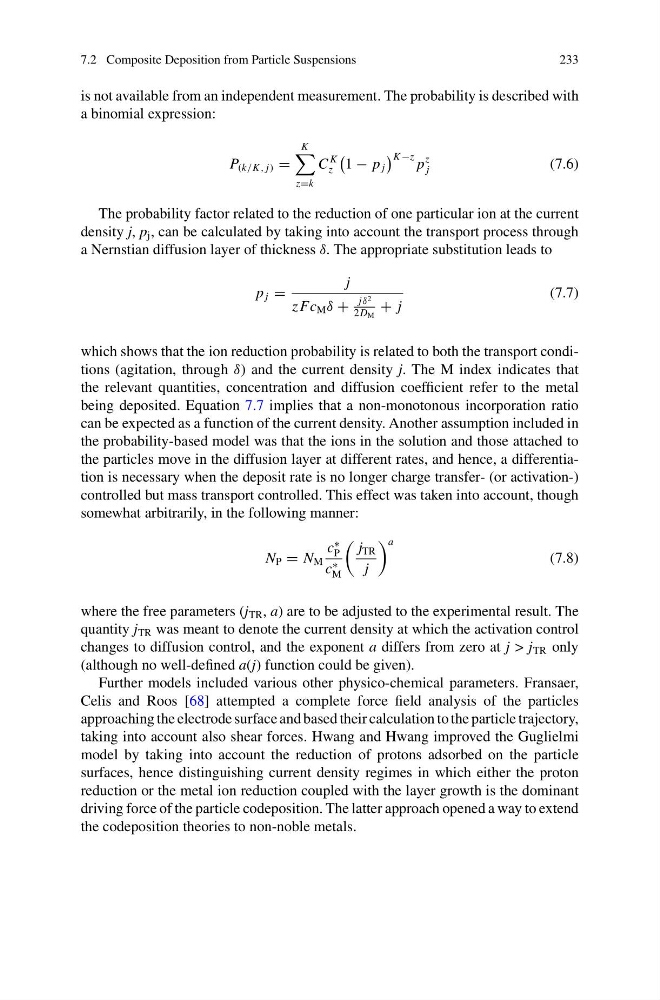
which shows that the ion reduction probability is related to both the transport conditions (agitation, through δ) and the current density j. The M index indicates that
the relevant quantities, concentration and diffusion coefficient refer to the metal
being deposited. Equation 7.7 implies that a non-monotonous incorporation ratio
can be expected as a function of the current density. Another assumption included in
the probability-based model was that the ions in the solution and those attached to
the particles move in the diffusion layer at different rates, and hence, a differentiation is necessary when the deposit rate is no longer charge transfer- (or activation-)
controlled but mass transport controlled. This effect was taken into account, though
somewhat arbitrarily, in the following manner:
N P = N M
c
∗
P
c
∗
M
j TR
j
a
(7.8)
where the free parameters (j TR , a) are to be adjusted to the experimental result. The
quantity j TR was meant to denote the current density at which the activation control
changes to diffusion control, and the exponent a differs from zero at j > j TR only
(although no well-defined a(j) function could be given).
Further models included various other physico-chemical parameters. Fransaer,
Celis and Roos [68] attempted a complete force field analysis of the particles
approaching the electrode surface and based their calculation to the particle trajectory,
taking into account also shear forces. Hwang and Hwang improved the Guglielmi
model by taking into account the reduction of protons adsorbed on the particle
surfaces, hence distinguishing current density regimes in which either the proton
reduction or the metal ion reduction coupled with the layer growth is the dominant
driving force of the particle codeposition. The latter approach opened a way to extend
the codeposition theories to non-noble metals.
233
is not available from an independent measurement. The probability is described with
a binomial expression:
P (k/K , j) =
K
z=k
C
K
z
1 − p j
K −z p
z
j
(7.6)
The probability factor related to the reduction of one particular ion at the current
density j, p j , can be calculated by taking into account the transport process through
a Nernstian diffusion layer of thickness δ. The appropriate substitution leads to
p j =
j
z Fc M δ +
jδ 2
2D M
+ j
(7.7)
which shows that the ion reduction probability is related to both the transport conditions (agitation, through δ) and the current density j. The M index indicates that
the relevant quantities, concentration and diffusion coefficient refer to the metal
being deposited. Equation 7.7 implies that a non-monotonous incorporation ratio
can be expected as a function of the current density. Another assumption included in
the probability-based model was that the ions in the solution and those attached to
the particles move in the diffusion layer at different rates, and hence, a differentiation is necessary when the deposit rate is no longer charge transfer- (or activation-)
controlled but mass transport controlled. This effect was taken into account, though
somewhat arbitrarily, in the following manner:
N P = N M
c
∗
P
c
∗
M
j TR
j
a
(7.8)
where the free parameters (j TR , a) are to be adjusted to the experimental result. The
quantity j TR was meant to denote the current density at which the activation control
changes to diffusion control, and the exponent a differs from zero at j > j TR only
(although no well-defined a(j) function could be given).
Further models included various other physico-chemical parameters. Fransaer,
Celis and Roos [68] attempted a complete force field analysis of the particles
approaching the electrode surface and based their calculation to the particle trajectory,
taking into account also shear forces. Hwang and Hwang improved the Guglielmi
model by taking into account the reduction of protons adsorbed on the particle
surfaces, hence distinguishing current density regimes in which either the proton
reduction or the metal ion reduction coupled with the layer growth is the dominant
driving force of the particle codeposition. The latter approach opened a way to extend
the codeposition theories to non-noble metals.