

6.3 Electrodeposited Nanocrystalline Alloys
207
Table 6.1 Literature
references for works on
electrodeposited Ig-Tr alloys
dealing with the aspects of
nanocrystallinity
Constituent elements
References
Ni–Mo
[167–179]
Ni–W
[180–193]
Co–Mo
[194]
Co–W
[195, 196]
Fe–W
[181, 188]
Ni–Fe–W
[197–199]
6.3.4 Alloys of Iron Group Metals with Palladium
and Platinum
The major motivation of the pursuits concerning the electrodeposition of the iron
group metal alloys with platinum metals (Pl) is the magnetic properties of the equilibrium phase of these alloys. The Ig–Pl alloys are usually obtained as relatively
disordered nanocrystalline deposits whose coercivity is small. Annealing results in
a recrystallization (giving rise to the occurrence of the so-called L1 0 phase for Co–
Pt and Fe–Pt alloys), which is accompanied with a grain growth and, importantly,
a dramatic increase of coercivity, leading to coercive fields larger than 1.5 kOe.
Beside the magnetic properties, hydrogen absorption and electrocatalytic properties
were in the focus of research of nc-Ig–Pl alloys. A summary of the works in which
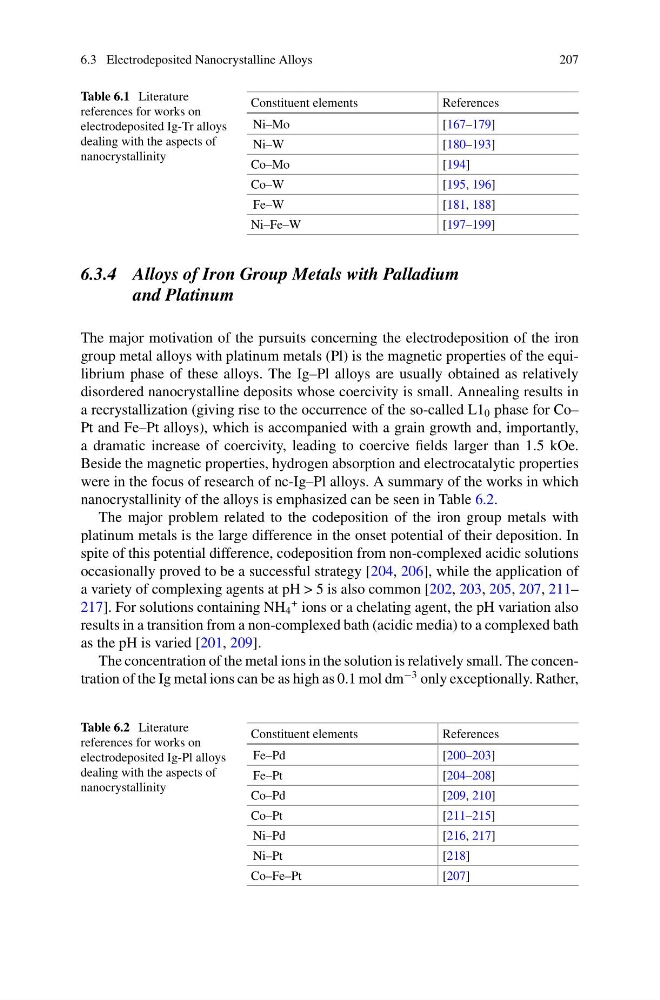
nanocrystallinity of the alloys is emphasized can be seen in Table 6.2.
The major problem related to the codeposition of the iron group metals with
platinum metals is the large difference in the onset potential of their deposition. In
spite of this potential difference, codeposition from non-complexed acidic solutions
occasionally proved to be a successful strategy [204, 206], while the application of
a variety of complexing agents at pH > 5 is also common [202, 203, 205, 207, 211–
217]. For solutions containing NH 4
+ ions or a chelating agent, the pH variation also
results in a transition from a non-complexed bath (acidic media) to a complexed bath
as the pH is varied [201, 209].
The concentration of the metal ions in the solution is relatively small. The concentration of the Ig metal ions can be as high as 0.1 mol dm
−3 only exceptionally. Rather,
Table 6.2 Literature
references for works on
electrodeposited Ig-Pl alloys
dealing with the aspects of
nanocrystallinity
Constituent elements
References
Fe–Pd
[200–203]
Fe–Pt
[204–208]
Co–Pd
[209, 210]
Co–Pt
[211–215]
Ni–Pd
[216, 217]
Ni–Pt
[218]
Co–Fe–Pt
[207]
207
Table 6.1 Literature
references for works on
electrodeposited Ig-Tr alloys
dealing with the aspects of
nanocrystallinity
Constituent elements
References
Ni–Mo
[167–179]
Ni–W
[180–193]
Co–Mo
[194]
Co–W
[195, 196]
Fe–W
[181, 188]
Ni–Fe–W
[197–199]
6.3.4 Alloys of Iron Group Metals with Palladium
and Platinum
The major motivation of the pursuits concerning the electrodeposition of the iron
group metal alloys with platinum metals (Pl) is the magnetic properties of the equilibrium phase of these alloys. The Ig–Pl alloys are usually obtained as relatively
disordered nanocrystalline deposits whose coercivity is small. Annealing results in
a recrystallization (giving rise to the occurrence of the so-called L1 0 phase for Co–
Pt and Fe–Pt alloys), which is accompanied with a grain growth and, importantly,
a dramatic increase of coercivity, leading to coercive fields larger than 1.5 kOe.
Beside the magnetic properties, hydrogen absorption and electrocatalytic properties
were in the focus of research of nc-Ig–Pl alloys. A summary of the works in which
nanocrystallinity of the alloys is emphasized can be seen in Table 6.2.
The major problem related to the codeposition of the iron group metals with
platinum metals is the large difference in the onset potential of their deposition. In
spite of this potential difference, codeposition from non-complexed acidic solutions
occasionally proved to be a successful strategy [204, 206], while the application of
a variety of complexing agents at pH > 5 is also common [202, 203, 205, 207, 211–
217]. For solutions containing NH 4
+ ions or a chelating agent, the pH variation also
results in a transition from a non-complexed bath (acidic media) to a complexed bath
as the pH is varied [201, 209].
The concentration of the metal ions in the solution is relatively small. The concentration of the Ig metal ions can be as high as 0.1 mol dm
−3 only exceptionally. Rather,
Table 6.2 Literature
references for works on
electrodeposited Ig-Pl alloys
dealing with the aspects of
nanocrystallinity
Constituent elements
References
Fe–Pd
[200–203]
Fe–Pt
[204–208]
Co–Pd
[209, 210]
Co–Pt
[211–215]
Ni–Pd
[216, 217]
Ni–Pt
[218]
Co–Fe–Pt
[207]