

6.3 Electrodeposited Nanocrystalline Alloys
203
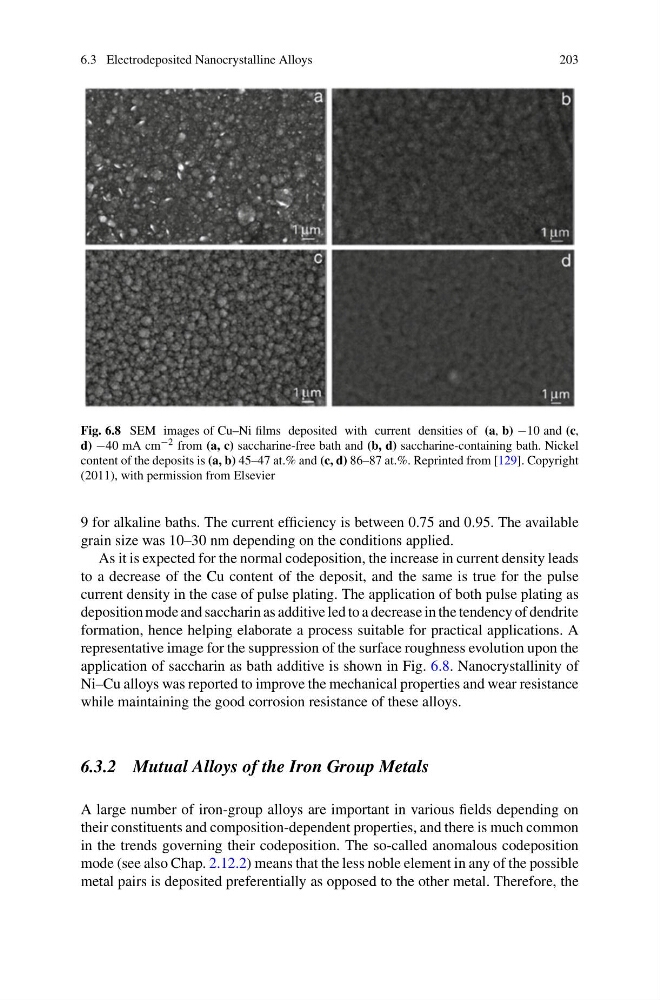
Fig. 6.8 SEM images of Cu–Ni films deposited with current densities of (a, b) −10 and (c,
d) −40 mA cm −2 from (a, c) saccharine-free bath and (b, d) saccharine-containing bath. Nickel
content of the deposits is (a, b) 45–47 at.% and (c, d) 86–87 at.%. Reprinted from [129]. Copyright
(2011), with permission from Elsevier
9 for alkaline baths. The current efficiency is between 0.75 and 0.95. The available
grain size was 10–30 nm depending on the conditions applied.
As it is expected for the normal codeposition, the increase in current density leads
to a decrease of the Cu content of the deposit, and the same is true for the pulse
current density in the case of pulse plating. The application of both pulse plating as
deposition mode and saccharin as additive led to a decrease in the tendency of dendrite
formation, hence helping elaborate a process suitable for practical applications. A
representative image for the suppression of the surface roughness evolution upon the
application of saccharin as bath additive is shown in Fig. 6.8. Nanocrystallinity of
Ni–Cu alloys was reported to improve the mechanical properties and wear resistance
while maintaining the good corrosion resistance of these alloys.
6.3.2 Mutual Alloys of the Iron Group Metals
A large number of iron-group alloys are important in various fields depending on
their constituents and composition-dependent properties, and there is much common
in the trends governing their codeposition. The so-called anomalous codeposition
mode (see also Chap. 2.12.2) means that the less noble element in any of the possible
metal pairs is deposited preferentially as opposed to the other metal. Therefore, the
203
Fig. 6.8 SEM images of Cu–Ni films deposited with current densities of (a, b) −10 and (c,
d) −40 mA cm −2 from (a, c) saccharine-free bath and (b, d) saccharine-containing bath. Nickel
content of the deposits is (a, b) 45–47 at.% and (c, d) 86–87 at.%. Reprinted from [129]. Copyright
(2011), with permission from Elsevier
9 for alkaline baths. The current efficiency is between 0.75 and 0.95. The available
grain size was 10–30 nm depending on the conditions applied.
As it is expected for the normal codeposition, the increase in current density leads
to a decrease of the Cu content of the deposit, and the same is true for the pulse
current density in the case of pulse plating. The application of both pulse plating as
deposition mode and saccharin as additive led to a decrease in the tendency of dendrite
formation, hence helping elaborate a process suitable for practical applications. A
representative image for the suppression of the surface roughness evolution upon the
application of saccharin as bath additive is shown in Fig. 6.8. Nanocrystallinity of
Ni–Cu alloys was reported to improve the mechanical properties and wear resistance
while maintaining the good corrosion resistance of these alloys.
6.3.2 Mutual Alloys of the Iron Group Metals
A large number of iron-group alloys are important in various fields depending on
their constituents and composition-dependent properties, and there is much common
in the trends governing their codeposition. The so-called anomalous codeposition
mode (see also Chap. 2.12.2) means that the less noble element in any of the possible
metal pairs is deposited preferentially as opposed to the other metal. Therefore, the