

6.2 Nanocrystalline Deposits of Metallic Elements
201
sulphur accumulation at the grain boundaries in the early stage of recrystallization
that impacts the further diffusion processes at the grain boundaries.
Hardness, yield strength and ultimate tensile strength of nc-Co were larger than
that of bulk microcrystalline cobalt by a factor of 2–3 [108]. However, the friction
coefficient shows an adverse behaviour than that found generally for nanocrystalline
materials [98]. Although the friction coefficient of nc-Co was found to be much
smaller than that of nc-Ni (0.2–0.25 vs. 0.6–0.7), it slightly increased with decreasing
grain size. Nevertheless, the wear loss varied with grain size in the normal way in
the sense that a smaller grain size resulted in a smaller wear loss.
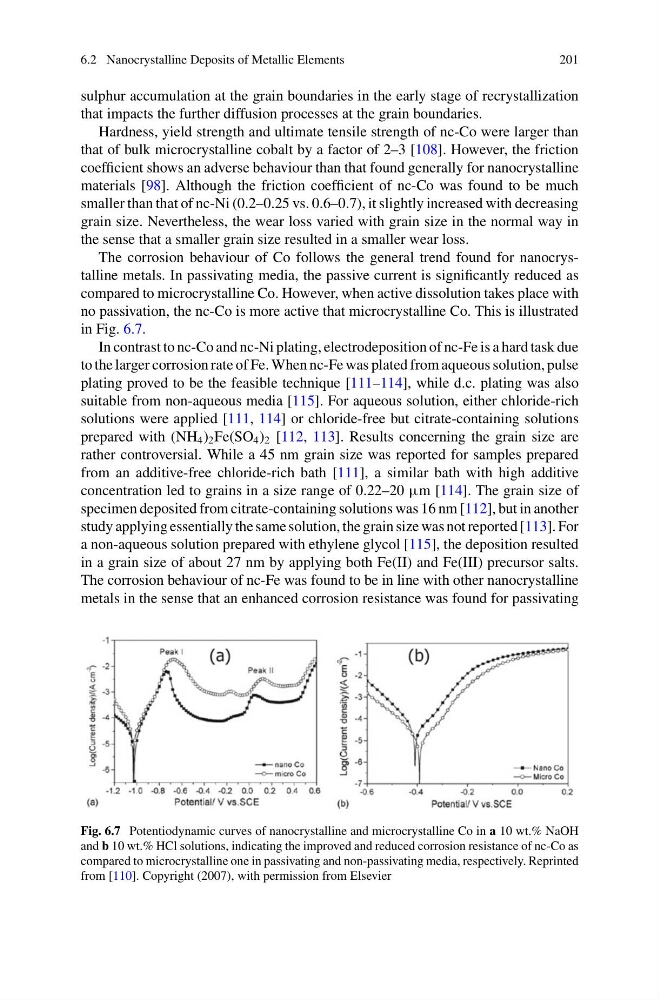
The corrosion behaviour of Co follows the general trend found for nanocrystalline metals. In passivating media, the passive current is significantly reduced as
compared to microcrystalline Co. However, when active dissolution takes place with
no passivation, the nc-Co is more active that microcrystalline Co. This is illustrated
in Fig. 6.7.
In contrast to nc-Co and nc-Ni plating, electrodeposition of nc-Fe is a hard task due
to the larger corrosion rate of Fe. When nc-Fe was plated from aqueous solution, pulse
plating proved to be the feasible technique [111–114], while d.c. plating was also
suitable from non-aqueous media [115]. For aqueous solution, either chloride-rich
solutions were applied [111, 114] or chloride-free but citrate-containing solutions
prepared with (NH 4 ) 2 Fe(SO 4 ) 2 [112, 113]. Results concerning the grain size are
rather controversial. While a 45 nm grain size was reported for samples prepared
from an additive-free chloride-rich bath [111], a similar bath with high additive
concentration led to grains in a size range of 0.22–20 μm [114]. The grain size of
specimen deposited from citrate-containing solutions was 16 nm [112], but in another
study applying essentially the same solution, the grain size was not reported [113]. For
a non-aqueous solution prepared with ethylene glycol [115], the deposition resulted
in a grain size of about 27 nm by applying both Fe(II) and Fe(III) precursor salts.
The corrosion behaviour of nc-Fe was found to be in line with other nanocrystalline
metals in the sense that an enhanced corrosion resistance was found for passivating
Fig. 6.7 Potentiodynamic curves of nanocrystalline and microcrystalline Co in a 10 wt.% NaOH
and b 10 wt.% HCl solutions, indicating the improved and reduced corrosion resistance of nc-Co as
compared to microcrystalline one in passivating and non-passivating media, respectively. Reprinted
from [110]. Copyright (2007), with permission from Elsevier
201
sulphur accumulation at the grain boundaries in the early stage of recrystallization
that impacts the further diffusion processes at the grain boundaries.
Hardness, yield strength and ultimate tensile strength of nc-Co were larger than
that of bulk microcrystalline cobalt by a factor of 2–3 [108]. However, the friction
coefficient shows an adverse behaviour than that found generally for nanocrystalline
materials [98]. Although the friction coefficient of nc-Co was found to be much
smaller than that of nc-Ni (0.2–0.25 vs. 0.6–0.7), it slightly increased with decreasing
grain size. Nevertheless, the wear loss varied with grain size in the normal way in
the sense that a smaller grain size resulted in a smaller wear loss.
The corrosion behaviour of Co follows the general trend found for nanocrystalline metals. In passivating media, the passive current is significantly reduced as
compared to microcrystalline Co. However, when active dissolution takes place with
no passivation, the nc-Co is more active that microcrystalline Co. This is illustrated
in Fig. 6.7.
In contrast to nc-Co and nc-Ni plating, electrodeposition of nc-Fe is a hard task due
to the larger corrosion rate of Fe. When nc-Fe was plated from aqueous solution, pulse
plating proved to be the feasible technique [111–114], while d.c. plating was also
suitable from non-aqueous media [115]. For aqueous solution, either chloride-rich
solutions were applied [111, 114] or chloride-free but citrate-containing solutions
prepared with (NH 4 ) 2 Fe(SO 4 ) 2 [112, 113]. Results concerning the grain size are
rather controversial. While a 45 nm grain size was reported for samples prepared
from an additive-free chloride-rich bath [111], a similar bath with high additive
concentration led to grains in a size range of 0.22–20 μm [114]. The grain size of
specimen deposited from citrate-containing solutions was 16 nm [112], but in another
study applying essentially the same solution, the grain size was not reported [113]. For
a non-aqueous solution prepared with ethylene glycol [115], the deposition resulted
in a grain size of about 27 nm by applying both Fe(II) and Fe(III) precursor salts.
The corrosion behaviour of nc-Fe was found to be in line with other nanocrystalline
metals in the sense that an enhanced corrosion resistance was found for passivating
Fig. 6.7 Potentiodynamic curves of nanocrystalline and microcrystalline Co in a 10 wt.% NaOH
and b 10 wt.% HCl solutions, indicating the improved and reduced corrosion resistance of nc-Co as
compared to microcrystalline one in passivating and non-passivating media, respectively. Reprinted
from [110]. Copyright (2007), with permission from Elsevier