

198
6 Nanocrystalline Deposits
and Amadeh [82]. Other additives applied are buthanol [86], formic acid [59] and
chemically non-specified proprietary additives [66].
Since the sulphur and carbon concentrations fundamentally impact the grain size
of the nc-Ni deposits, their effect can be rated only if an accurate concentration
measurement is performed for the electroplated specimen [62, 64, 70, 72, 87–93]. The
concentration of both C and S may vary between 200 and 2200 ppm; nevertheless, the
impact of sulphur is by far more important for essentially all sample properties (grain
size, hardness, tensile stress and annealing behaviour). The accurate measurement
of sulphur is important for translating the technical parameter of the deposition
(i.e., saccharin concentration) to an inherent property of nc-Ni (i.e., the sulphur
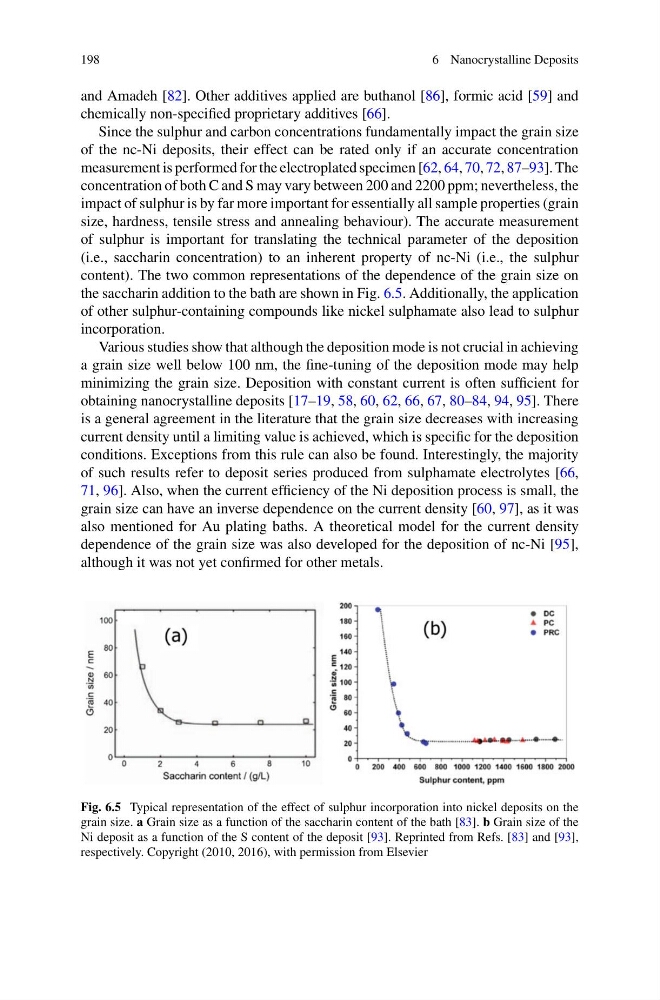
content). The two common representations of the dependence of the grain size on
the saccharin addition to the bath are shown in Fig. 6.5. Additionally, the application
of other sulphur-containing compounds like nickel sulphamate also lead to sulphur
incorporation.
Various studies show that although the deposition mode is not crucial in achieving
a grain size well below 100 nm, the fine-tuning of the deposition mode may help
minimizing the grain size. Deposition with constant current is often sufficient for
obtaining nanocrystalline deposits [17–19, 58, 60, 62, 66, 67, 80–84, 94, 95]. There
is a general agreement in the literature that the grain size decreases with increasing
current density until a limiting value is achieved, which is specific for the deposition
conditions. Exceptions from this rule can also be found. Interestingly, the majority
of such results refer to deposit series produced from sulphamate electrolytes [66,
71, 96]. Also, when the current efficiency of the Ni deposition process is small, the
grain size can have an inverse dependence on the current density [60, 97], as it was
also mentioned for Au plating baths. A theoretical model for the current density
dependence of the grain size was also developed for the deposition of nc-Ni [95],
although it was not yet confirmed for other metals.
Fig. 6.5 Typical representation of the effect of sulphur incorporation into nickel deposits on the
grain size. a Grain size as a function of the saccharin content of the bath [83]. b Grain size of the
Ni deposit as a function of the S content of the deposit [93]. Reprinted from Refs. [83] and [93],
respectively. Copyright (2010, 2016), with permission from Elsevier
6 Nanocrystalline Deposits
and Amadeh [82]. Other additives applied are buthanol [86], formic acid [59] and
chemically non-specified proprietary additives [66].
Since the sulphur and carbon concentrations fundamentally impact the grain size
of the nc-Ni deposits, their effect can be rated only if an accurate concentration
measurement is performed for the electroplated specimen [62, 64, 70, 72, 87–93]. The
concentration of both C and S may vary between 200 and 2200 ppm; nevertheless, the
impact of sulphur is by far more important for essentially all sample properties (grain
size, hardness, tensile stress and annealing behaviour). The accurate measurement
of sulphur is important for translating the technical parameter of the deposition
(i.e., saccharin concentration) to an inherent property of nc-Ni (i.e., the sulphur
content). The two common representations of the dependence of the grain size on
the saccharin addition to the bath are shown in Fig. 6.5. Additionally, the application
of other sulphur-containing compounds like nickel sulphamate also lead to sulphur
incorporation.
Various studies show that although the deposition mode is not crucial in achieving
a grain size well below 100 nm, the fine-tuning of the deposition mode may help
minimizing the grain size. Deposition with constant current is often sufficient for
obtaining nanocrystalline deposits [17–19, 58, 60, 62, 66, 67, 80–84, 94, 95]. There
is a general agreement in the literature that the grain size decreases with increasing
current density until a limiting value is achieved, which is specific for the deposition
conditions. Exceptions from this rule can also be found. Interestingly, the majority
of such results refer to deposit series produced from sulphamate electrolytes [66,
71, 96]. Also, when the current efficiency of the Ni deposition process is small, the
grain size can have an inverse dependence on the current density [60, 97], as it was
also mentioned for Au plating baths. A theoretical model for the current density
dependence of the grain size was also developed for the deposition of nc-Ni [95],
although it was not yet confirmed for other metals.
Fig. 6.5 Typical representation of the effect of sulphur incorporation into nickel deposits on the
grain size. a Grain size as a function of the saccharin content of the bath [83]. b Grain size of the
Ni deposit as a function of the S content of the deposit [93]. Reprinted from Refs. [83] and [93],
respectively. Copyright (2010, 2016), with permission from Elsevier