

196
6 Nanocrystalline Deposits
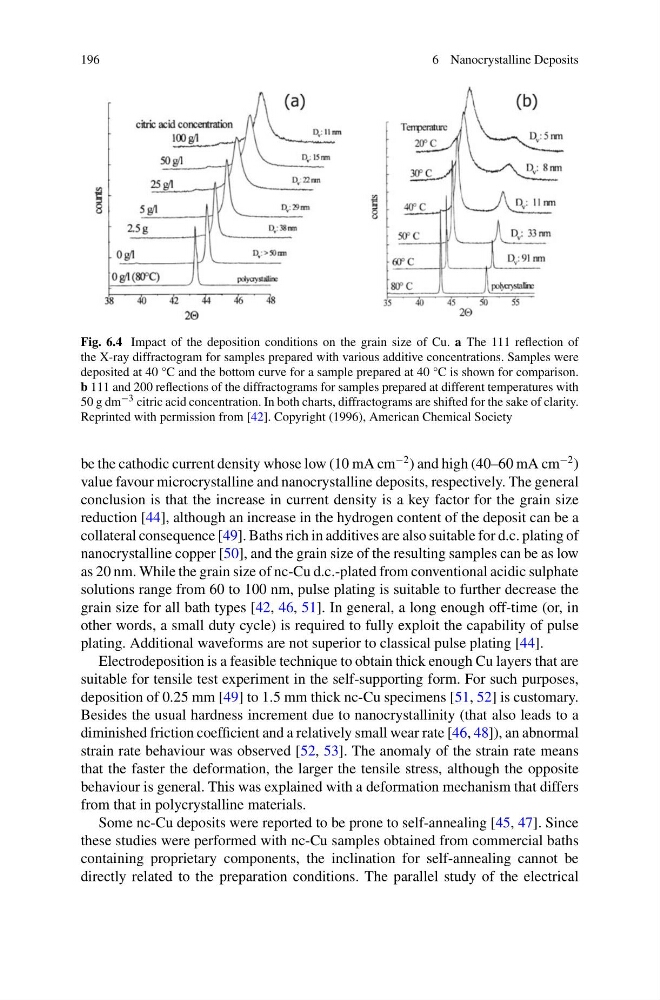
Fig. 6.4 Impact of the deposition conditions on the grain size of Cu. a The 111 reflection of
the X-ray diffractogram for samples prepared with various additive concentrations. Samples were
deposited at 40 °C and the bottom curve for a sample prepared at 40 °C is shown for comparison.
b 111 and 200 reflections of the diffractograms for samples prepared at different temperatures with
50 g dm −3 citric acid concentration. In both charts, diffractograms are shifted for the sake of clarity.
Reprinted with permission from [42]. Copyright (1996), American Chemical Society
be the cathodic current density whose low (10 mA cm
−2 ) and high (40–60 mA cm
−2 )
value favour microcrystalline and nanocrystalline deposits, respectively. The general
conclusion is that the increase in current density is a key factor for the grain size
reduction [44], although an increase in the hydrogen content of the deposit can be a
collateral consequence [49]. Baths rich in additives are also suitable for d.c. plating of
nanocrystalline copper [50], and the grain size of the resulting samples can be as low
as 20 nm. While the grain size of nc-Cu d.c.-plated from conventional acidic sulphate
solutions range from 60 to 100 nm, pulse plating is suitable to further decrease the
grain size for all bath types [42, 46, 51]. In general, a long enough off-time (or, in
other words, a small duty cycle) is required to fully exploit the capability of pulse
plating. Additional waveforms are not superior to classical pulse plating [44].
Electrodeposition is a feasible technique to obtain thick enough Cu layers that are
suitable for tensile test experiment in the self-supporting form. For such purposes,
deposition of 0.25 mm [49] to 1.5 mm thick nc-Cu specimens [51, 52] is customary.
Besides the usual hardness increment due to nanocrystallinity (that also leads to a
diminished friction coefficient and a relatively small wear rate [46, 48]), an abnormal
strain rate behaviour was observed [52, 53]. The anomaly of the strain rate means
that the faster the deformation, the larger the tensile stress, although the opposite
behaviour is general. This was explained with a deformation mechanism that differs
from that in polycrystalline materials.
Some nc-Cu deposits were reported to be prone to self-annealing [45, 47]. Since
these studies were performed with nc-Cu samples obtained from commercial baths
containing proprietary components, the inclination for self-annealing cannot be
directly related to the preparation conditions. The parallel study of the electrical
6 Nanocrystalline Deposits
Fig. 6.4 Impact of the deposition conditions on the grain size of Cu. a The 111 reflection of
the X-ray diffractogram for samples prepared with various additive concentrations. Samples were
deposited at 40 °C and the bottom curve for a sample prepared at 40 °C is shown for comparison.
b 111 and 200 reflections of the diffractograms for samples prepared at different temperatures with
50 g dm −3 citric acid concentration. In both charts, diffractograms are shifted for the sake of clarity.
Reprinted with permission from [42]. Copyright (1996), American Chemical Society
be the cathodic current density whose low (10 mA cm
−2 ) and high (40–60 mA cm
−2 )
value favour microcrystalline and nanocrystalline deposits, respectively. The general
conclusion is that the increase in current density is a key factor for the grain size
reduction [44], although an increase in the hydrogen content of the deposit can be a
collateral consequence [49]. Baths rich in additives are also suitable for d.c. plating of
nanocrystalline copper [50], and the grain size of the resulting samples can be as low
as 20 nm. While the grain size of nc-Cu d.c.-plated from conventional acidic sulphate
solutions range from 60 to 100 nm, pulse plating is suitable to further decrease the
grain size for all bath types [42, 46, 51]. In general, a long enough off-time (or, in
other words, a small duty cycle) is required to fully exploit the capability of pulse
plating. Additional waveforms are not superior to classical pulse plating [44].
Electrodeposition is a feasible technique to obtain thick enough Cu layers that are
suitable for tensile test experiment in the self-supporting form. For such purposes,
deposition of 0.25 mm [49] to 1.5 mm thick nc-Cu specimens [51, 52] is customary.
Besides the usual hardness increment due to nanocrystallinity (that also leads to a
diminished friction coefficient and a relatively small wear rate [46, 48]), an abnormal
strain rate behaviour was observed [52, 53]. The anomaly of the strain rate means
that the faster the deformation, the larger the tensile stress, although the opposite
behaviour is general. This was explained with a deformation mechanism that differs
from that in polycrystalline materials.
Some nc-Cu deposits were reported to be prone to self-annealing [45, 47]. Since
these studies were performed with nc-Cu samples obtained from commercial baths
containing proprietary components, the inclination for self-annealing cannot be
directly related to the preparation conditions. The parallel study of the electrical