

190
6 Nanocrystalline Deposits
Mechanical properties of nanocrystalline materials. A key feature of the
nanocrystalline materials is the hardness enhancement as the grain size decreases.
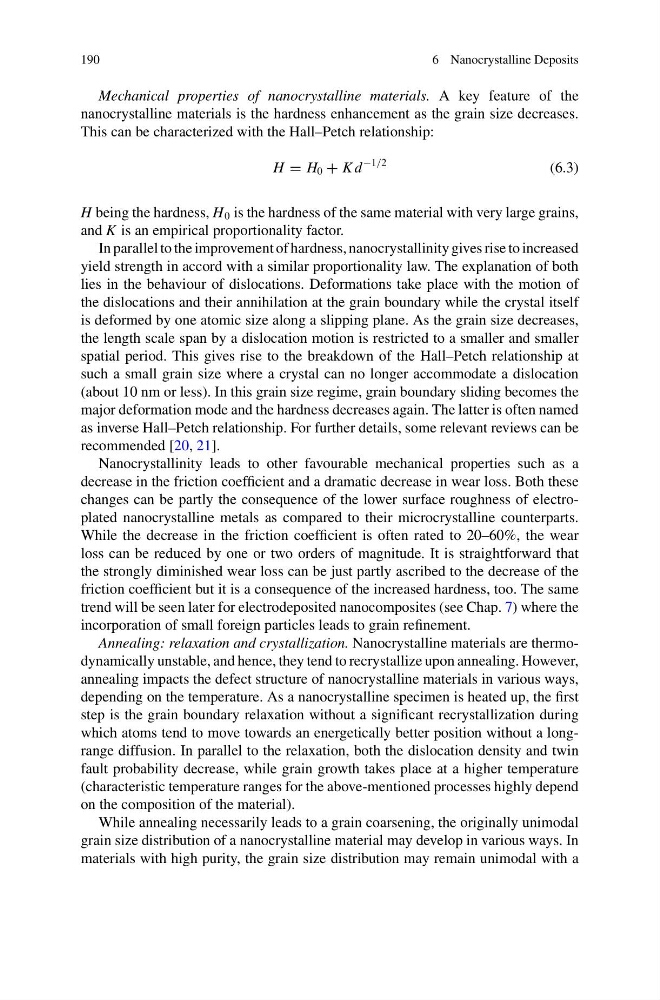
This can be characterized with the Hall–Petch relationship:
H = H 0 + K d
−1/2
(6.3)
H being the hardness, H 0 is the hardness of the same material with very large grains,
and K is an empirical proportionality factor.
In parallel to the improvement of hardness, nanocrystallinity gives rise to increased
yield strength in accord with a similar proportionality law. The explanation of both
lies in the behaviour of dislocations. Deformations take place with the motion of
the dislocations and their annihilation at the grain boundary while the crystal itself
is deformed by one atomic size along a slipping plane. As the grain size decreases,
the length scale span by a dislocation motion is restricted to a smaller and smaller
spatial period. This gives rise to the breakdown of the Hall–Petch relationship at
such a small grain size where a crystal can no longer accommodate a dislocation
(about 10 nm or less). In this grain size regime, grain boundary sliding becomes the
major deformation mode and the hardness decreases again. The latter is often named
as inverse Hall–Petch relationship. For further details, some relevant reviews can be
recommended [20, 21].
Nanocrystallinity leads to other favourable mechanical properties such as a
decrease in the friction coefficient and a dramatic decrease in wear loss. Both these
changes can be partly the consequence of the lower surface roughness of electroplated nanocrystalline metals as compared to their microcrystalline counterparts.
While the decrease in the friction coefficient is often rated to 20–60%, the wear
loss can be reduced by one or two orders of magnitude. It is straightforward that
the strongly diminished wear loss can be just partly ascribed to the decrease of the
friction coefficient but it is a consequence of the increased hardness, too. The same
trend will be seen later for electrodeposited nanocomposites (see Chap. 7) where the
incorporation of small foreign particles leads to grain refinement.
Annealing: relaxation and crystallization. Nanocrystalline materials are thermodynamically unstable, and hence, they tend to recrystallize upon annealing. However,
annealing impacts the defect structure of nanocrystalline materials in various ways,
depending on the temperature. As a nanocrystalline specimen is heated up, the first
step is the grain boundary relaxation without a significant recrystallization during
which atoms tend to move towards an energetically better position without a longrange diffusion. In parallel to the relaxation, both the dislocation density and twin
fault probability decrease, while grain growth takes place at a higher temperature
(characteristic temperature ranges for the above-mentioned processes highly depend
on the composition of the material).
While annealing necessarily leads to a grain coarsening, the originally unimodal
grain size distribution of a nanocrystalline material may develop in various ways. In
materials with high purity, the grain size distribution may remain unimodal with a
6 Nanocrystalline Deposits
Mechanical properties of nanocrystalline materials. A key feature of the
nanocrystalline materials is the hardness enhancement as the grain size decreases.
This can be characterized with the Hall–Petch relationship:
H = H 0 + K d
−1/2
(6.3)
H being the hardness, H 0 is the hardness of the same material with very large grains,
and K is an empirical proportionality factor.
In parallel to the improvement of hardness, nanocrystallinity gives rise to increased
yield strength in accord with a similar proportionality law. The explanation of both
lies in the behaviour of dislocations. Deformations take place with the motion of
the dislocations and their annihilation at the grain boundary while the crystal itself
is deformed by one atomic size along a slipping plane. As the grain size decreases,
the length scale span by a dislocation motion is restricted to a smaller and smaller
spatial period. This gives rise to the breakdown of the Hall–Petch relationship at
such a small grain size where a crystal can no longer accommodate a dislocation
(about 10 nm or less). In this grain size regime, grain boundary sliding becomes the
major deformation mode and the hardness decreases again. The latter is often named
as inverse Hall–Petch relationship. For further details, some relevant reviews can be
recommended [20, 21].
Nanocrystallinity leads to other favourable mechanical properties such as a
decrease in the friction coefficient and a dramatic decrease in wear loss. Both these
changes can be partly the consequence of the lower surface roughness of electroplated nanocrystalline metals as compared to their microcrystalline counterparts.
While the decrease in the friction coefficient is often rated to 20–60%, the wear
loss can be reduced by one or two orders of magnitude. It is straightforward that
the strongly diminished wear loss can be just partly ascribed to the decrease of the
friction coefficient but it is a consequence of the increased hardness, too. The same
trend will be seen later for electrodeposited nanocomposites (see Chap. 7) where the
incorporation of small foreign particles leads to grain refinement.
Annealing: relaxation and crystallization. Nanocrystalline materials are thermodynamically unstable, and hence, they tend to recrystallize upon annealing. However,
annealing impacts the defect structure of nanocrystalline materials in various ways,
depending on the temperature. As a nanocrystalline specimen is heated up, the first
step is the grain boundary relaxation without a significant recrystallization during
which atoms tend to move towards an energetically better position without a longrange diffusion. In parallel to the relaxation, both the dislocation density and twin
fault probability decrease, while grain growth takes place at a higher temperature
(characteristic temperature ranges for the above-mentioned processes highly depend
on the composition of the material).
While annealing necessarily leads to a grain coarsening, the originally unimodal
grain size distribution of a nanocrystalline material may develop in various ways. In
materials with high purity, the grain size distribution may remain unimodal with a