

5.4 Properties of Electrodeposited CMAs
175
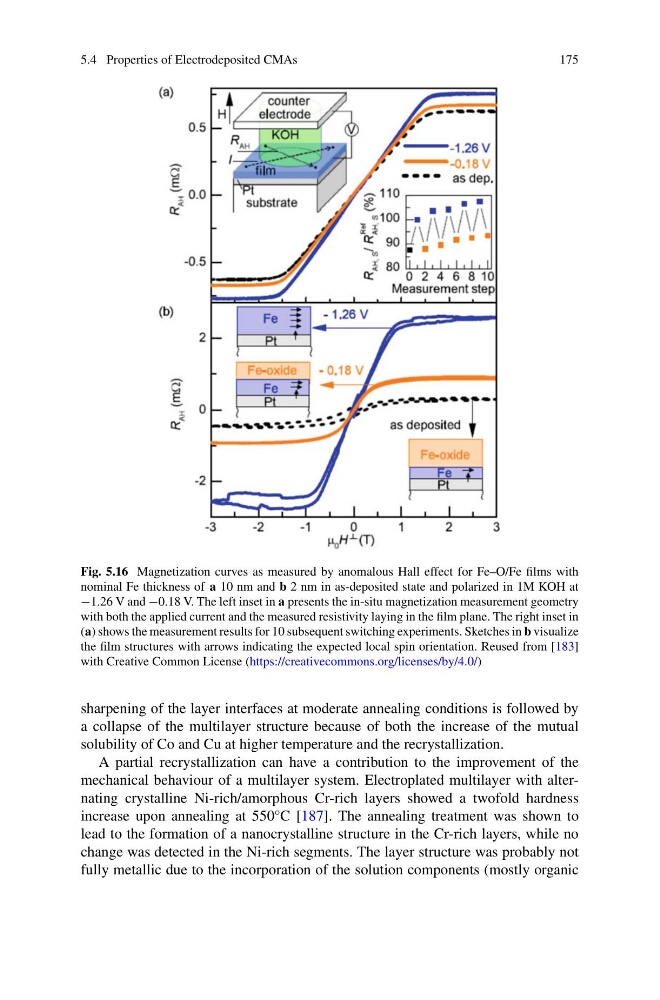
Fig. 5.16 Magnetization curves as measured by anomalous Hall effect for Fe–O/Fe films with
nominal Fe thickness of a 10 nm and b 2 nm in as-deposited state and polarized in 1M KOH at
−1.26 V and −0.18 V. The left inset in a presents the in-situ magnetization measurement geometry
with both the applied current and the measured resistivity laying in the film plane. The right inset in
(a) shows the measurement results for 10 subsequent switching experiments. Sketches in b visualize
the film structures with arrows indicating the expected local spin orientation. Reused from [183]
with Creative Common License (https://creativecommons.org/licenses/by/4.0/)
sharpening of the layer interfaces at moderate annealing conditions is followed by
a collapse of the multilayer structure because of both the increase of the mutual
solubility of Co and Cu at higher temperature and the recrystallization.
A partial recrystallization can have a contribution to the improvement of the
mechanical behaviour of a multilayer system. Electroplated multilayer with alternating crystalline Ni-rich/amorphous Cr-rich layers showed a twofold hardness
increase upon annealing at 550°C [187]. The annealing treatment was shown to
lead to the formation of a nanocrystalline structure in the Cr-rich layers, while no
change was detected in the Ni-rich segments. The layer structure was probably not
fully metallic due to the incorporation of the solution components (mostly organic
175
Fig. 5.16 Magnetization curves as measured by anomalous Hall effect for Fe–O/Fe films with
nominal Fe thickness of a 10 nm and b 2 nm in as-deposited state and polarized in 1M KOH at
−1.26 V and −0.18 V. The left inset in a presents the in-situ magnetization measurement geometry
with both the applied current and the measured resistivity laying in the film plane. The right inset in
(a) shows the measurement results for 10 subsequent switching experiments. Sketches in b visualize
the film structures with arrows indicating the expected local spin orientation. Reused from [183]
with Creative Common License (https://creativecommons.org/licenses/by/4.0/)
sharpening of the layer interfaces at moderate annealing conditions is followed by
a collapse of the multilayer structure because of both the increase of the mutual
solubility of Co and Cu at higher temperature and the recrystallization.
A partial recrystallization can have a contribution to the improvement of the
mechanical behaviour of a multilayer system. Electroplated multilayer with alternating crystalline Ni-rich/amorphous Cr-rich layers showed a twofold hardness
increase upon annealing at 550°C [187]. The annealing treatment was shown to
lead to the formation of a nanocrystalline structure in the Cr-rich layers, while no
change was detected in the Ni-rich segments. The layer structure was probably not
fully metallic due to the incorporation of the solution components (mostly organic