

164
5 Compositionally Modulated and Multilayered Deposits
hardness improved. A hardness plateau was observed when the multilayer structure
could no longer be developed (at 15 nm thickness or lower). It is remarkable that the
coincidence of the multilayer structure with the deviation from the trend observed at
higher layer thicknesses was confirmed here with a TEM study.
5.4.4 Corrosion Properties of Compositionally Modulated
Deposits
The composition modulation technique in coating preparation for corrosion protection was introduced in the 1990s. It was the general experience that multilayered
deposits provide better corrosion protection than even layers with the same mean
composition as the multilayered ones. The advantage of the multilayer structure in
the corrosion resistance is evidenced for sublayers with several micrometre thickness,
too; therefore, the enhanced protection performance for multilayers is unrelated to
any nanoscale phenomenon that cannot be found for larger modulation length scales.
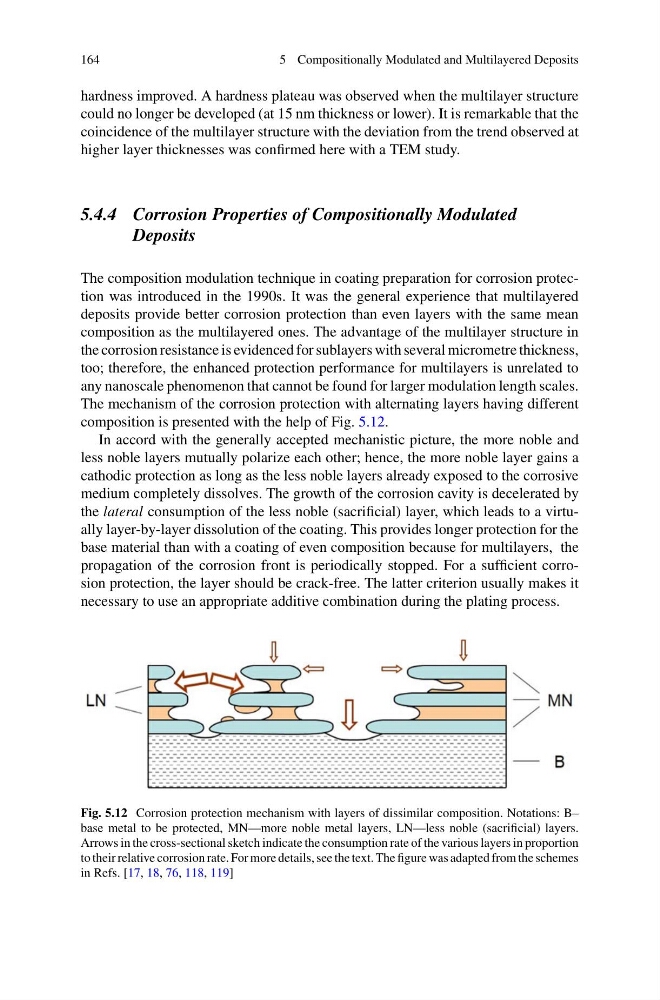
The mechanism of the corrosion protection with alternating layers having different
composition is presented with the help of Fig. 5.12.
In accord with the generally accepted mechanistic picture, the more noble and
less noble layers mutually polarize each other; hence, the more noble layer gains a
cathodic protection as long as the less noble layers already exposed to the corrosive
medium completely dissolves. The growth of the corrosion cavity is decelerated by
the lateral consumption of the less noble (sacrificial) layer, which leads to a virtually layer-by-layer dissolution of the coating. This provides longer protection for the
base material than with a coating of even composition because for multilayers, the
propagation of the corrosion front is periodically stopped. For a sufficient corrosion protection, the layer should be crack-free. The latter criterion usually makes it
necessary to use an appropriate additive combination during the plating process.
Fig. 5.12 Corrosion protection mechanism with layers of dissimilar composition. Notations: B–
base metal to be protected, MN—more noble metal layers, LN—less noble (sacrificial) layers.
Arrows in the cross-sectional sketch indicate the consumption rate of the various layers in proportion
to their relative corrosion rate. For more details, see the text. The figure was adapted from the schemes
in Refs. [17, 18, 76, 118, 119]
5 Compositionally Modulated and Multilayered Deposits
hardness improved. A hardness plateau was observed when the multilayer structure
could no longer be developed (at 15 nm thickness or lower). It is remarkable that the
coincidence of the multilayer structure with the deviation from the trend observed at
higher layer thicknesses was confirmed here with a TEM study.
5.4.4 Corrosion Properties of Compositionally Modulated
Deposits
The composition modulation technique in coating preparation for corrosion protection was introduced in the 1990s. It was the general experience that multilayered
deposits provide better corrosion protection than even layers with the same mean
composition as the multilayered ones. The advantage of the multilayer structure in
the corrosion resistance is evidenced for sublayers with several micrometre thickness,
too; therefore, the enhanced protection performance for multilayers is unrelated to
any nanoscale phenomenon that cannot be found for larger modulation length scales.
The mechanism of the corrosion protection with alternating layers having different
composition is presented with the help of Fig. 5.12.
In accord with the generally accepted mechanistic picture, the more noble and
less noble layers mutually polarize each other; hence, the more noble layer gains a
cathodic protection as long as the less noble layers already exposed to the corrosive
medium completely dissolves. The growth of the corrosion cavity is decelerated by
the lateral consumption of the less noble (sacrificial) layer, which leads to a virtually layer-by-layer dissolution of the coating. This provides longer protection for the
base material than with a coating of even composition because for multilayers, the
propagation of the corrosion front is periodically stopped. For a sufficient corrosion protection, the layer should be crack-free. The latter criterion usually makes it
necessary to use an appropriate additive combination during the plating process.
Fig. 5.12 Corrosion protection mechanism with layers of dissimilar composition. Notations: B–
base metal to be protected, MN—more noble metal layers, LN—less noble (sacrificial) layers.
Arrows in the cross-sectional sketch indicate the consumption rate of the various layers in proportion
to their relative corrosion rate. For more details, see the text. The figure was adapted from the schemes
in Refs. [17, 18, 76, 118, 119]