

152
5 Compositionally Modulated and Multilayered Deposits
modulation can be even along the electrode surface. This method has been demonstrated for protective coating composed of Ni–Co [76] and Ni–Sn [77] alloys. Due
to the relative simplicity of the ultrasonic agitation, this method is foreseen to have
bright prospects, especially if the layer thicknesses do not have to be maintained
highly uniform.
5.4 Properties of Electrodeposited CMAs
5.4.1 Composition Variation in Ultrathin Electrodeposited
Alloy Layers
Metal deposition as ultrathin layers discussed in Chap. 4.3 referred mostly to pure
metals. In that case, the metal ion concentration was higher than a few millimole
per litre, and the deposition of the ultrathin layers was not mass transport controlled.
The choice of single-component deposits in the implementation of the observation
technique (such as in situ STM or magnetometry for metal deposition) is a natural
choice in general. Ultrathin alloy layers discussed in Chap. 4.3 were produced with
extremely dilute solutions, and the deposition of both components was diffusioncontrolled from practically the formation of the first atomic layer. In this chapter,
a feature of the alloy deposition process will be presented that would make it very
difficult to characterize nanoscale alloy layers produced with conventional plating
solutions due to the uncertainty in the composition and in the component distribution
of the resulting deposits. First, regular codeposition will be characterized, and then
the composition depth profile generally occurring for any alloy plating system will
be given.
The peculiar feature of the regular codeposition is that the MN metal can be
deposited without the contamination of the LN metal. Hence, if the deposition of an
LN/MN metal pair is started with a fixed current, the MN metal will be deposited
first as long as its transport rate is high enough for accounting the current applied
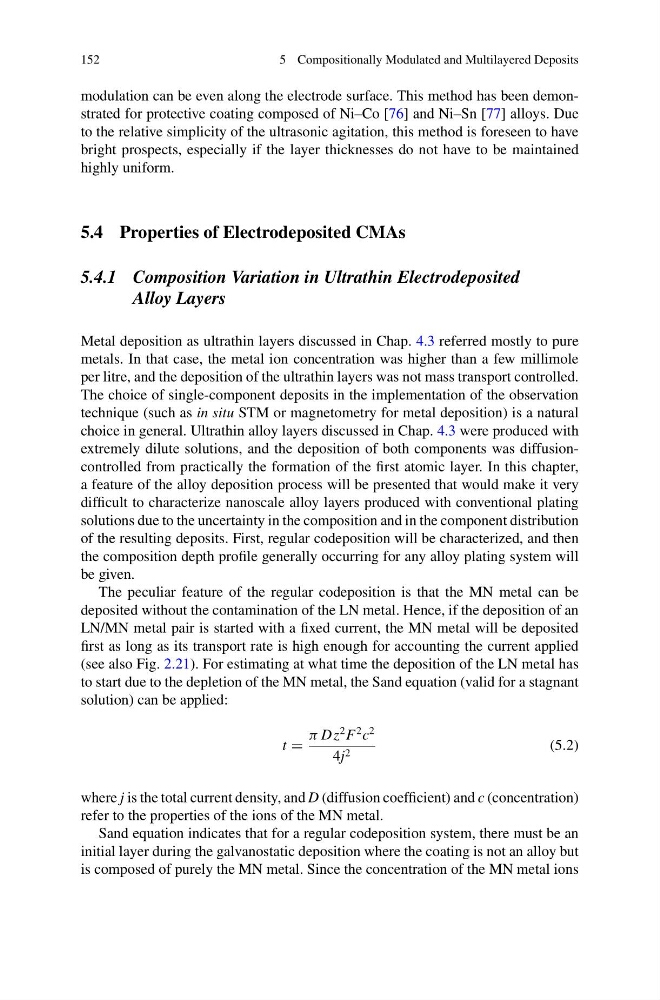
(see also Fig. 2.21). For estimating at what time the deposition of the LN metal has
to start due to the depletion of the MN metal, the Sand equation (valid for a stagnant
solution) can be applied:
t =
π D z
2 F
2 c
2
4j 2
(5.2)
where j is the total current density, and D (diffusion coefficient) and c (concentration)
refer to the properties of the ions of the MN metal.
Sand equation indicates that for a regular codeposition system, there must be an
initial layer during the galvanostatic deposition where the coating is not an alloy but
is composed of purely the MN metal. Since the concentration of the MN metal ions
5 Compositionally Modulated and Multilayered Deposits
modulation can be even along the electrode surface. This method has been demonstrated for protective coating composed of Ni–Co [76] and Ni–Sn [77] alloys. Due
to the relative simplicity of the ultrasonic agitation, this method is foreseen to have
bright prospects, especially if the layer thicknesses do not have to be maintained
highly uniform.
5.4 Properties of Electrodeposited CMAs
5.4.1 Composition Variation in Ultrathin Electrodeposited
Alloy Layers
Metal deposition as ultrathin layers discussed in Chap. 4.3 referred mostly to pure
metals. In that case, the metal ion concentration was higher than a few millimole
per litre, and the deposition of the ultrathin layers was not mass transport controlled.
The choice of single-component deposits in the implementation of the observation
technique (such as in situ STM or magnetometry for metal deposition) is a natural
choice in general. Ultrathin alloy layers discussed in Chap. 4.3 were produced with
extremely dilute solutions, and the deposition of both components was diffusioncontrolled from practically the formation of the first atomic layer. In this chapter,
a feature of the alloy deposition process will be presented that would make it very
difficult to characterize nanoscale alloy layers produced with conventional plating
solutions due to the uncertainty in the composition and in the component distribution
of the resulting deposits. First, regular codeposition will be characterized, and then
the composition depth profile generally occurring for any alloy plating system will
be given.
The peculiar feature of the regular codeposition is that the MN metal can be
deposited without the contamination of the LN metal. Hence, if the deposition of an
LN/MN metal pair is started with a fixed current, the MN metal will be deposited
first as long as its transport rate is high enough for accounting the current applied
(see also Fig. 2.21). For estimating at what time the deposition of the LN metal has
to start due to the depletion of the MN metal, the Sand equation (valid for a stagnant
solution) can be applied:
t =
π D z
2 F
2 c
2
4j 2
(5.2)
where j is the total current density, and D (diffusion coefficient) and c (concentration)
refer to the properties of the ions of the MN metal.
Sand equation indicates that for a regular codeposition system, there must be an
initial layer during the galvanostatic deposition where the coating is not an alloy but
is composed of purely the MN metal. Since the concentration of the MN metal ions