

5.3 The Single-Bath Method
145
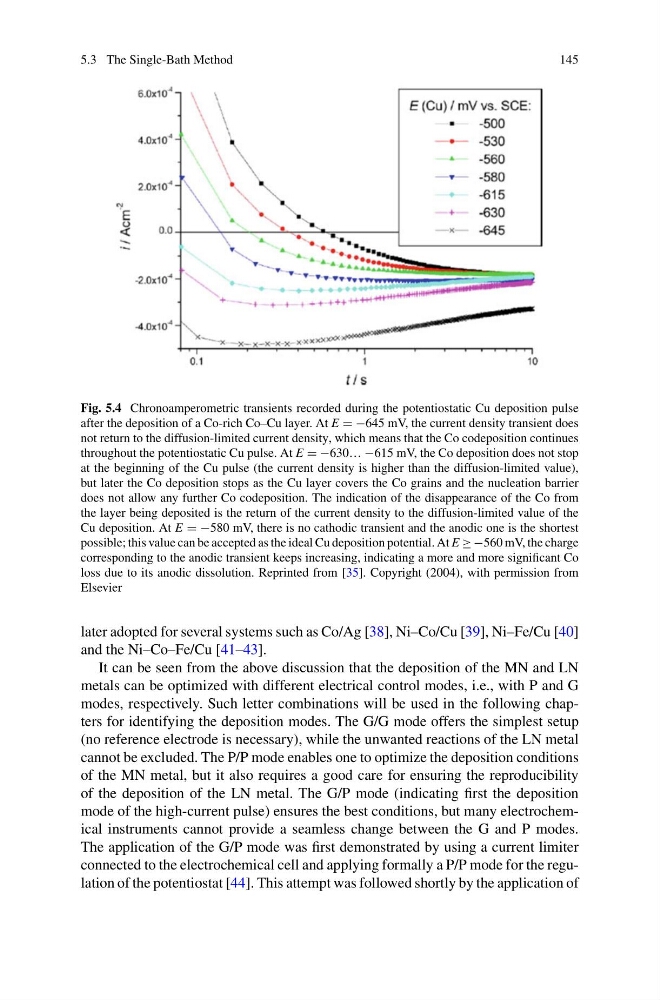
Fig. 5.4 Chronoamperometric transients recorded during the potentiostatic Cu deposition pulse
after the deposition of a Co-rich Co–Cu layer. At E = −645 mV, the current density transient does
not return to the diffusion-limited current density, which means that the Co codeposition continues
throughout the potentiostatic Cu pulse. At E = −630… −615 mV, the Co deposition does not stop
at the beginning of the Cu pulse (the current density is higher than the diffusion-limited value),
but later the Co deposition stops as the Cu layer covers the Co grains and the nucleation barrier
does not allow any further Co codeposition. The indication of the disappearance of the Co from
the layer being deposited is the return of the current density to the diffusion-limited value of the
Cu deposition. At E = −580 mV, there is no cathodic transient and the anodic one is the shortest
possible; this value can be accepted as the ideal Cu deposition potential. At E ≥ −560 mV, the charge
corresponding to the anodic transient keeps increasing, indicating a more and more significant Co
loss due to its anodic dissolution. Reprinted from [35]. Copyright (2004), with permission from
Elsevier
later adopted for several systems such as Co/Ag [38], Ni–Co/Cu [39], Ni–Fe/Cu [40]
and the Ni–Co–Fe/Cu [41–43].
It can be seen from the above discussion that the deposition of the MN and LN
metals can be optimized with different electrical control modes, i.e., with P and G
modes, respectively. Such letter combinations will be used in the following chapters for identifying the deposition modes. The G/G mode offers the simplest setup
(no reference electrode is necessary), while the unwanted reactions of the LN metal
cannot be excluded. The P/P mode enables one to optimize the deposition conditions
of the MN metal, but it also requires a good care for ensuring the reproducibility
of the deposition of the LN metal. The G/P mode (indicating first the deposition
mode of the high-current pulse) ensures the best conditions, but many electrochemical instruments cannot provide a seamless change between the G and P modes.
The application of the G/P mode was first demonstrated by using a current limiter
connected to the electrochemical cell and applying formally a P/P mode for the regulation of the potentiostat [44]. This attempt was followed shortly by the application of
145
Fig. 5.4 Chronoamperometric transients recorded during the potentiostatic Cu deposition pulse
after the deposition of a Co-rich Co–Cu layer. At E = −645 mV, the current density transient does
not return to the diffusion-limited current density, which means that the Co codeposition continues
throughout the potentiostatic Cu pulse. At E = −630… −615 mV, the Co deposition does not stop
at the beginning of the Cu pulse (the current density is higher than the diffusion-limited value),
but later the Co deposition stops as the Cu layer covers the Co grains and the nucleation barrier
does not allow any further Co codeposition. The indication of the disappearance of the Co from
the layer being deposited is the return of the current density to the diffusion-limited value of the
Cu deposition. At E = −580 mV, there is no cathodic transient and the anodic one is the shortest
possible; this value can be accepted as the ideal Cu deposition potential. At E ≥ −560 mV, the charge
corresponding to the anodic transient keeps increasing, indicating a more and more significant Co
loss due to its anodic dissolution. Reprinted from [35]. Copyright (2004), with permission from
Elsevier
later adopted for several systems such as Co/Ag [38], Ni–Co/Cu [39], Ni–Fe/Cu [40]
and the Ni–Co–Fe/Cu [41–43].
It can be seen from the above discussion that the deposition of the MN and LN
metals can be optimized with different electrical control modes, i.e., with P and G
modes, respectively. Such letter combinations will be used in the following chapters for identifying the deposition modes. The G/G mode offers the simplest setup
(no reference electrode is necessary), while the unwanted reactions of the LN metal
cannot be excluded. The P/P mode enables one to optimize the deposition conditions
of the MN metal, but it also requires a good care for ensuring the reproducibility
of the deposition of the LN metal. The G/P mode (indicating first the deposition
mode of the high-current pulse) ensures the best conditions, but many electrochemical instruments cannot provide a seamless change between the G and P modes.
The application of the G/P mode was first demonstrated by using a current limiter
connected to the electrochemical cell and applying formally a P/P mode for the regulation of the potentiostat [44]. This attempt was followed shortly by the application of