

138
5 Compositionally Modulated and Multilayered Deposits
An interesting combination of the double-bath and single-bath methods was
applied for plating [Cu/Co/Cu/Ni–Fe] N multilayers [29]. The two baths used were
as follows. One bath was optimized for the deposition of the Ni–Fe layer to obtain
the low-coercivity material Ni 80 Fe 20 (Permalloy) without either Co or Cu impurity.
The typical thickness of this layer was only 2.8 nm. The second bath contained the
Co and Cu salts from which pure Cu and a Co-rich Co–Cu alloy could be deposited.
The Cu layer thickness was 3.6 nm, and it could protect the Co-rich layer during the
immersion process. The major goal was the deposition of well-separated magnetic
layers with strongly different coercivity.
5.2.3 Cell Configurations with a Rotating Cathode
The alternating immersion variant of the multiple-bath method can be improved by
avoiding the removal of the cathode from the liquid and retaining the alternating
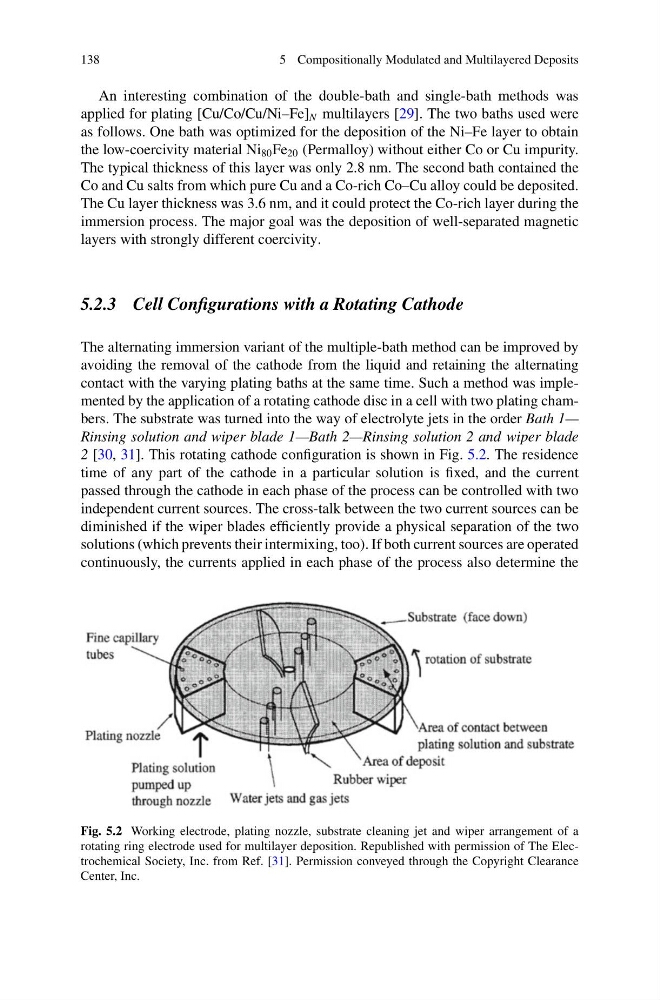
contact with the varying plating baths at the same time. Such a method was implemented by the application of a rotating cathode disc in a cell with two plating chambers. The substrate was turned into the way of electrolyte jets in the order Bath 1—
Rinsing solution and wiper blade 1—Bath 2—Rinsing solution 2 and wiper blade
2 [30, 31]. This rotating cathode configuration is shown in Fig. 5.2. The residence
time of any part of the cathode in a particular solution is fixed, and the current
passed through the cathode in each phase of the process can be controlled with two
independent current sources. The cross-talk between the two current sources can be
diminished if the wiper blades efficiently provide a physical separation of the two
solutions (which prevents their intermixing, too). If both current sources are operated
continuously, the currents applied in each phase of the process also determine the
Fig. 5.2 Working electrode, plating nozzle, substrate cleaning jet and wiper arrangement of a
rotating ring electrode used for multilayer deposition. Republished with permission of The Electrochemical Society, Inc. from Ref. [31]. Permission conveyed through the Copyright Clearance
Center, Inc.
5 Compositionally Modulated and Multilayered Deposits
An interesting combination of the double-bath and single-bath methods was
applied for plating [Cu/Co/Cu/Ni–Fe] N multilayers [29]. The two baths used were
as follows. One bath was optimized for the deposition of the Ni–Fe layer to obtain
the low-coercivity material Ni 80 Fe 20 (Permalloy) without either Co or Cu impurity.
The typical thickness of this layer was only 2.8 nm. The second bath contained the
Co and Cu salts from which pure Cu and a Co-rich Co–Cu alloy could be deposited.
The Cu layer thickness was 3.6 nm, and it could protect the Co-rich layer during the
immersion process. The major goal was the deposition of well-separated magnetic
layers with strongly different coercivity.
5.2.3 Cell Configurations with a Rotating Cathode
The alternating immersion variant of the multiple-bath method can be improved by
avoiding the removal of the cathode from the liquid and retaining the alternating
contact with the varying plating baths at the same time. Such a method was implemented by the application of a rotating cathode disc in a cell with two plating chambers. The substrate was turned into the way of electrolyte jets in the order Bath 1—
Rinsing solution and wiper blade 1—Bath 2—Rinsing solution 2 and wiper blade
2 [30, 31]. This rotating cathode configuration is shown in Fig. 5.2. The residence
time of any part of the cathode in a particular solution is fixed, and the current
passed through the cathode in each phase of the process can be controlled with two
independent current sources. The cross-talk between the two current sources can be
diminished if the wiper blades efficiently provide a physical separation of the two
solutions (which prevents their intermixing, too). If both current sources are operated
continuously, the currents applied in each phase of the process also determine the
Fig. 5.2 Working electrode, plating nozzle, substrate cleaning jet and wiper arrangement of a
rotating ring electrode used for multilayer deposition. Republished with permission of The Electrochemical Society, Inc. from Ref. [31]. Permission conveyed through the Copyright Clearance
Center, Inc.