

4.3 Non-UPD Deposition of Ultrathin Metallic Layers
111
c
a
b
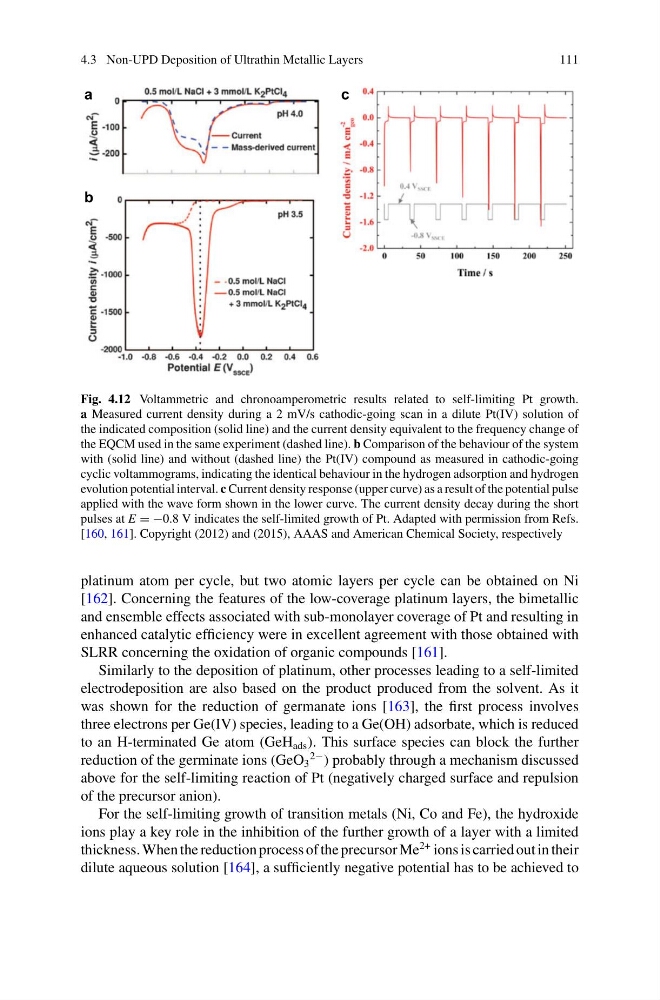
Fig. 4.12 Voltammetric and chronoamperometric results related to self-limiting Pt growth.
a Measured current density during a 2 mV/s cathodic-going scan in a dilute Pt(IV) solution of
the indicated composition (solid line) and the current density equivalent to the frequency change of
the EQCM used in the same experiment (dashed line). b Comparison of the behaviour of the system
with (solid line) and without (dashed line) the Pt(IV) compound as measured in cathodic-going
cyclic voltammograms, indicating the identical behaviour in the hydrogen adsorption and hydrogen
evolution potential interval. c Current density response (upper curve) as a result of the potential pulse
applied with the wave form shown in the lower curve. The current density decay during the short
pulses at E = −0.8 V indicates the self-limited growth of Pt. Adapted with permission from Refs.
[160, 161]. Copyright (2012) and (2015), AAAS and American Chemical Society, respectively
platinum atom per cycle, but two atomic layers per cycle can be obtained on Ni
[162]. Concerning the features of the low-coverage platinum layers, the bimetallic
and ensemble effects associated with sub-monolayer coverage of Pt and resulting in
enhanced catalytic efficiency were in excellent agreement with those obtained with
SLRR concerning the oxidation of organic compounds [161].
Similarly to the deposition of platinum, other processes leading to a self-limited
electrodeposition are also based on the product produced from the solvent. As it
was shown for the reduction of germanate ions [163], the first process involves
three electrons per Ge(IV) species, leading to a Ge(OH) adsorbate, which is reduced
to an H-terminated Ge atom (GeH ads ). This surface species can block the further
reduction of the germinate ions (GeO 3
2− ) probably through a mechanism discussed
above for the self-limiting reaction of Pt (negatively charged surface and repulsion
of the precursor anion).
For the self-limiting growth of transition metals (Ni, Co and Fe), the hydroxide
ions play a key role in the inhibition of the further growth of a layer with a limited
thickness. When the reduction process of the precursor Me
2+ ions is carried out in their
dilute aqueous solution [164], a sufficiently negative potential has to be achieved to
111
c
a
b
Fig. 4.12 Voltammetric and chronoamperometric results related to self-limiting Pt growth.
a Measured current density during a 2 mV/s cathodic-going scan in a dilute Pt(IV) solution of
the indicated composition (solid line) and the current density equivalent to the frequency change of
the EQCM used in the same experiment (dashed line). b Comparison of the behaviour of the system
with (solid line) and without (dashed line) the Pt(IV) compound as measured in cathodic-going
cyclic voltammograms, indicating the identical behaviour in the hydrogen adsorption and hydrogen
evolution potential interval. c Current density response (upper curve) as a result of the potential pulse
applied with the wave form shown in the lower curve. The current density decay during the short
pulses at E = −0.8 V indicates the self-limited growth of Pt. Adapted with permission from Refs.
[160, 161]. Copyright (2012) and (2015), AAAS and American Chemical Society, respectively
platinum atom per cycle, but two atomic layers per cycle can be obtained on Ni
[162]. Concerning the features of the low-coverage platinum layers, the bimetallic
and ensemble effects associated with sub-monolayer coverage of Pt and resulting in
enhanced catalytic efficiency were in excellent agreement with those obtained with
SLRR concerning the oxidation of organic compounds [161].
Similarly to the deposition of platinum, other processes leading to a self-limited
electrodeposition are also based on the product produced from the solvent. As it
was shown for the reduction of germanate ions [163], the first process involves
three electrons per Ge(IV) species, leading to a Ge(OH) adsorbate, which is reduced
to an H-terminated Ge atom (GeH ads ). This surface species can block the further
reduction of the germinate ions (GeO 3
2− ) probably through a mechanism discussed
above for the self-limiting reaction of Pt (negatively charged surface and repulsion
of the precursor anion).
For the self-limiting growth of transition metals (Ni, Co and Fe), the hydroxide
ions play a key role in the inhibition of the further growth of a layer with a limited
thickness. When the reduction process of the precursor Me
2+ ions is carried out in their
dilute aqueous solution [164], a sufficiently negative potential has to be achieved to