

4.2 Combination of UPD with Other Surface-Area-Limited Processes
107
4.2.4 Application of SLRR Deposits
The major motivation to study SLRR processes has been the efficient utilization
of noble metals as catalyst since the invention of the technique. On the one hand,
heterogeneous catalysts must always exhibit a surface layer of favourable catalytic
properties, irrespectively of the bulk composition. Hence, the most efficient application of a relatively expensive catalyst is its deposition as a monoatomic surface
layer. This is exactly what SLRR does. On the other hand, however, a monoatomic
coverage of a substrate material with foreign guest atoms creates a different environment at the atomic scale from the bulk catalyst. Therefore, catalytic properties
can also be tuned with a proper substrate–guest atom match, creating catalysts that
cannot exist in the bulk form.
It is an important feature of the SLRR process that even sub-monolayer coverage
can be achieved that is very hard to create by direct d.c. deposition methods. The
control of the coverage of the sacrificial UPD layer (through its deposition potential)
is a convenient manner to carry out such a regulation [130, 132, 141]. It was found
that catalysts with such sub-monolayer thickness have different catalytic effects than
the bulk counterparts of the same materials; moreover, the catalytic activity in the
ultralow coverage state is outstanding as compared to the bulk form. Such effects
were found for the oxidation of methanol [130, 141], formic acid [112, 124] and
ethanol [131] and for the reduction of oxygen [134] on sub-monolayer Pt or Pd
SLRR films. In a similar manner, a sub-monolayer Pt SLRR layer enhanced the
hydrogen adsorption–desorption rate of Pd films (that were also obtained with the
SLRR route) [17]. It is interesting to note that not only a sub-monolayer Pt coverage
on Au can yield an excellent catalytic activity but vice versa; i.e., a sub-monolayerthick Au deposit can also enhance the catalytic activity of Pt [138]. This again points
out the complex nature of the atomic-scale interaction in catalysis.
The SLRR process is applicable not only for ultrathin layer formation from one
element but also for the preparation of a mixed layer if the process has the suitable
stoichiometry. This was exploited for the preparation of mixed Pd–Pt layers [151].
In the first step, Au was covered with a Pt layer of sub-monolayer coverage by taking
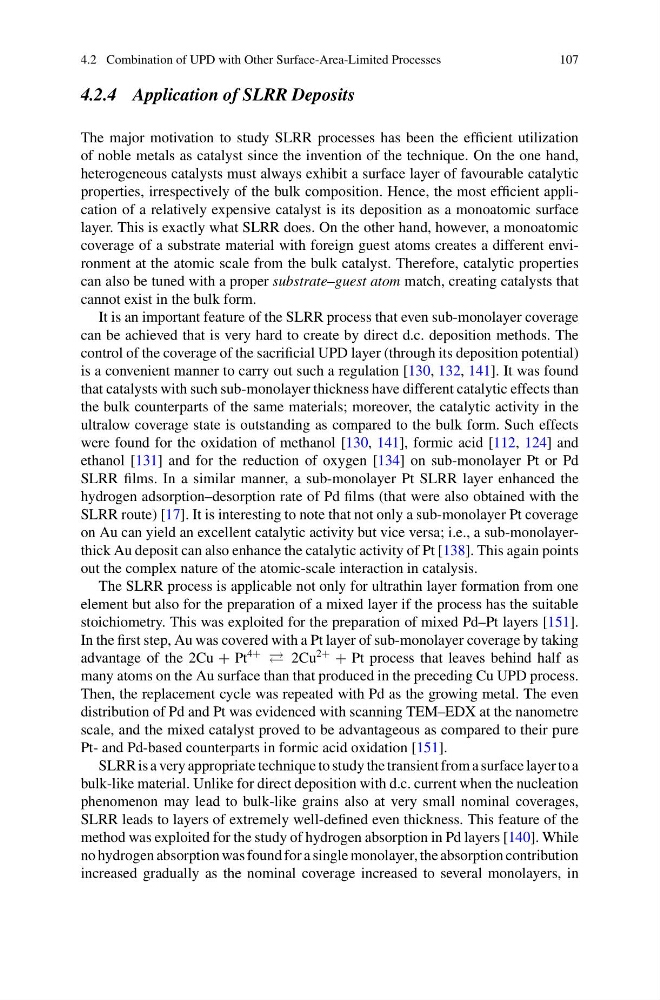
advantage of the 2Cu + Pt
4+
2Cu
2+
+ Pt process that leaves behind half as
many atoms on the Au surface than that produced in the preceding Cu UPD process.
Then, the replacement cycle was repeated with Pd as the growing metal. The even
distribution of Pd and Pt was evidenced with scanning TEM–EDX at the nanometre
scale, and the mixed catalyst proved to be advantageous as compared to their pure
Pt- and Pd-based counterparts in formic acid oxidation [151].
SLRR is a very appropriate technique to study the transient from a surface layer to a
bulk-like material. Unlike for direct deposition with d.c. current when the nucleation
phenomenon may lead to bulk-like grains also at very small nominal coverages,
SLRR leads to layers of extremely well-defined even thickness. This feature of the
method was exploited for the study of hydrogen absorption in Pd layers [140]. While
no hydrogen absorption was found for a single monolayer, the absorption contribution
increased gradually as the nominal coverage increased to several monolayers, in
107
4.2.4 Application of SLRR Deposits
The major motivation to study SLRR processes has been the efficient utilization
of noble metals as catalyst since the invention of the technique. On the one hand,
heterogeneous catalysts must always exhibit a surface layer of favourable catalytic
properties, irrespectively of the bulk composition. Hence, the most efficient application of a relatively expensive catalyst is its deposition as a monoatomic surface
layer. This is exactly what SLRR does. On the other hand, however, a monoatomic
coverage of a substrate material with foreign guest atoms creates a different environment at the atomic scale from the bulk catalyst. Therefore, catalytic properties
can also be tuned with a proper substrate–guest atom match, creating catalysts that
cannot exist in the bulk form.
It is an important feature of the SLRR process that even sub-monolayer coverage
can be achieved that is very hard to create by direct d.c. deposition methods. The
control of the coverage of the sacrificial UPD layer (through its deposition potential)
is a convenient manner to carry out such a regulation [130, 132, 141]. It was found
that catalysts with such sub-monolayer thickness have different catalytic effects than
the bulk counterparts of the same materials; moreover, the catalytic activity in the
ultralow coverage state is outstanding as compared to the bulk form. Such effects
were found for the oxidation of methanol [130, 141], formic acid [112, 124] and
ethanol [131] and for the reduction of oxygen [134] on sub-monolayer Pt or Pd
SLRR films. In a similar manner, a sub-monolayer Pt SLRR layer enhanced the
hydrogen adsorption–desorption rate of Pd films (that were also obtained with the
SLRR route) [17]. It is interesting to note that not only a sub-monolayer Pt coverage
on Au can yield an excellent catalytic activity but vice versa; i.e., a sub-monolayerthick Au deposit can also enhance the catalytic activity of Pt [138]. This again points
out the complex nature of the atomic-scale interaction in catalysis.
The SLRR process is applicable not only for ultrathin layer formation from one
element but also for the preparation of a mixed layer if the process has the suitable
stoichiometry. This was exploited for the preparation of mixed Pd–Pt layers [151].
In the first step, Au was covered with a Pt layer of sub-monolayer coverage by taking
advantage of the 2Cu + Pt
4+
2Cu
2+
+ Pt process that leaves behind half as
many atoms on the Au surface than that produced in the preceding Cu UPD process.
Then, the replacement cycle was repeated with Pd as the growing metal. The even
distribution of Pd and Pt was evidenced with scanning TEM–EDX at the nanometre
scale, and the mixed catalyst proved to be advantageous as compared to their pure
Pt- and Pd-based counterparts in formic acid oxidation [151].
SLRR is a very appropriate technique to study the transient from a surface layer to a
bulk-like material. Unlike for direct deposition with d.c. current when the nucleation
phenomenon may lead to bulk-like grains also at very small nominal coverages,
SLRR leads to layers of extremely well-defined even thickness. This feature of the
method was exploited for the study of hydrogen absorption in Pd layers [140]. While
no hydrogen absorption was found for a single monolayer, the absorption contribution
increased gradually as the nominal coverage increased to several monolayers, in