

Optimal Auxiliary Functions Method for Nonlinear Vibration …
53
A novel procedure based on the Sturm’s theorem for real-valued polynomials is
developed by Omarov et al. [13] to predict and identify periodic and non-periodic
solutions for a grapheme-based MEMS lumped parameter model with general initial
conditions. The procedure is supplemented numerically by using Python codes.
Skrzypacz et al. [14] presented bifurcation analysis of dynamic pull-in for a lumped
model. The restoring force of the spring is derived based on the nonlinear constitutive
stress–strain law, and the driving force of the mass attached to the spring is based on
the electrostatic Coulomb force, respectively.
In the present work, we have obtained an approximate analytical solution for the
nonlinear vibrations of doubly clamped nanobeam taking into account the Casimir
force. For this purpose, we apply the optimal auxiliary functions method in a proper
manner. Our technique does not contain restrictive hypotheses and is very rapidly
convergent, after the first iteration. The approximate solutions are nearly identical
with numerical integration results obtained by means of a fourth-order Runge–Kutta
method.
2 Nonlinear Equation for Nanobeam
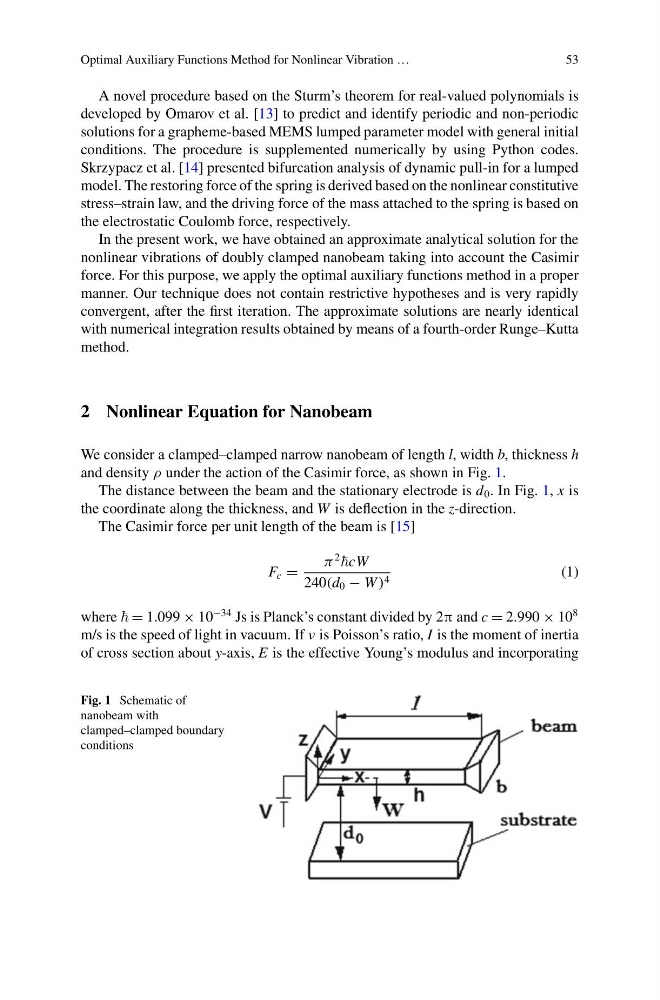
We consider a clamped–clamped narrow nanobeam of length l, width b, thickness h
and density ρ under the action of the Casimir force, as shown in Fig. 1.
The distance between the beam and the stationary electrode is d 0 . In Fig. 1, x is
the coordinate along the thickness, and W is deflection in the z-direction.
The Casimir force per unit length of the beam is [15]
F c =
π
2
cW
240(d 0 − W ) 4
(1)
where = 1.099 × 10
−34 Js is Planck’s constant divided by 2π and c = 2.990 × 10
8
m/s is the speed of light in vacuum. If ν is Poisson’s ratio, I is the moment of inertia
of cross section about y-axis, E is the effective Young’s modulus and incorporating
Fig. 1 Schematic of
nanobeam with
clamped–clamped boundary
conditions
53
A novel procedure based on the Sturm’s theorem for real-valued polynomials is
developed by Omarov et al. [13] to predict and identify periodic and non-periodic
solutions for a grapheme-based MEMS lumped parameter model with general initial
conditions. The procedure is supplemented numerically by using Python codes.
Skrzypacz et al. [14] presented bifurcation analysis of dynamic pull-in for a lumped
model. The restoring force of the spring is derived based on the nonlinear constitutive
stress–strain law, and the driving force of the mass attached to the spring is based on
the electrostatic Coulomb force, respectively.
In the present work, we have obtained an approximate analytical solution for the
nonlinear vibrations of doubly clamped nanobeam taking into account the Casimir
force. For this purpose, we apply the optimal auxiliary functions method in a proper
manner. Our technique does not contain restrictive hypotheses and is very rapidly
convergent, after the first iteration. The approximate solutions are nearly identical
with numerical integration results obtained by means of a fourth-order Runge–Kutta
method.
2 Nonlinear Equation for Nanobeam
We consider a clamped–clamped narrow nanobeam of length l, width b, thickness h
and density ρ under the action of the Casimir force, as shown in Fig. 1.
The distance between the beam and the stationary electrode is d 0 . In Fig. 1, x is
the coordinate along the thickness, and W is deflection in the z-direction.
The Casimir force per unit length of the beam is [15]
F c =
π
2
cW
240(d 0 − W ) 4
(1)
where = 1.099 × 10
−34 Js is Planck’s constant divided by 2π and c = 2.990 × 10
8
m/s is the speed of light in vacuum. If ν is Poisson’s ratio, I is the moment of inertia
of cross section about y-axis, E is the effective Young’s modulus and incorporating
Fig. 1 Schematic of
nanobeam with
clamped–clamped boundary
conditions