

36
L. Cveticanin and D. Cveticanin
averaged equations follow
˙
A
A
= −
1
α + 3
dM
M
, ˙
θ = 0
(63)
Integrating the relations, it is obtained
A = A(0)
M(0)
M
1
α+3 ,
(64)
ψ = θ (0) + A(0)
α−1
2
t
∫
0
M(0)
M
α−1
2(α+3)
α + 1
2
k
M(τ )
dt
(65)
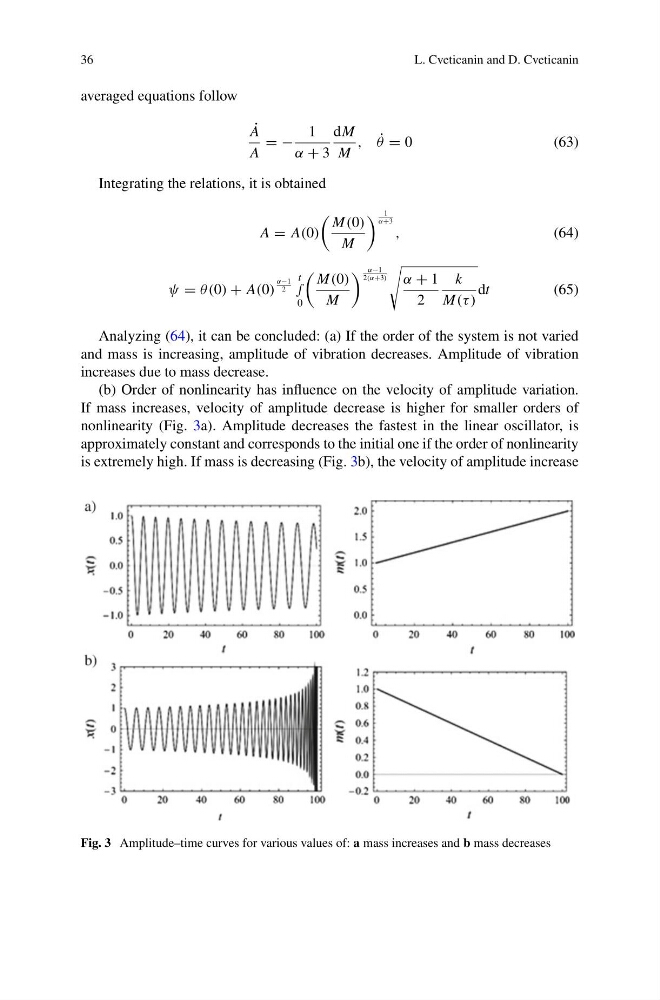
Analyzing (64), it can be concluded: (a) If the order of the system is not varied
and mass is increasing, amplitude of vibration decreases. Amplitude of vibration
increases due to mass decrease.
(b) Order of nonlinearity has influence on the velocity of amplitude variation.
If mass increases, velocity of amplitude decrease is higher for smaller orders of
nonlinearity (Fig. 3a). Amplitude decreases the fastest in the linear oscillator, is
approximately constant and corresponds to the initial one if the order of nonlinearity
is extremely high. If mass is decreasing (Fig. 3b), the velocity of amplitude increase
Fig. 3 Amplitude–time curves for various values of: a mass increases and b mass decreases
L. Cveticanin and D. Cveticanin
averaged equations follow
˙
A
A
= −
1
α + 3
dM
M
, ˙
θ = 0
(63)
Integrating the relations, it is obtained
A = A(0)
M(0)
M
1
α+3 ,
(64)
ψ = θ (0) + A(0)
α−1
2
t
∫
0
M(0)
M
α−1
2(α+3)
α + 1
2
k
M(τ )
dt
(65)
Analyzing (64), it can be concluded: (a) If the order of the system is not varied
and mass is increasing, amplitude of vibration decreases. Amplitude of vibration
increases due to mass decrease.
(b) Order of nonlinearity has influence on the velocity of amplitude variation.
If mass increases, velocity of amplitude decrease is higher for smaller orders of
nonlinearity (Fig. 3a). Amplitude decreases the fastest in the linear oscillator, is
approximately constant and corresponds to the initial one if the order of nonlinearity
is extremely high. If mass is decreasing (Fig. 3b), the velocity of amplitude increase
Fig. 3 Amplitude–time curves for various values of: a mass increases and b mass decreases