

518
V. Iancu and L. Cindea
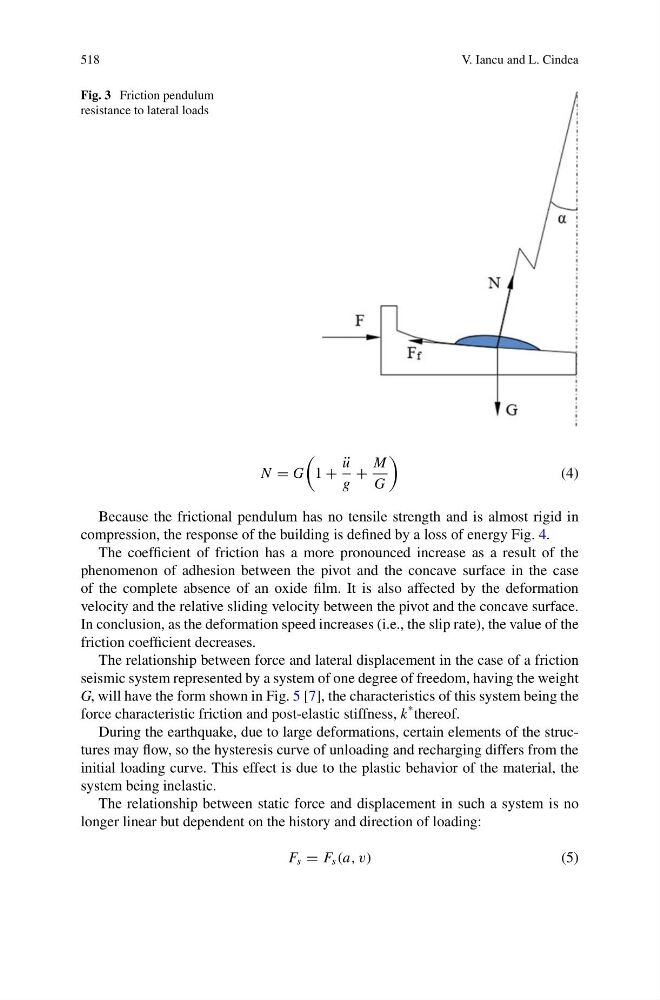
Fig. 3 Friction pendulum
resistance to lateral loads
N = G
1 +
¨
u
g
+
M
G
(4)
Because the frictional pendulum has no tensile strength and is almost rigid in
compression, the response of the building is defined by a loss of energy Fig. 4.
The coefficient of friction has a more pronounced increase as a result of the
phenomenon of adhesion between the pivot and the concave surface in the case
of the complete absence of an oxide film. It is also affected by the deformation
velocity and the relative sliding velocity between the pivot and the concave surface.
In conclusion, as the deformation speed increases (i.e., the slip rate), the value of the
friction coefficient decreases.
The relationship between force and lateral displacement in the case of a friction
seismic system represented by a system of one degree of freedom, having the weight
G, will have the form shown in Fig. 5 [7], the characteristics of this system being the
force characteristic friction and post-elastic stiffness, k
* thereof.
During the earthquake, due to large deformations, certain elements of the structures may flow, so the hysteresis curve of unloading and recharging differs from the
initial loading curve. This effect is due to the plastic behavior of the material, the
system being inelastic.
The relationship between static force and displacement in such a system is no
longer linear but dependent on the history and direction of loading:
F s = F s (a, v)
(5)
V. Iancu and L. Cindea
Fig. 3 Friction pendulum
resistance to lateral loads
N = G
1 +
¨
u
g
+
M
G
(4)
Because the frictional pendulum has no tensile strength and is almost rigid in
compression, the response of the building is defined by a loss of energy Fig. 4.
The coefficient of friction has a more pronounced increase as a result of the
phenomenon of adhesion between the pivot and the concave surface in the case
of the complete absence of an oxide film. It is also affected by the deformation
velocity and the relative sliding velocity between the pivot and the concave surface.
In conclusion, as the deformation speed increases (i.e., the slip rate), the value of the
friction coefficient decreases.
The relationship between force and lateral displacement in the case of a friction
seismic system represented by a system of one degree of freedom, having the weight
G, will have the form shown in Fig. 5 [7], the characteristics of this system being the
force characteristic friction and post-elastic stiffness, k
* thereof.
During the earthquake, due to large deformations, certain elements of the structures may flow, so the hysteresis curve of unloading and recharging differs from the
initial loading curve. This effect is due to the plastic behavior of the material, the
system being inelastic.
The relationship between static force and displacement in such a system is no
longer linear but dependent on the history and direction of loading:
F s = F s (a, v)
(5)