

30
L. Cveticanin and D. Cveticanin
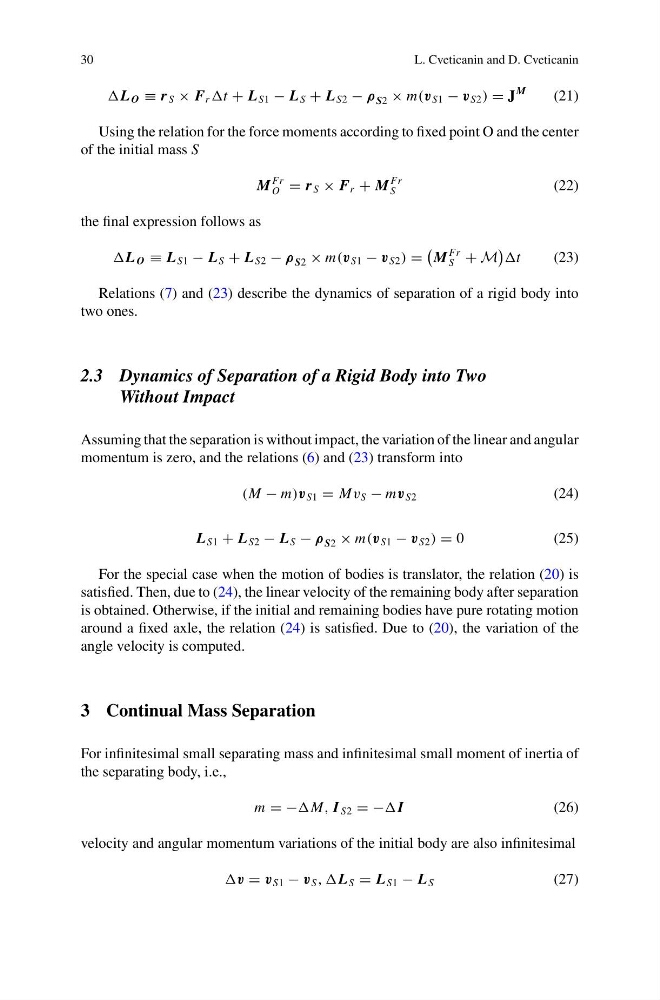
L O ≡ r S × F r t + L S1 − L S + L S2 − ρ S2 × m(v S1 − v S2 ) = J
M
(21)
Using the relation for the force moments according to fixed point O and the center
of the initial mass S
M
Fr
O = r S × F r + M
Fr
S
(22)
the final expression follows as
L O ≡ L S1 − L S + L S2 − ρ S2 × m(v S1 − v S2 ) =
M
Fr
S + M
t
(23)
Relations (7) and (23) describe the dynamics of separation of a rigid body into
two ones.
2.3 Dynamics of Separation of a Rigid Body into Two
Without Impact
Assuming that the separation is without impact, the variation of the linear and angular
momentum is zero, and the relations (6) and (23) transform into
(M − m)v S1 = Mv S − mv S2
(24)
L S1 + L S2 − L S − ρ S2 × m(v S1 − v S2 ) = 0
(25)
For the special case when the motion of bodies is translator, the relation (20) is
satisfied. Then, due to (24), the linear velocity of the remaining body after separation
is obtained. Otherwise, if the initial and remaining bodies have pure rotating motion
around a fixed axle, the relation (24) is satisfied. Due to (20), the variation of the
angle velocity is computed.
3 Continual Mass Separation
For infinitesimal small separating mass and infinitesimal small moment of inertia of
the separating body, i.e.,
m = −M, I S2 = −I
(26)
velocity and angular momentum variations of the initial body are also infinitesimal
v = v S1 − v S , ,L S = L S1 − L S
(27)
L. Cveticanin and D. Cveticanin
L O ≡ r S × F r t + L S1 − L S + L S2 − ρ S2 × m(v S1 − v S2 ) = J
M
(21)
Using the relation for the force moments according to fixed point O and the center
of the initial mass S
M
Fr
O = r S × F r + M
Fr
S
(22)
the final expression follows as
L O ≡ L S1 − L S + L S2 − ρ S2 × m(v S1 − v S2 ) =
M
Fr
S + M
t
(23)
Relations (7) and (23) describe the dynamics of separation of a rigid body into
two ones.
2.3 Dynamics of Separation of a Rigid Body into Two
Without Impact
Assuming that the separation is without impact, the variation of the linear and angular
momentum is zero, and the relations (6) and (23) transform into
(M − m)v S1 = Mv S − mv S2
(24)
L S1 + L S2 − L S − ρ S2 × m(v S1 − v S2 ) = 0
(25)
For the special case when the motion of bodies is translator, the relation (20) is
satisfied. Then, due to (24), the linear velocity of the remaining body after separation
is obtained. Otherwise, if the initial and remaining bodies have pure rotating motion
around a fixed axle, the relation (24) is satisfied. Due to (20), the variation of the
angle velocity is computed.
3 Continual Mass Separation
For infinitesimal small separating mass and infinitesimal small moment of inertia of
the separating body, i.e.,
m = −M, I S2 = −I
(26)
velocity and angular momentum variations of the initial body are also infinitesimal
v = v S1 − v S , ,L S = L S1 − L S
(27)