

490
P. Szuchy
• Brüel&Kjaer PHOTON + Dynamic Signal Analyzer
• Brüel&Kjaer LDSvibrator with V201, M4 trunnion kit
• Brüel&Kjaer LDS LPA100 amplifier
• 8230 DeltaTron Force Transducer,
• Accelerometers
• Computer, rack.
As it was mentioned before the working principle of the metamaterial investigated
resembles the dynamic reduction of vibration, but in a mass-in-mass arrangement.
Accordingly, there is an external carrying case, the m 1 mass that is excited periodically. In this case there are some attached masses (m 2 , m 3 , m 4 etc.) arranged in a
properly arranged geometrical formation. These attached masses take over the vibration energy of the case if the excitation frequency is closed to their natural angular
frequency, reducing the vibration amplitude of the mass m 1 . During the experiment
the attached masses are fixed to the case and the reduction of vibration is measured
in the given frequency range changing the sweeping the excitation frequency.
Figure 7a presents one of the metamaterial cases (red color on Fig. 7a), gripped
by a vice. Under it there is the LDS Vibrator that can shake with maximum 17.8 N
force and 5 mm amplitude on a frequency between 10 and 13,000 Hz given by
the signal generator. The 100–1000 Hz frequency range is the target range of the
research because the vibrations in this range are the most harmful. The PHOTON +
Signal Analyzer and Signal Generator gives signal for the vibrator through the LDS
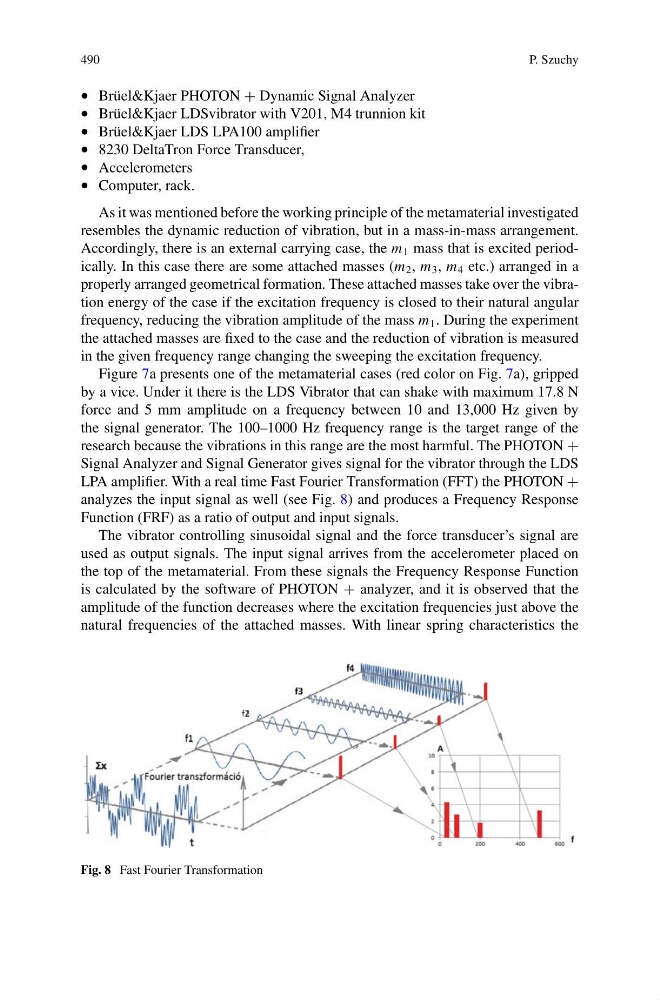
LPA amplifier. With a real time Fast Fourier Transformation (FFT) the PHOTON +
analyzes the input signal as well (see Fig. 8) and produces a Frequency Response
Function (FRF) as a ratio of output and input signals.
The vibrator controlling sinusoidal signal and the force transducer’s signal are
used as output signals. The input signal arrives from the accelerometer placed on
the top of the metamaterial. From these signals the Frequency Response Function
is calculated by the software of PHOTON + analyzer, and it is observed that the
amplitude of the function decreases where the excitation frequencies just above the
natural frequencies of the attached masses. With linear spring characteristics the
Fig. 8 Fast Fourier Transformation
P. Szuchy
• Brüel&Kjaer PHOTON + Dynamic Signal Analyzer
• Brüel&Kjaer LDSvibrator with V201, M4 trunnion kit
• Brüel&Kjaer LDS LPA100 amplifier
• 8230 DeltaTron Force Transducer,
• Accelerometers
• Computer, rack.
As it was mentioned before the working principle of the metamaterial investigated
resembles the dynamic reduction of vibration, but in a mass-in-mass arrangement.
Accordingly, there is an external carrying case, the m 1 mass that is excited periodically. In this case there are some attached masses (m 2 , m 3 , m 4 etc.) arranged in a
properly arranged geometrical formation. These attached masses take over the vibration energy of the case if the excitation frequency is closed to their natural angular
frequency, reducing the vibration amplitude of the mass m 1 . During the experiment
the attached masses are fixed to the case and the reduction of vibration is measured
in the given frequency range changing the sweeping the excitation frequency.
Figure 7a presents one of the metamaterial cases (red color on Fig. 7a), gripped
by a vice. Under it there is the LDS Vibrator that can shake with maximum 17.8 N
force and 5 mm amplitude on a frequency between 10 and 13,000 Hz given by
the signal generator. The 100–1000 Hz frequency range is the target range of the
research because the vibrations in this range are the most harmful. The PHOTON +
Signal Analyzer and Signal Generator gives signal for the vibrator through the LDS
LPA amplifier. With a real time Fast Fourier Transformation (FFT) the PHOTON +
analyzes the input signal as well (see Fig. 8) and produces a Frequency Response
Function (FRF) as a ratio of output and input signals.
The vibrator controlling sinusoidal signal and the force transducer’s signal are
used as output signals. The input signal arrives from the accelerometer placed on
the top of the metamaterial. From these signals the Frequency Response Function
is calculated by the software of PHOTON + analyzer, and it is observed that the
amplitude of the function decreases where the excitation frequencies just above the
natural frequencies of the attached masses. With linear spring characteristics the
Fig. 8 Fast Fourier Transformation