

Composed Isolation System Concept for Vibration Effects Mitigation …
477
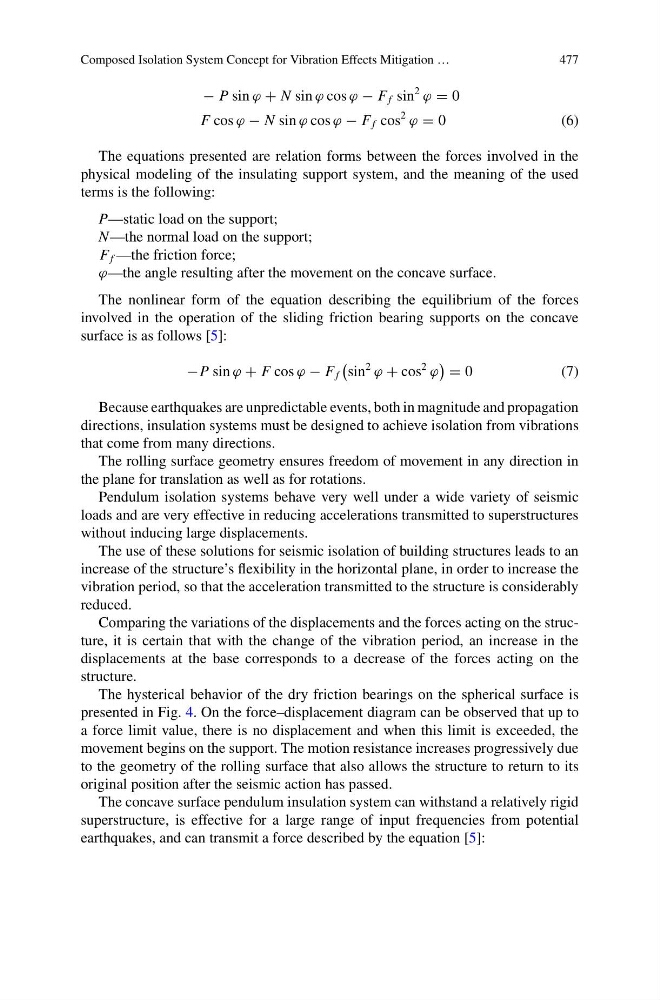
− P sin ϕ + N sin ϕ cos ϕ − F f sin
2
ϕ = 0
F cos ϕ − N sin ϕ cos ϕ − F f cos
2
ϕ = 0
( 6 )
The equations presented are relation forms between the forces involved in the
physical modeling of the insulating support system, and the meaning of the used
terms is the following:
P—static load on the support;
N—the normal load on the support;
F f —the friction force;
ϕ—the angle resulting after the movement on the concave surface.
The nonlinear form of the equation describing the equilibrium of the forces
involved in the operation of the sliding friction bearing supports on the concave
surface is as follows [5]:
−P sin ϕ + F cos ϕ − F f
sin
2
ϕ + cos
2
ϕ
= 0
( 7 )
Because earthquakes are unpredictable events, both in magnitude and propagation
directions, insulation systems must be designed to achieve isolation from vibrations
that come from many directions.
The rolling surface geometry ensures freedom of movement in any direction in
the plane for translation as well as for rotations.
Pendulum isolation systems behave very well under a wide variety of seismic
loads and are very effective in reducing accelerations transmitted to superstructures
without inducing large displacements.
The use of these solutions for seismic isolation of building structures leads to an
increase of the structure’s flexibility in the horizontal plane, in order to increase the
vibration period, so that the acceleration transmitted to the structure is considerably
reduced.
Comparing the variations of the displacements and the forces acting on the structure, it is certain that with the change of the vibration period, an increase in the
displacements at the base corresponds to a decrease of the forces acting on the
structure.
The hysterical behavior of the dry friction bearings on the spherical surface is
presented in Fig. 4. On the force–displacement diagram can be observed that up to
a force limit value, there is no displacement and when this limit is exceeded, the
movement begins on the support. The motion resistance increases progressively due
to the geometry of the rolling surface that also allows the structure to return to its
original position after the seismic action has passed.
The concave surface pendulum insulation system can withstand a relatively rigid
superstructure, is effective for a large range of input frequencies from potential
earthquakes, and can transmit a force described by the equation [5]:
477
− P sin ϕ + N sin ϕ cos ϕ − F f sin
2
ϕ = 0
F cos ϕ − N sin ϕ cos ϕ − F f cos
2
ϕ = 0
( 6 )
The equations presented are relation forms between the forces involved in the
physical modeling of the insulating support system, and the meaning of the used
terms is the following:
P—static load on the support;
N—the normal load on the support;
F f —the friction force;
ϕ—the angle resulting after the movement on the concave surface.
The nonlinear form of the equation describing the equilibrium of the forces
involved in the operation of the sliding friction bearing supports on the concave
surface is as follows [5]:
−P sin ϕ + F cos ϕ − F f
sin
2
ϕ + cos
2
ϕ
= 0
( 7 )
Because earthquakes are unpredictable events, both in magnitude and propagation
directions, insulation systems must be designed to achieve isolation from vibrations
that come from many directions.
The rolling surface geometry ensures freedom of movement in any direction in
the plane for translation as well as for rotations.
Pendulum isolation systems behave very well under a wide variety of seismic
loads and are very effective in reducing accelerations transmitted to superstructures
without inducing large displacements.
The use of these solutions for seismic isolation of building structures leads to an
increase of the structure’s flexibility in the horizontal plane, in order to increase the
vibration period, so that the acceleration transmitted to the structure is considerably
reduced.
Comparing the variations of the displacements and the forces acting on the structure, it is certain that with the change of the vibration period, an increase in the
displacements at the base corresponds to a decrease of the forces acting on the
structure.
The hysterical behavior of the dry friction bearings on the spherical surface is
presented in Fig. 4. On the force–displacement diagram can be observed that up to
a force limit value, there is no displacement and when this limit is exceeded, the
movement begins on the support. The motion resistance increases progressively due
to the geometry of the rolling surface that also allows the structure to return to its
original position after the seismic action has passed.
The concave surface pendulum insulation system can withstand a relatively rigid
superstructure, is effective for a large range of input frequencies from potential
earthquakes, and can transmit a force described by the equation [5]: