

Application of Friction Pendulum Bearings …
457
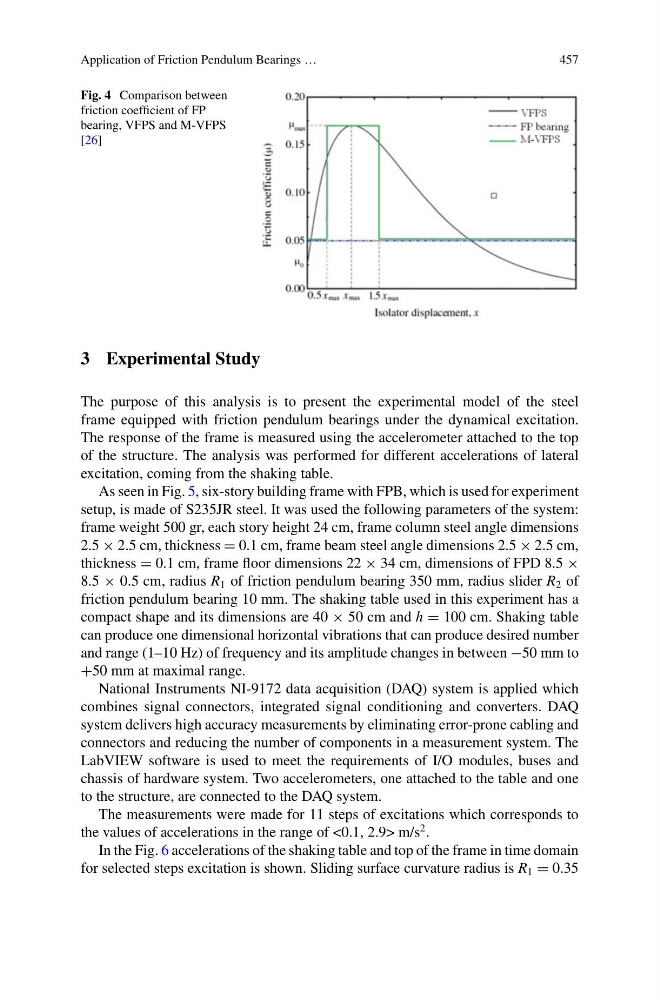
Fig. 4 Comparison between
friction coefficient of FP
bearing, VFPS and M-VFPS
[26]
3 Experimental Study
The purpose of this analysis is to present the experimental model of the steel
frame equipped with friction pendulum bearings under the dynamical excitation.
The response of the frame is measured using the accelerometer attached to the top
of the structure. The analysis was performed for different accelerations of lateral
excitation, coming from the shaking table.
As seen in Fig. 5, six-story building frame with FPB, which is used for experiment
setup, is made of S235JR steel. It was used the following parameters of the system:
frame weight 500 gr, each story height 24 cm, frame column steel angle dimensions
2.5 × 2.5 cm, thickness = 0.1 cm, frame beam steel angle dimensions 2.5 × 2.5 cm,
thickness = 0.1 cm, frame floor dimensions 22 × 34 cm, dimensions of FPD 8.5 ×
8.5 × 0.5 cm, radius R 1 of friction pendulum bearing 350 mm, radius slider R 2 of
friction pendulum bearing 10 mm. The shaking table used in this experiment has a
compact shape and its dimensions are 40 × 50 cm and h = 100 cm. Shaking table
can produce one dimensional horizontal vibrations that can produce desired number
and range (1–10 Hz) of frequency and its amplitude changes in between −50 mm to
+50 mm at maximal range.
National Instruments NI-9172 data acquisition (DAQ) system is applied which
combines signal connectors, integrated signal conditioning and converters. DAQ
system delivers high accuracy measurements by eliminating error-prone cabling and
connectors and reducing the number of components in a measurement system. The
LabVIEW software is used to meet the requirements of I/O modules, buses and
chassis of hardware system. Two accelerometers, one attached to the table and one
to the structure, are connected to the DAQ system.
The measurements were made for 11 steps of excitations which corresponds to
the values of accelerations in the range of <0.1, 2.9> m/s
2 .
In the Fig. 6 accelerations of the shaking table and top of the frame in time domain
for selected steps excitation is shown. Sliding surface curvature radius is R 1 = 0.35
457
Fig. 4 Comparison between
friction coefficient of FP
bearing, VFPS and M-VFPS
[26]
3 Experimental Study
The purpose of this analysis is to present the experimental model of the steel
frame equipped with friction pendulum bearings under the dynamical excitation.
The response of the frame is measured using the accelerometer attached to the top
of the structure. The analysis was performed for different accelerations of lateral
excitation, coming from the shaking table.
As seen in Fig. 5, six-story building frame with FPB, which is used for experiment
setup, is made of S235JR steel. It was used the following parameters of the system:
frame weight 500 gr, each story height 24 cm, frame column steel angle dimensions
2.5 × 2.5 cm, thickness = 0.1 cm, frame beam steel angle dimensions 2.5 × 2.5 cm,
thickness = 0.1 cm, frame floor dimensions 22 × 34 cm, dimensions of FPD 8.5 ×
8.5 × 0.5 cm, radius R 1 of friction pendulum bearing 350 mm, radius slider R 2 of
friction pendulum bearing 10 mm. The shaking table used in this experiment has a
compact shape and its dimensions are 40 × 50 cm and h = 100 cm. Shaking table
can produce one dimensional horizontal vibrations that can produce desired number
and range (1–10 Hz) of frequency and its amplitude changes in between −50 mm to
+50 mm at maximal range.
National Instruments NI-9172 data acquisition (DAQ) system is applied which
combines signal connectors, integrated signal conditioning and converters. DAQ
system delivers high accuracy measurements by eliminating error-prone cabling and
connectors and reducing the number of components in a measurement system. The
LabVIEW software is used to meet the requirements of I/O modules, buses and
chassis of hardware system. Two accelerometers, one attached to the table and one
to the structure, are connected to the DAQ system.
The measurements were made for 11 steps of excitations which corresponds to
the values of accelerations in the range of <0.1, 2.9> m/s
2 .
In the Fig. 6 accelerations of the shaking table and top of the frame in time domain
for selected steps excitation is shown. Sliding surface curvature radius is R 1 = 0.35