

396
M. Dragomir et al.
model was proposed in [3]. Optimization of vibrating devices has been analyzed in
[4–6].
Deducing exact mathematical equations that describe this complex process is often
difficult and, therefore, most of the equations proposed by researchers in the literature
are based on several simplifying assumptions that make these calculations easier.
These can lead to more or less relevant results, with respect to the real phenomenon.
This paper studies a system consisting of three oscillating sieves used to strain
a seed mixture. A model with a finite number of degrees of freedom is considered
[7–9] which improves the simplified model presented in a previous paper [10].
2 Model of the System
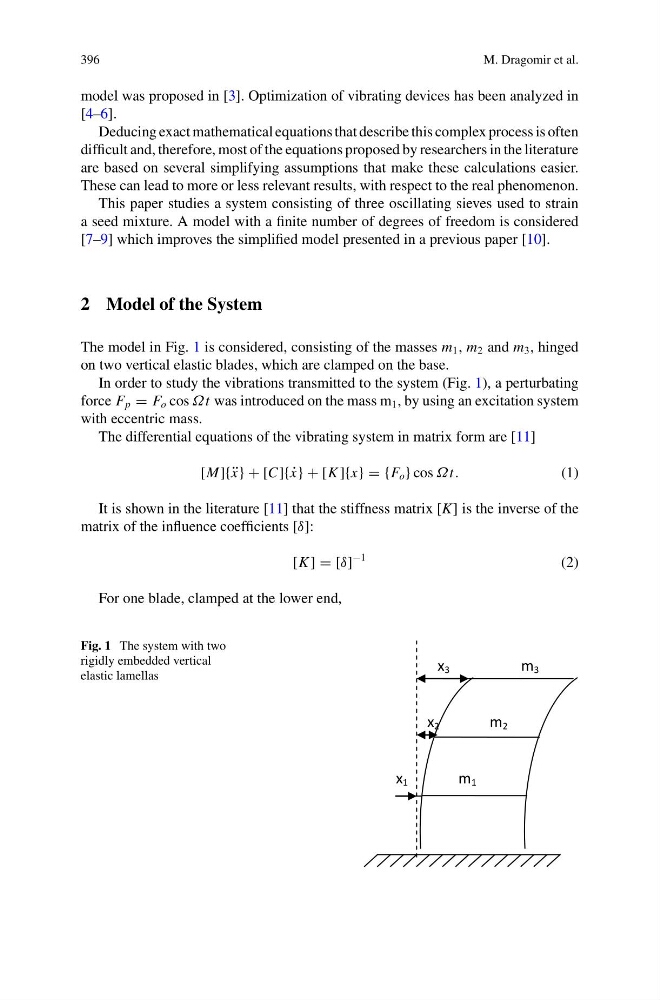
The model in Fig. 1 is considered, consisting of the masses m 1 , m 2 and m 3 , hinged
on two vertical elastic blades, which are clamped on the base.
In order to study the vibrations transmitted to the system (Fig. 1), a perturbating
force F p = F o cos Ωt was introduced on the mass m 1 , by using an excitation system
with eccentric mass.
The differential equations of the vibrating system in matrix form are [11]
[M]{ ¨
x} + [C]{ ˙
x} + [K ]{x} = {F o } cos Ωt.
(1)
It is shown in the literature [11] that the stiffness matrix [K] is the inverse of the
matrix of the influence coefficients [δ]:
[K ] = [δ]
−1
(2)
For one blade, clamped at the lower end,
Fig. 1 The system with two
rigidly embedded vertical
elastic lamellas
m 1
m 2
m 3
x 1
x 2
x 3
M. Dragomir et al.
model was proposed in [3]. Optimization of vibrating devices has been analyzed in
[4–6].
Deducing exact mathematical equations that describe this complex process is often
difficult and, therefore, most of the equations proposed by researchers in the literature
are based on several simplifying assumptions that make these calculations easier.
These can lead to more or less relevant results, with respect to the real phenomenon.
This paper studies a system consisting of three oscillating sieves used to strain
a seed mixture. A model with a finite number of degrees of freedom is considered
[7–9] which improves the simplified model presented in a previous paper [10].
2 Model of the System
The model in Fig. 1 is considered, consisting of the masses m 1 , m 2 and m 3 , hinged
on two vertical elastic blades, which are clamped on the base.
In order to study the vibrations transmitted to the system (Fig. 1), a perturbating
force F p = F o cos Ωt was introduced on the mass m 1 , by using an excitation system
with eccentric mass.
The differential equations of the vibrating system in matrix form are [11]
[M]{ ¨
x} + [C]{ ˙
x} + [K ]{x} = {F o } cos Ωt.
(1)
It is shown in the literature [11] that the stiffness matrix [K] is the inverse of the
matrix of the influence coefficients [δ]:
[K ] = [δ]
−1
(2)
For one blade, clamped at the lower end,
Fig. 1 The system with two
rigidly embedded vertical
elastic lamellas
m 1
m 2
m 3
x 1
x 2
x 3