

Dependence Between the Percussion Centre and the Uniformity …
353
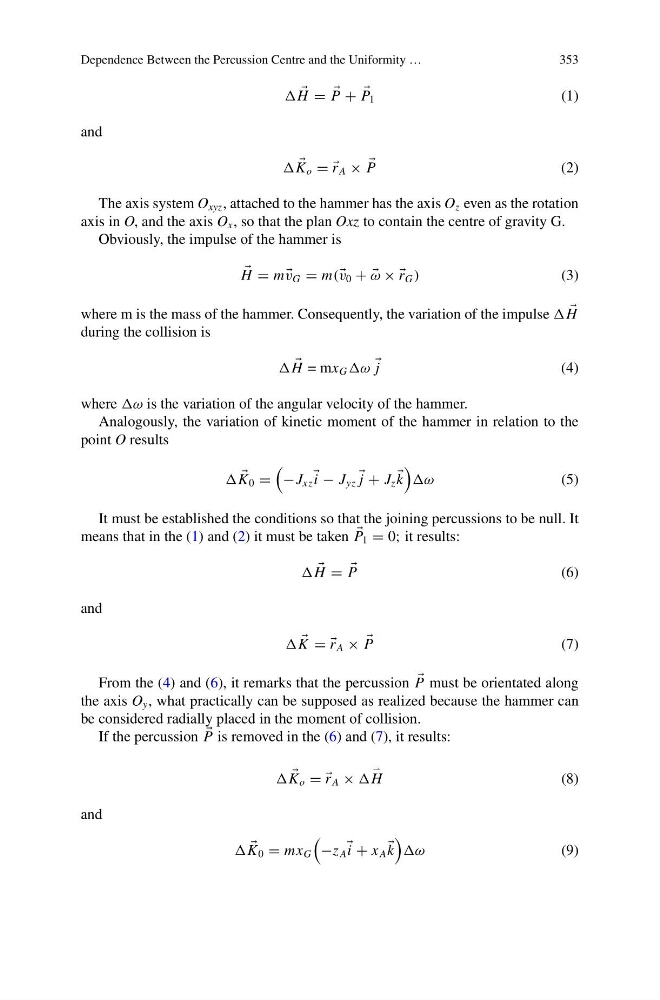
H =
P +
P 1
(1)
and
K o = =
r A ×
P
(2)
The axis system O xyz , attached to the hammer has the axis O z even as the rotation
axis in O, and the axis O x , so that the plan Oxz to contain the centre of gravity G.
Obviously, the impulse of the hammer is
H = m
v G = m( v 0 + +
ω × ×
r G )
(3)
where m is the mass of the hammer. Consequently, the variation of the impulse
H
during the collision is
H = mx G ω j
(4)
where ω is the variation of the angular velocity of the hammer.
Analogously, the variation of kinetic moment of the hammer in relation to the
point O results
K 0 =
−J xz i − J yz j + J z
k
ω
(5)
It must be established the conditions so that the joining percussions to be null. It
means that in the (1) and (2) it must be taken
P 1 = 0; it results:
H =
P
(6)
and
K = =
r A ×
P
(7)
From the (4) and (6), it remarks that the percussion
P must be orientated along
the axis O y , what practically can be supposed as realized because the hammer can
be considered radially placed in the moment of collision.
If the percussion
P is removed in the (6) and (7), it results:
K o = =
r A ×
H
(8)
and
K 0 = mx G
−z A i + x A
k
ω
(9)
353
H =
P +
P 1
(1)
and
K o = =
r A ×
P
(2)
The axis system O xyz , attached to the hammer has the axis O z even as the rotation
axis in O, and the axis O x , so that the plan Oxz to contain the centre of gravity G.
Obviously, the impulse of the hammer is
H = m
v G = m( v 0 + +
ω × ×
r G )
(3)
where m is the mass of the hammer. Consequently, the variation of the impulse
H
during the collision is
H = mx G ω j
(4)
where ω is the variation of the angular velocity of the hammer.
Analogously, the variation of kinetic moment of the hammer in relation to the
point O results
K 0 =
−J xz i − J yz j + J z
k
ω
(5)
It must be established the conditions so that the joining percussions to be null. It
means that in the (1) and (2) it must be taken
P 1 = 0; it results:
H =
P
(6)
and
K = =
r A ×
P
(7)
From the (4) and (6), it remarks that the percussion
P must be orientated along
the axis O y , what practically can be supposed as realized because the hammer can
be considered radially placed in the moment of collision.
If the percussion
P is removed in the (6) and (7), it results:
K o = =
r A ×
H
(8)
and
K 0 = mx G
−z A i + x A
k
ω
(9)