

344
A. Gerocs et al.
analysis of displacement and stress distribution. The obtained results show real opportunities regarding both weight reduction and optimization of material consumption
and costs.
Other researches [3, 4] have studied the possibilities to reduce the gearbox radiated
noise by increasing the housing stiffness. This measure can be applied by placing
ribs, in particular positions, on the housing surface. Research results have shown that
by placing stiffening ribs along the connection lines between the bearing shells and
the nearest fixed point of the gearbox it is possible to obtain good results regarding
the reduction of noise [5, 6].
Modal analysis has recently became a powerful tool in the design and optimization
of various mechanical components [7, 8], being constantly employed, principally in
the primary stages of the product design [9, 10].
Currently, there are available a lot of researches [11, 12] concerning modal analysis
performed on gearboxes, but seeing the complexity of the subject, the topic supports
favorable circumstances for alternative investigations.
The objective of this work is to perform an FEA on an existent gearbox housing, by
using two different software, in order to prevent undesired resonance in real operating
circumstances. Furthermore, the numerical results are validated by experimental data.
2 Case Study
The study presented here is concerned with the determination of the natural frequencies of the housing being part of a single helical gearbox. The fundamental technical
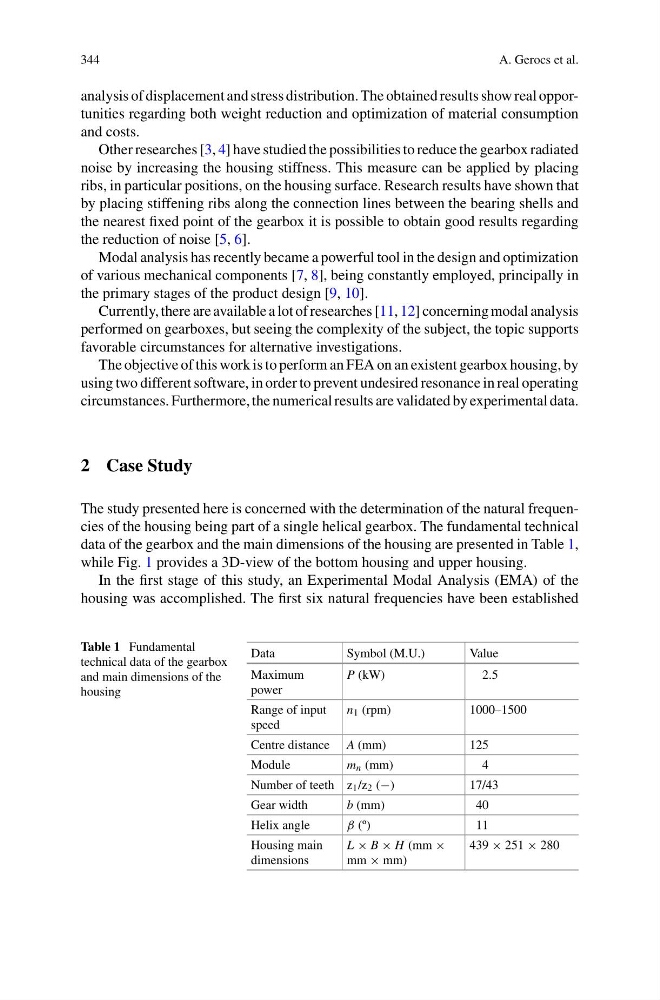
data of the gearbox and the main dimensions of the housing are presented in Table 1,
while Fig. 1 provides a 3D-view of the bottom housing and upper housing.
In the first stage of this study, an Experimental Modal Analysis (EMA) of the
housing was accomplished. The first six natural frequencies have been established
Table 1 Fundamental
technical data of the gearbox
and main dimensions of the
housing
Data
Symbol (M.U.)
Value
Maximum
power
P (kW)
2.5
Range of input
speed
n 1 (rpm)
1000–1500
Centre distance A (mm)
125
Module
m n (mm)
4
Number of teeth z 1 /z 2 (−)
17/43
Gear width
b (mm)
40
Helix angle
β (º)
11
Housing main
dimensions
L × B × H (mm ×
mm × mm)
439 × 251 × 280
A. Gerocs et al.
analysis of displacement and stress distribution. The obtained results show real opportunities regarding both weight reduction and optimization of material consumption
and costs.
Other researches [3, 4] have studied the possibilities to reduce the gearbox radiated
noise by increasing the housing stiffness. This measure can be applied by placing
ribs, in particular positions, on the housing surface. Research results have shown that
by placing stiffening ribs along the connection lines between the bearing shells and
the nearest fixed point of the gearbox it is possible to obtain good results regarding
the reduction of noise [5, 6].
Modal analysis has recently became a powerful tool in the design and optimization
of various mechanical components [7, 8], being constantly employed, principally in
the primary stages of the product design [9, 10].
Currently, there are available a lot of researches [11, 12] concerning modal analysis
performed on gearboxes, but seeing the complexity of the subject, the topic supports
favorable circumstances for alternative investigations.
The objective of this work is to perform an FEA on an existent gearbox housing, by
using two different software, in order to prevent undesired resonance in real operating
circumstances. Furthermore, the numerical results are validated by experimental data.
2 Case Study
The study presented here is concerned with the determination of the natural frequencies of the housing being part of a single helical gearbox. The fundamental technical
data of the gearbox and the main dimensions of the housing are presented in Table 1,
while Fig. 1 provides a 3D-view of the bottom housing and upper housing.
In the first stage of this study, an Experimental Modal Analysis (EMA) of the
housing was accomplished. The first six natural frequencies have been established
Table 1 Fundamental
technical data of the gearbox
and main dimensions of the
housing
Data
Symbol (M.U.)
Value
Maximum
power
P (kW)
2.5
Range of input
speed
n 1 (rpm)
1000–1500
Centre distance A (mm)
125
Module
m n (mm)
4
Number of teeth z 1 /z 2 (−)
17/43
Gear width
b (mm)
40
Helix angle
β (º)
11
Housing main
dimensions
L × B × H (mm ×
mm × mm)
439 × 251 × 280