

Experimental Analysis of Noise and Chatter Detection in Milling …
341
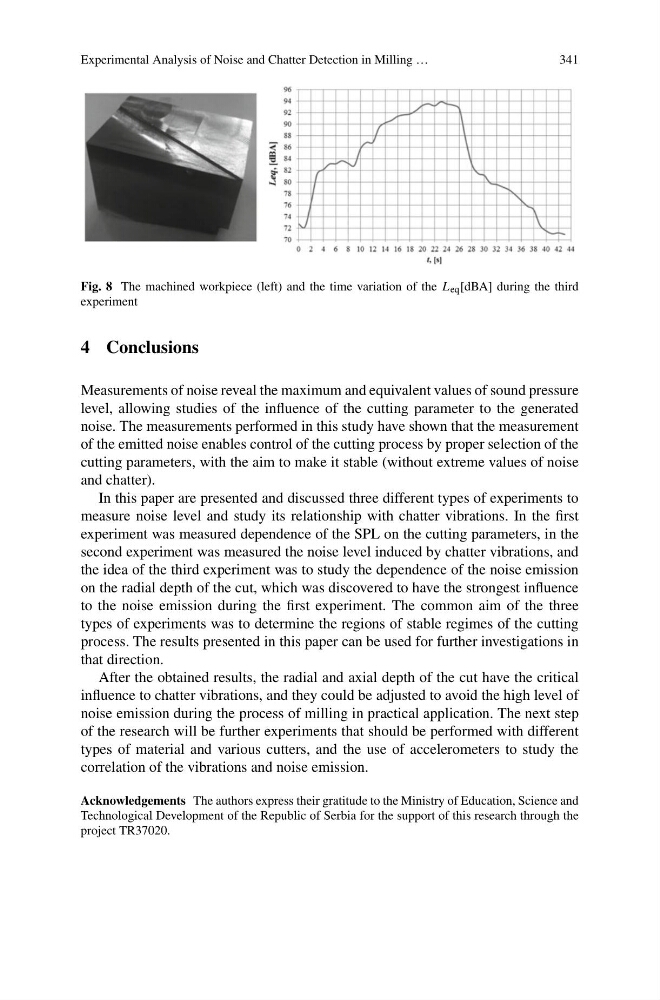
Fig. 8 The machined workpiece (left) and the time variation of the L eq [dBA] during the third
experiment
4 Conclusions
Measurements of noise reveal the maximum and equivalent values of sound pressure
level, allowing studies of the influence of the cutting parameter to the generated
noise. The measurements performed in this study have shown that the measurement
of the emitted noise enables control of the cutting process by proper selection of the
cutting parameters, with the aim to make it stable (without extreme values of noise
and chatter).
In this paper are presented and discussed three different types of experiments to
measure noise level and study its relationship with chatter vibrations. In the first
experiment was measured dependence of the SPL on the cutting parameters, in the
second experiment was measured the noise level induced by chatter vibrations, and
the idea of the third experiment was to study the dependence of the noise emission
on the radial depth of the cut, which was discovered to have the strongest influence
to the noise emission during the first experiment. The common aim of the three
types of experiments was to determine the regions of stable regimes of the cutting
process. The results presented in this paper can be used for further investigations in
that direction.
After the obtained results, the radial and axial depth of the cut have the critical
influence to chatter vibrations, and they could be adjusted to avoid the high level of
noise emission during the process of milling in practical application. The next step
of the research will be further experiments that should be performed with different
types of material and various cutters, and the use of accelerometers to study the
correlation of the vibrations and noise emission.
Acknowledgements The authors express their gratitude to the Ministry of Education, Science and
Technological Development of the Republic of Serbia for the support of this research through the
project TR37020.
341
Fig. 8 The machined workpiece (left) and the time variation of the L eq [dBA] during the third
experiment
4 Conclusions
Measurements of noise reveal the maximum and equivalent values of sound pressure
level, allowing studies of the influence of the cutting parameter to the generated
noise. The measurements performed in this study have shown that the measurement
of the emitted noise enables control of the cutting process by proper selection of the
cutting parameters, with the aim to make it stable (without extreme values of noise
and chatter).
In this paper are presented and discussed three different types of experiments to
measure noise level and study its relationship with chatter vibrations. In the first
experiment was measured dependence of the SPL on the cutting parameters, in the
second experiment was measured the noise level induced by chatter vibrations, and
the idea of the third experiment was to study the dependence of the noise emission
on the radial depth of the cut, which was discovered to have the strongest influence
to the noise emission during the first experiment. The common aim of the three
types of experiments was to determine the regions of stable regimes of the cutting
process. The results presented in this paper can be used for further investigations in
that direction.
After the obtained results, the radial and axial depth of the cut have the critical
influence to chatter vibrations, and they could be adjusted to avoid the high level of
noise emission during the process of milling in practical application. The next step
of the research will be further experiments that should be performed with different
types of material and various cutters, and the use of accelerometers to study the
correlation of the vibrations and noise emission.
Acknowledgements The authors express their gratitude to the Ministry of Education, Science and
Technological Development of the Republic of Serbia for the support of this research through the
project TR37020.