

248
M. I. Baritz and M. G. Apostoaie
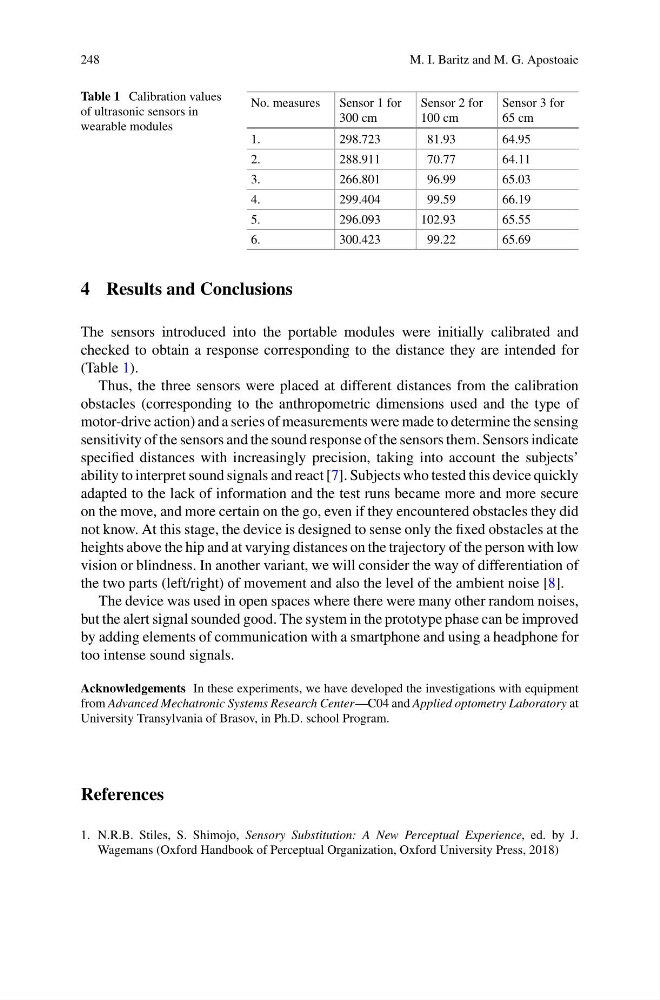
Table 1 Calibration values
of ultrasonic sensors in
wearable modules
No. measures
Sensor 1 for
300 cm
Sensor 2 for
100 cm
Sensor 3 for
65 cm
1.
298.723
81.93
64.95
2.
288.911
70.77
64.11
3.
266.801
96.99
65.03
4.
299.404
99.59
66.19
5.
296.093
102.93
65.55
6.
300.423
99.22
65.69
4 Results and Conclusions
The sensors introduced into the portable modules were initially calibrated and
checked to obtain a response corresponding to the distance they are intended for
(Table 1).
Thus, the three sensors were placed at different distances from the calibration
obstacles (corresponding to the anthropometric dimensions used and the type of
motor-drive action) and a series of measurements were made to determine the sensing
sensitivity of the sensors and the sound response of the sensors them. Sensors indicate
specified distances with increasingly precision, taking into account the subjects’
ability to interpret sound signals and react [7]. Subjects who tested this device quickly
adapted to the lack of information and the test runs became more and more secure
on the move, and more certain on the go, even if they encountered obstacles they did
not know. At this stage, the device is designed to sense only the fixed obstacles at the
heights above the hip and at varying distances on the trajectory of the person with low
vision or blindness. In another variant, we will consider the way of differentiation of
the two parts (left/right) of movement and also the level of the ambient noise [8].
The device was used in open spaces where there were many other random noises,
but the alert signal sounded good. The system in the prototype phase can be improved
by adding elements of communication with a smartphone and using a headphone for
too intense sound signals.
Acknowledgements In these experiments, we have developed the investigations with equipment
from Advanced Mechatronic Systems Research Center—C04 and Applied optometry Laboratory at
University Transylvania of Brasov, in Ph.D. school Program.
References
1. N.R.B. Stiles, S. Shimojo, Sensory Substitution: A New Perceptual Experience, ed. by J.
Wagemans (Oxford Handbook of Perceptual Organization, Oxford University Press, 2018)
M. I. Baritz and M. G. Apostoaie
Table 1 Calibration values
of ultrasonic sensors in
wearable modules
No. measures
Sensor 1 for
300 cm
Sensor 2 for
100 cm
Sensor 3 for
65 cm
1.
298.723
81.93
64.95
2.
288.911
70.77
64.11
3.
266.801
96.99
65.03
4.
299.404
99.59
66.19
5.
296.093
102.93
65.55
6.
300.423
99.22
65.69
4 Results and Conclusions
The sensors introduced into the portable modules were initially calibrated and
checked to obtain a response corresponding to the distance they are intended for
(Table 1).
Thus, the three sensors were placed at different distances from the calibration
obstacles (corresponding to the anthropometric dimensions used and the type of
motor-drive action) and a series of measurements were made to determine the sensing
sensitivity of the sensors and the sound response of the sensors them. Sensors indicate
specified distances with increasingly precision, taking into account the subjects’
ability to interpret sound signals and react [7]. Subjects who tested this device quickly
adapted to the lack of information and the test runs became more and more secure
on the move, and more certain on the go, even if they encountered obstacles they did
not know. At this stage, the device is designed to sense only the fixed obstacles at the
heights above the hip and at varying distances on the trajectory of the person with low
vision or blindness. In another variant, we will consider the way of differentiation of
the two parts (left/right) of movement and also the level of the ambient noise [8].
The device was used in open spaces where there were many other random noises,
but the alert signal sounded good. The system in the prototype phase can be improved
by adding elements of communication with a smartphone and using a headphone for
too intense sound signals.
Acknowledgements In these experiments, we have developed the investigations with equipment
from Advanced Mechatronic Systems Research Center—C04 and Applied optometry Laboratory at
University Transylvania of Brasov, in Ph.D. school Program.
References
1. N.R.B. Stiles, S. Shimojo, Sensory Substitution: A New Perceptual Experience, ed. by J.
Wagemans (Oxford Handbook of Perceptual Organization, Oxford University Press, 2018)