

Angular Momentum About the Total Body Center of Mass Computed …
231
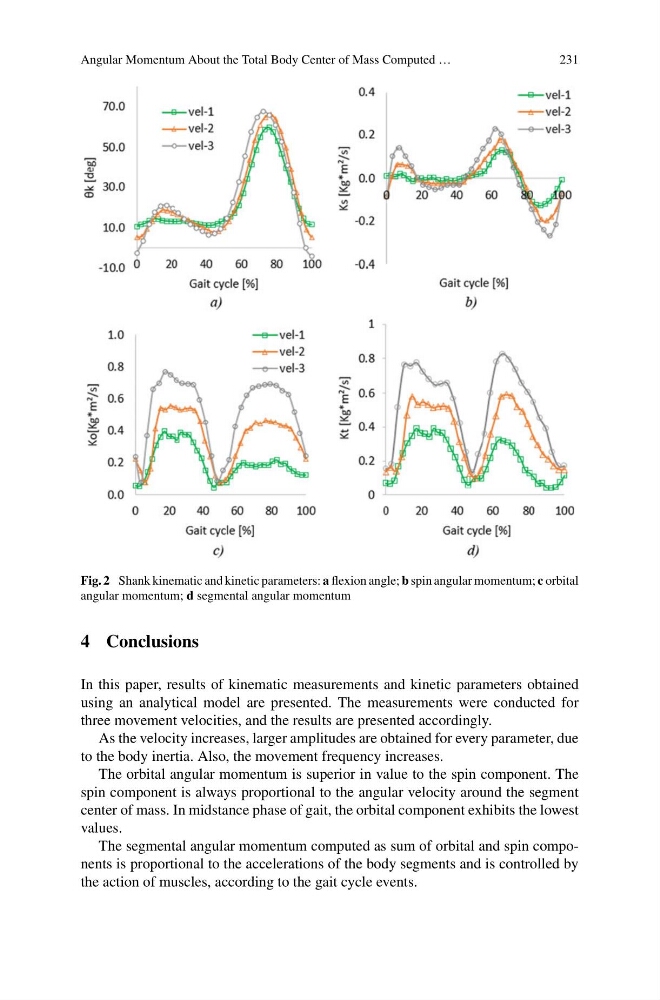
Fig. 2 Shank kinematic and kinetic parameters: a flexion angle; b spin angular momentum; c orbital
angular momentum; d segmental angular momentum
4 Conclusions
In this paper, results of kinematic measurements and kinetic parameters obtained
using an analytical model are presented. The measurements were conducted for
three movement velocities, and the results are presented accordingly.
As the velocity increases, larger amplitudes are obtained for every parameter, due
to the body inertia. Also, the movement frequency increases.
The orbital angular momentum is superior in value to the spin component. The
spin component is always proportional to the angular velocity around the segment
center of mass. In midstance phase of gait, the orbital component exhibits the lowest
values.
The segmental angular momentum computed as sum of orbital and spin components is proportional to the accelerations of the body segments and is controlled by
the action of muscles, according to the gait cycle events.
231
Fig. 2 Shank kinematic and kinetic parameters: a flexion angle; b spin angular momentum; c orbital
angular momentum; d segmental angular momentum
4 Conclusions
In this paper, results of kinematic measurements and kinetic parameters obtained
using an analytical model are presented. The measurements were conducted for
three movement velocities, and the results are presented accordingly.
As the velocity increases, larger amplitudes are obtained for every parameter, due
to the body inertia. Also, the movement frequency increases.
The orbital angular momentum is superior in value to the spin component. The
spin component is always proportional to the angular velocity around the segment
center of mass. In midstance phase of gait, the orbital component exhibits the lowest
values.
The segmental angular momentum computed as sum of orbital and spin components is proportional to the accelerations of the body segments and is controlled by
the action of muscles, according to the gait cycle events.