

Mitigating Noise Pollution Level When Loading Useful Mineral …
213
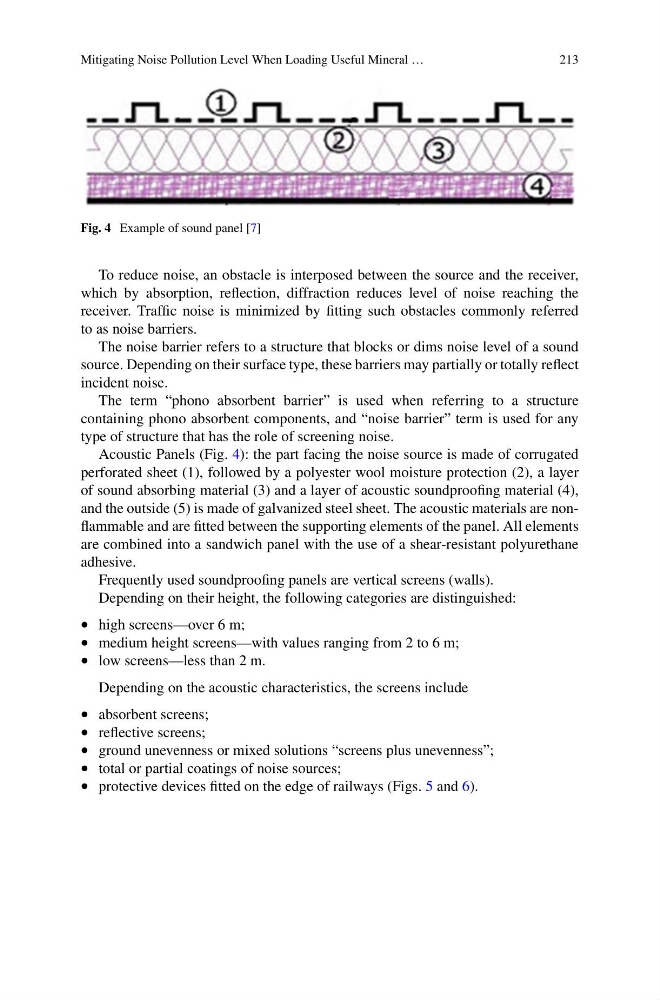
Fig. 4 Example of sound panel [7]
To reduce noise, an obstacle is interposed between the source and the receiver,
which by absorption, reflection, diffraction reduces level of noise reaching the
receiver. Traffic noise is minimized by fitting such obstacles commonly referred
to as noise barriers.
The noise barrier refers to a structure that blocks or dims noise level of a sound
source. Depending on their surface type, these barriers may partially or totally reflect
incident noise.
The term “phono absorbent barrier” is used when referring to a structure
containing phono absorbent components, and “noise barrier” term is used for any
type of structure that has the role of screening noise.
Acoustic Panels (Fig. 4): the part facing the noise source is made of corrugated
perforated sheet (1), followed by a polyester wool moisture protection (2), a layer
of sound absorbing material (3) and a layer of acoustic soundproofing material (4),
and the outside (5) is made of galvanized steel sheet. The acoustic materials are nonflammable and are fitted between the supporting elements of the panel. All elements
are combined into a sandwich panel with the use of a shear-resistant polyurethane
adhesive.
Frequently used soundproofing panels are vertical screens (walls).
Depending on their height, the following categories are distinguished:
• high screens—over 6 m;
• medium height screens—with values ranging from 2 to 6 m;
• low screens—less than 2 m.
Depending on the acoustic characteristics, the screens include
• absorbent screens;
• reflective screens;
• ground unevenness or mixed solutions “screens plus unevenness”;
• total or partial coatings of noise sources;
• protective devices fitted on the edge of railways (Figs. 5 and 6).
213
Fig. 4 Example of sound panel [7]
To reduce noise, an obstacle is interposed between the source and the receiver,
which by absorption, reflection, diffraction reduces level of noise reaching the
receiver. Traffic noise is minimized by fitting such obstacles commonly referred
to as noise barriers.
The noise barrier refers to a structure that blocks or dims noise level of a sound
source. Depending on their surface type, these barriers may partially or totally reflect
incident noise.
The term “phono absorbent barrier” is used when referring to a structure
containing phono absorbent components, and “noise barrier” term is used for any
type of structure that has the role of screening noise.
Acoustic Panels (Fig. 4): the part facing the noise source is made of corrugated
perforated sheet (1), followed by a polyester wool moisture protection (2), a layer
of sound absorbing material (3) and a layer of acoustic soundproofing material (4),
and the outside (5) is made of galvanized steel sheet. The acoustic materials are nonflammable and are fitted between the supporting elements of the panel. All elements
are combined into a sandwich panel with the use of a shear-resistant polyurethane
adhesive.
Frequently used soundproofing panels are vertical screens (walls).
Depending on their height, the following categories are distinguished:
• high screens—over 6 m;
• medium height screens—with values ranging from 2 to 6 m;
• low screens—less than 2 m.
Depending on the acoustic characteristics, the screens include
• absorbent screens;
• reflective screens;
• ground unevenness or mixed solutions “screens plus unevenness”;
• total or partial coatings of noise sources;
• protective devices fitted on the edge of railways (Figs. 5 and 6).