

208
S. Simion et al.
Table 1 Measuring point and
activity deployed
Measuring point Activity deployed
1
Loading small limestone in convoy trains
(next to car scales)
2
Loading bulky limestone in convoy trains
(next to car scales)
3
Auto access gate area
4
Loading silo
5
Loading silo
6
Transporting conveyer belt area
7
Loading trucks with front loader behind the
silo
8
Loading trucks with front loader behind the
silo
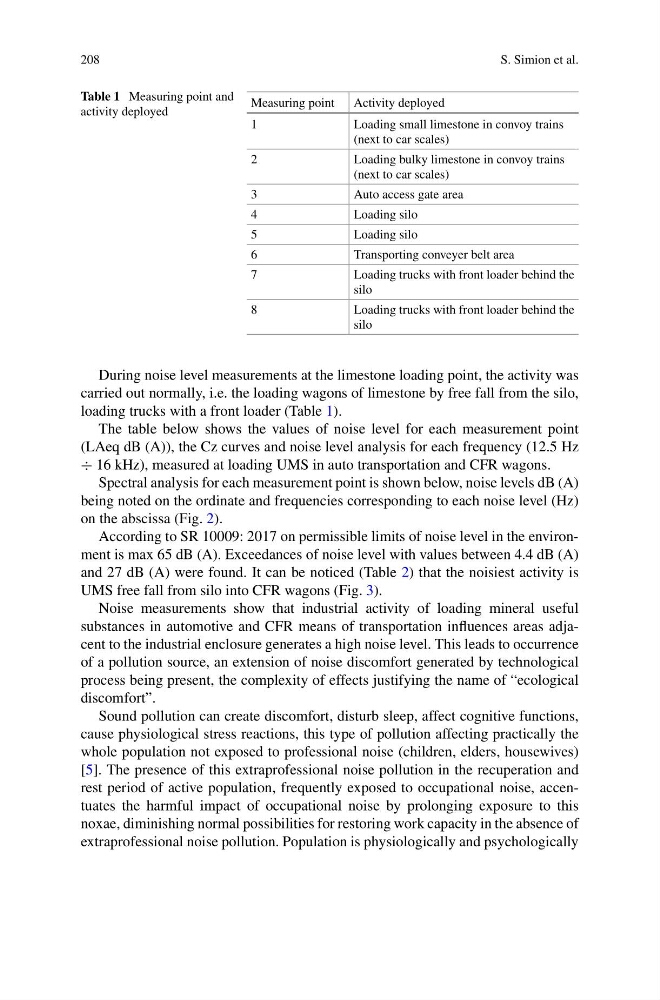
During noise level measurements at the limestone loading point, the activity was
carried out normally, i.e. the loading wagons of limestone by free fall from the silo,
loading trucks with a front loader (Table 1).
The table below shows the values of noise level for each measurement point
(LAeq dB (A)), the Cz curves and noise level analysis for each frequency (12.5 Hz
÷ 16 kHz), measured at loading UMS in auto transportation and CFR wagons.
Spectral analysis for each measurement point is shown below, noise levels dB (A)
being noted on the ordinate and frequencies corresponding to each noise level (Hz)
on the abscissa (Fig. 2).
According to SR 10009: 2017 on permissible limits of noise level in the environment is max 65 dB (A). Exceedances of noise level with values between 4.4 dB (A)
and 27 dB (A) were found. It can be noticed (Table 2) that the noisiest activity is
UMS free fall from silo into CFR wagons (Fig. 3).
Noise measurements show that industrial activity of loading mineral useful
substances in automotive and CFR means of transportation influences areas adjacent to the industrial enclosure generates a high noise level. This leads to occurrence
of a pollution source, an extension of noise discomfort generated by technological
process being present, the complexity of effects justifying the name of “ecological
discomfort”.
Sound pollution can create discomfort, disturb sleep, affect cognitive functions,
cause physiological stress reactions, this type of pollution affecting practically the
whole population not exposed to professional noise (children, elders, housewives)
[5]. The presence of this extraprofessional noise pollution in the recuperation and
rest period of active population, frequently exposed to occupational noise, accentuates the harmful impact of occupational noise by prolonging exposure to this
noxae, diminishing normal possibilities for restoring work capacity in the absence of
extraprofessional noise pollution. Population is physiologically and psychologically
S. Simion et al.
Table 1 Measuring point and
activity deployed
Measuring point Activity deployed
1
Loading small limestone in convoy trains
(next to car scales)
2
Loading bulky limestone in convoy trains
(next to car scales)
3
Auto access gate area
4
Loading silo
5
Loading silo
6
Transporting conveyer belt area
7
Loading trucks with front loader behind the
silo
8
Loading trucks with front loader behind the
silo
During noise level measurements at the limestone loading point, the activity was
carried out normally, i.e. the loading wagons of limestone by free fall from the silo,
loading trucks with a front loader (Table 1).
The table below shows the values of noise level for each measurement point
(LAeq dB (A)), the Cz curves and noise level analysis for each frequency (12.5 Hz
÷ 16 kHz), measured at loading UMS in auto transportation and CFR wagons.
Spectral analysis for each measurement point is shown below, noise levels dB (A)
being noted on the ordinate and frequencies corresponding to each noise level (Hz)
on the abscissa (Fig. 2).
According to SR 10009: 2017 on permissible limits of noise level in the environment is max 65 dB (A). Exceedances of noise level with values between 4.4 dB (A)
and 27 dB (A) were found. It can be noticed (Table 2) that the noisiest activity is
UMS free fall from silo into CFR wagons (Fig. 3).
Noise measurements show that industrial activity of loading mineral useful
substances in automotive and CFR means of transportation influences areas adjacent to the industrial enclosure generates a high noise level. This leads to occurrence
of a pollution source, an extension of noise discomfort generated by technological
process being present, the complexity of effects justifying the name of “ecological
discomfort”.
Sound pollution can create discomfort, disturb sleep, affect cognitive functions,
cause physiological stress reactions, this type of pollution affecting practically the
whole population not exposed to professional noise (children, elders, housewives)
[5]. The presence of this extraprofessional noise pollution in the recuperation and
rest period of active population, frequently exposed to occupational noise, accentuates the harmful impact of occupational noise by prolonging exposure to this
noxae, diminishing normal possibilities for restoring work capacity in the absence of
extraprofessional noise pollution. Population is physiologically and psychologically