

An Analysis of How Physical and Social Factors Influence …
187
fatigue, which along with environmental factors affect the comfort and performance
of the crew. Among the environmental factors that act on sailors, vessel motions and
noise are the most important [10]. Large waves can prevent sailors from maintaining
their balance and carrying out their tasks [11]. Dobie also said that “a mix of people
and technology interact you will find human factors; a branch of engineering in which
the primary emphasis is on the human input” [11].
An important factor that greatly influences the habilitation and performance of
crews and passengers (in the case of cruise ships) is the temperature. A special
situation is the work in the engine room. There were studied the temperature and the
awkward working postures [12]. Another factor, in the comfort and performance of
a crew, is the number of days spent on the ship [13].
Vibrations act on humans in many ways. They are transmitted to the entire body:
through whole-body surface simultaneously when laying a bed, through the feet
when standing and buttocks when seated (WBV), through hands when in contact
with vibrating equipment (HAV) and indirectly when objects in the field of vision
move, causing blurring of vision and difficulties of interpretation data [11]. Wholebody vibration from 2 to 12 Hz can have affected human performance [14]. Low
frequencies can lead to fatigue, decreased performance, accidents or health hazards.
The limits of vibrations set out in the regulations are not intended to respect single
spectrum components, but refer to its global characteristic value.
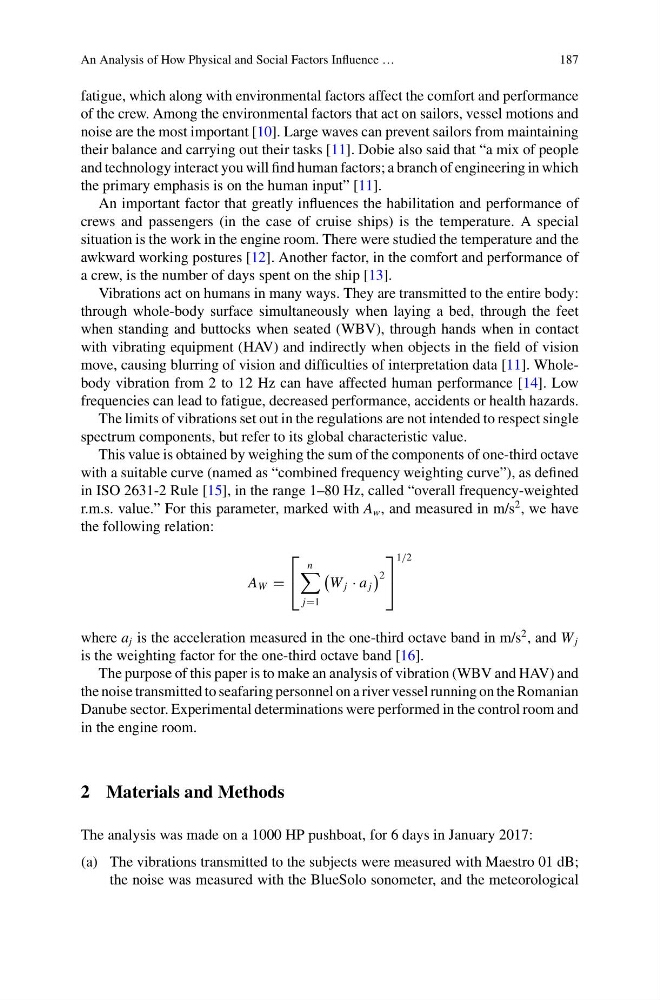
This value is obtained by weighing the sum of the components of one-third octave
with a suitable curve (named as “combined frequency weighting curve”), as defined
in ISO 2631-2 Rule [15], in the range 1–80 Hz, called “overall frequency-weighted
r.m.s. value.” For this parameter, marked with A w , and measured in m/s
2 , we have
the following relation:
A W =
⎡
⎣
n
j=1
W j · a j
2
⎤
⎦
1/2
where a j is the acceleration measured in the one-third octave band in m/s
2 , and W j
is the weighting factor for the one-third octave band [16].
The purpose of this paper is to make an analysis of vibration (WBV and HAV) and
the noise transmitted to seafaring personnel on a river vessel running on the Romanian
Danube sector. Experimental determinations were performed in the control room and
in the engine room.
2 Materials and Methods
The analysis was made on a 1000 HP pushboat, for 6 days in January 2017:
(a) The vibrations transmitted to the subjects were measured with Maestro 01 dB;
the noise was measured with the BlueSolo sonometer, and the meteorological
187
fatigue, which along with environmental factors affect the comfort and performance
of the crew. Among the environmental factors that act on sailors, vessel motions and
noise are the most important [10]. Large waves can prevent sailors from maintaining
their balance and carrying out their tasks [11]. Dobie also said that “a mix of people
and technology interact you will find human factors; a branch of engineering in which
the primary emphasis is on the human input” [11].
An important factor that greatly influences the habilitation and performance of
crews and passengers (in the case of cruise ships) is the temperature. A special
situation is the work in the engine room. There were studied the temperature and the
awkward working postures [12]. Another factor, in the comfort and performance of
a crew, is the number of days spent on the ship [13].
Vibrations act on humans in many ways. They are transmitted to the entire body:
through whole-body surface simultaneously when laying a bed, through the feet
when standing and buttocks when seated (WBV), through hands when in contact
with vibrating equipment (HAV) and indirectly when objects in the field of vision
move, causing blurring of vision and difficulties of interpretation data [11]. Wholebody vibration from 2 to 12 Hz can have affected human performance [14]. Low
frequencies can lead to fatigue, decreased performance, accidents or health hazards.
The limits of vibrations set out in the regulations are not intended to respect single
spectrum components, but refer to its global characteristic value.
This value is obtained by weighing the sum of the components of one-third octave
with a suitable curve (named as “combined frequency weighting curve”), as defined
in ISO 2631-2 Rule [15], in the range 1–80 Hz, called “overall frequency-weighted
r.m.s. value.” For this parameter, marked with A w , and measured in m/s
2 , we have
the following relation:
A W =
⎡
⎣
n
j=1
W j · a j
2
⎤
⎦
1/2
where a j is the acceleration measured in the one-third octave band in m/s
2 , and W j
is the weighting factor for the one-third octave band [16].
The purpose of this paper is to make an analysis of vibration (WBV and HAV) and
the noise transmitted to seafaring personnel on a river vessel running on the Romanian
Danube sector. Experimental determinations were performed in the control room and
in the engine room.
2 Materials and Methods
The analysis was made on a 1000 HP pushboat, for 6 days in January 2017:
(a) The vibrations transmitted to the subjects were measured with Maestro 01 dB;
the noise was measured with the BlueSolo sonometer, and the meteorological