

Studies on the Experimental Validation of the Theoretical …
181
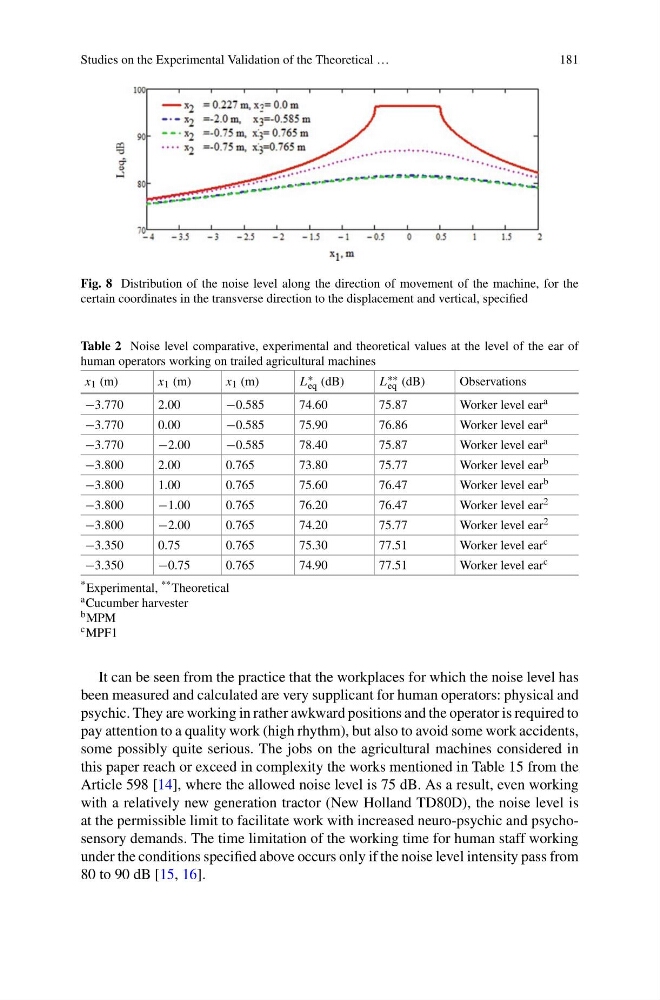
Fig. 8 Distribution of the noise level along the direction of movement of the machine, for the
certain coordinates in the transverse direction to the displacement and vertical, specified
Table 2 Noise level comparative, experimental and theoretical values at the level of the ear of
human operators working on trailed agricultural machines
x 1 (m)
x 1 (m)
x 1 (m)
L ∗
eq (dB)
L ∗∗
eq (dB)
Observations
−3.770
2.00
−0.585
74.60
75.87
Worker level ear a
−3.770
0.00
−0.585
75.90
76.86
Worker level ear a
−3.770
−2.00
−0.585
78.40
75.87
Worker level ear a
−3.800
2.00
0.765
73.80
75.77
Worker level ear b
−3.800
1.00
0.765
75.60
76.47
Worker level ear b
−3.800
−1.00
0.765
76.20
76.47
Worker level ear 2
−3.800
−2.00
0.765
74.20
75.77
Worker level ear 2
−3.350
0.75
0.765
75.30
77.51
Worker level ear c
−3.350
−0.75
0.765
74.90
77.51
Worker level ear c
* Experimental, ** Theoretical
a Cucumber harvester
b MPM
c MPF1
It can be seen from the practice that the workplaces for which the noise level has
been measured and calculated are very supplicant for human operators: physical and
psychic. They are working in rather awkward positions and the operator is required to
pay attention to a quality work (high rhythm), but also to avoid some work accidents,
some possibly quite serious. The jobs on the agricultural machines considered in
this paper reach or exceed in complexity the works mentioned in Table 15 from the
Article 598 [14], where the allowed noise level is 75 dB. As a result, even working
with a relatively new generation tractor (New Holland TD80D), the noise level is
at the permissible limit to facilitate work with increased neuro-psychic and psychosensory demands. The time limitation of the working time for human staff working
under the conditions specified above occurs only if the noise level intensity pass from
80 to 90 dB [15, 16].
181
Fig. 8 Distribution of the noise level along the direction of movement of the machine, for the
certain coordinates in the transverse direction to the displacement and vertical, specified
Table 2 Noise level comparative, experimental and theoretical values at the level of the ear of
human operators working on trailed agricultural machines
x 1 (m)
x 1 (m)
x 1 (m)
L ∗
eq (dB)
L ∗∗
eq (dB)
Observations
−3.770
2.00
−0.585
74.60
75.87
Worker level ear a
−3.770
0.00
−0.585
75.90
76.86
Worker level ear a
−3.770
−2.00
−0.585
78.40
75.87
Worker level ear a
−3.800
2.00
0.765
73.80
75.77
Worker level ear b
−3.800
1.00
0.765
75.60
76.47
Worker level ear b
−3.800
−1.00
0.765
76.20
76.47
Worker level ear 2
−3.800
−2.00
0.765
74.20
75.77
Worker level ear 2
−3.350
0.75
0.765
75.30
77.51
Worker level ear c
−3.350
−0.75
0.765
74.90
77.51
Worker level ear c
* Experimental, ** Theoretical
a Cucumber harvester
b MPM
c MPF1
It can be seen from the practice that the workplaces for which the noise level has
been measured and calculated are very supplicant for human operators: physical and
psychic. They are working in rather awkward positions and the operator is required to
pay attention to a quality work (high rhythm), but also to avoid some work accidents,
some possibly quite serious. The jobs on the agricultural machines considered in
this paper reach or exceed in complexity the works mentioned in Table 15 from the
Article 598 [14], where the allowed noise level is 75 dB. As a result, even working
with a relatively new generation tractor (New Holland TD80D), the noise level is
at the permissible limit to facilitate work with increased neuro-psychic and psychosensory demands. The time limitation of the working time for human staff working
under the conditions specified above occurs only if the noise level intensity pass from
80 to 90 dB [15, 16].