

142
D. Mihajlov et al.
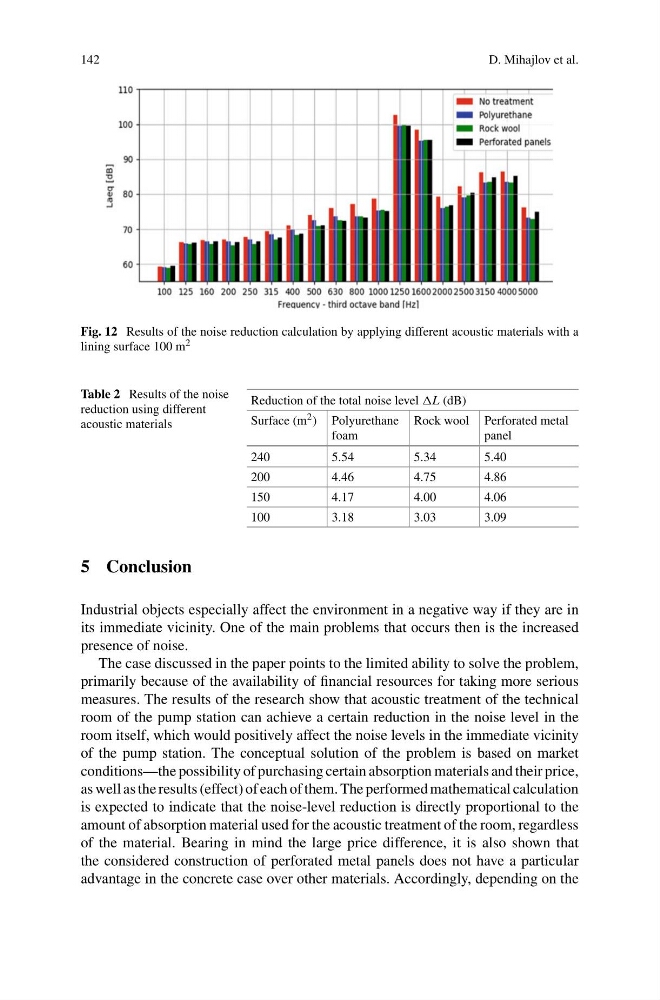
Fig. 12 Results of the noise reduction calculation by applying different acoustic materials with a
lining surface 100 m 2
Table 2 Results of the noise
reduction using different
acoustic materials
Reduction of the total noise level L (dB)
Surface (m 2 ) Polyurethane
foam
Rock wool Perforated metal
panel
240
5.54
5.34
5.40
200
4.46
4.75
4.86
150
4.17
4.00
4.06
100
3.18
3.03
3.09
5 Conclusion
Industrial objects especially affect the environment in a negative way if they are in
its immediate vicinity. One of the main problems that occurs then is the increased
presence of noise.
The case discussed in the paper points to the limited ability to solve the problem,
primarily because of the availability of financial resources for taking more serious
measures. The results of the research show that acoustic treatment of the technical
room of the pump station can achieve a certain reduction in the noise level in the
room itself, which would positively affect the noise levels in the immediate vicinity
of the pump station. The conceptual solution of the problem is based on market
conditions—the possibility of purchasing certain absorption materials and their price,
as well as the results (effect) of each of them. The performed mathematical calculation
is expected to indicate that the noise-level reduction is directly proportional to the
amount of absorption material used for the acoustic treatment of the room, regardless
of the material. Bearing in mind the large price difference, it is also shown that
the considered construction of perforated metal panels does not have a particular
advantage in the concrete case over other materials. Accordingly, depending on the
D. Mihajlov et al.
Fig. 12 Results of the noise reduction calculation by applying different acoustic materials with a
lining surface 100 m 2
Table 2 Results of the noise
reduction using different
acoustic materials
Reduction of the total noise level L (dB)
Surface (m 2 ) Polyurethane
foam
Rock wool Perforated metal
panel
240
5.54
5.34
5.40
200
4.46
4.75
4.86
150
4.17
4.00
4.06
100
3.18
3.03
3.09
5 Conclusion
Industrial objects especially affect the environment in a negative way if they are in
its immediate vicinity. One of the main problems that occurs then is the increased
presence of noise.
The case discussed in the paper points to the limited ability to solve the problem,
primarily because of the availability of financial resources for taking more serious
measures. The results of the research show that acoustic treatment of the technical
room of the pump station can achieve a certain reduction in the noise level in the
room itself, which would positively affect the noise levels in the immediate vicinity
of the pump station. The conceptual solution of the problem is based on market
conditions—the possibility of purchasing certain absorption materials and their price,
as well as the results (effect) of each of them. The performed mathematical calculation
is expected to indicate that the noise-level reduction is directly proportional to the
amount of absorption material used for the acoustic treatment of the room, regardless
of the material. Bearing in mind the large price difference, it is also shown that
the considered construction of perforated metal panels does not have a particular
advantage in the concrete case over other materials. Accordingly, depending on the